
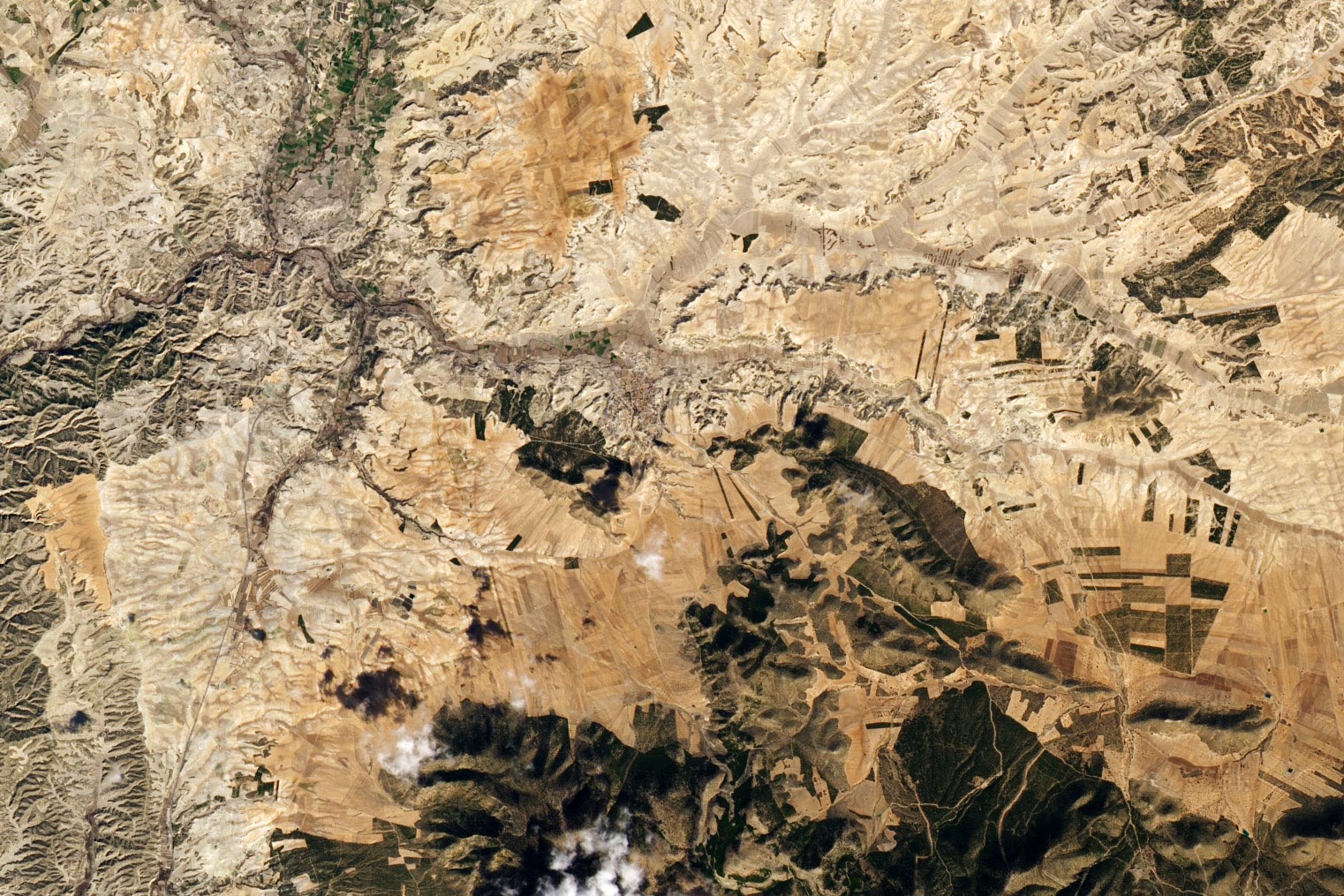
Ancient hominin fossils lie beneath the sandy soils on the outskirts of this village in southern Spain.
Fossil Discoveries
Once archaeologists began digging, they discovered that calcareous muds formed in ponds near the shores of an ancient lake had preserved vast troves of fossils. Among them: a child’s tooth that was 1.4 million years old. According to some experts, that meant the fossils in this area represented some of the oldest examples of hominins in western Europe. Other fossils discovered in this area include saber-toothed tigers, hyenas, hippos, horses, deer, bovids, mammoths, rhinoceroses, wild dogs, and wolves.
Modern Archaeology and Technology
The location of that first discovery, as well as several nearby fossil sites that archaeologists have excavated, are within the area shown in the wide view of this satellite image. The image was captured on February 23, 2024, by the OLI-2 (Operational Land Imager-2) on Landsat 9.
While satellites and remote sensing did not play a direct role in locating the fossils discovered in this area, these technologies have helped advance the field of archaeology in recent decades. Read more about that in Peering through the Sands of Time: Searching for the Origins of Space Archaeology.
NASA Earth Observatory image by Wanmei Liang, using Landsat data from the U.S. Geological Survey.
Never miss a breakthrough: Join the SciTechDaily newsletter.
Follow us on Google and Google News.