
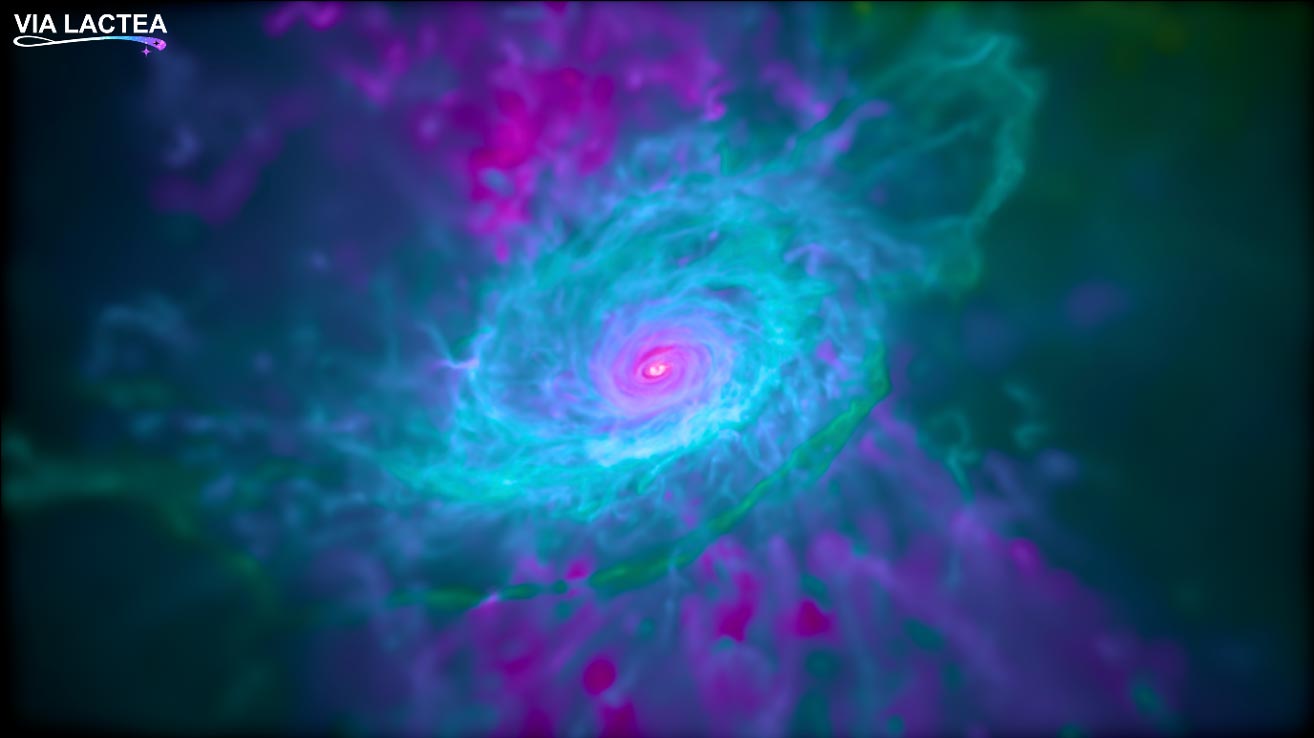
New simulations reveal that the Milky Way’s odd split between two chemically distinct groups of stars isn’t a universal galactic rule—it’s just one of many possible evolutionary paths.
By recreating dozens of Milky Way–like galaxies, researchers discovered that bursts of star formation, shifting gas inflows, and metal-poor material from the galactic outskirts can all produce this unusual dual pattern. Surprisingly, a dramatic past collision wasn’t required after all.
How the Milky Way’s Unusual Chemistry First Took Shape
New research is offering fresh insight into how galaxies like the Milky Way grow and change, as well as why their stars display unexpected chemical signatures. The study uncovers clues that help explain the origins of these patterns.
Published today (December 8) in Monthly Notices of the Royal Astronomical Society, the work investigates a long-standing mystery within the Milky Way: the existence of two separate groups of stars with distinct chemical properties, a feature known as the “chemical bimodality.”
When astronomers examine stars located near the Sun, they consistently identify two major categories based on the relative amounts of iron (Fe) and magnesium (Mg) in their atmospheres. These categories form two clear “sequences” in chemical diagrams, even though they partly overlap in metallicity (how rich they are in heavy elements like iron). This split has puzzled researchers for many years.
Computer simulation of a Milky Way-like galaxy from the Auriga suite, cycling between views of the stars, the gas colored by iron (Fe) abundance, and the gas colored by magnesium (Mg) abundance. The galaxy has developed a large, flat gas disc that forms a thin disc of young and blue stars. The gas disc was thicker in earlier stages, producing an older and redder population of stars in a thicker stellar disc. A scale bar in the lower-left corner indicates the size of the galaxy. For comparison, the Sun lies about 8 kiloparsecs (kpc) from the centre of our own Milky Way. Credit: Matthew D. A. Orkney (ICCUB-IEEC)/Auriga project
Simulating the Formation of Milky Way-like Galaxies
To explore where this chemical structure comes from, scientists at the Institute of Cosmos Sciences of the University of Barcelona (ICCUB) and the Centre national de la recherche scientifique (CNRS) carried out detailed computer simulations (called the Auriga simulations). These models recreate the development of Milky Way-like galaxies inside a virtual universe. By studying 30 of these simulated galaxies, the research team searched for the processes that could give rise to the two chemical sequences.
Understanding the Milky Way’s chemical history helps researchers reconstruct how our galaxy, and others in the universe, formed over billions of years. This includes Andromeda, the Milky Way’s nearest large companion galaxy, where no chemical bimodality has been detected so far. Insights like these also shed light on conditions in the early universe and the influence of cosmic gas streams and galaxy mergers.
“This study shows that the Milky Way’s chemical structure is not a universal blueprint,” said lead author Matthew Orkney, a researcher at ICCUB and the Institut d’Estudis Espacials de Catalunya (IEEC).
“Galaxies can follow different paths to reach similar outcomes, and that diversity is key to understanding galaxy evolution.”
Multiple Pathways to a Two-Track Chemical Pattern
The simulations indicate that Milky Way-like galaxies can develop two distinct chemical sequences through several different pathways. In some galaxies, this bimodality forms when bursts of intense star formation are followed by quieter periods. In others, it is driven by shifts in the flow of gas entering the galaxy from its surroundings.
The study also challenges an earlier assumption about the role of Gaia-Sausage-Enceladus (GSE), a smaller galaxy that collided with the Milky Way in the past. The new findings show that this collision is not required for the dual chemical pattern to appear. Instead, the simulations highlight the importance of metal-poor gas from the circumgalactic medium (CGM), which contributes to the formation of the second group of stars.
Moreover, the overall shape of each chemical sequence is closely connected to the galaxy’s specific history of star formation.
New Telescopes Will Test These Predictions
As powerful observatories such as the James Webb Space Telescope (JWST) and upcoming missions like PLATO and Chronos deliver sharper measurements of stars and galaxies, scientists will be able to assess these simulation results and refine current models of galaxy evolution.
“This study predicts that other galaxies should exhibit a diversity of chemical sequences. This will soon be probed in the era of 30m telescopes, where such studies in external galaxies will become routine,” said Dr. Chervin Laporte, of ICCUB-IEEC, CNRS-Observatoire de Paris, and Kavli IPMU.
“Ultimately, these will also help us further refine the physical evolutionary path of our own Milky Way.”
Reference: “The Milky Way in context: the formation of galactic discs and chemical sequences from a cosmological perspective” by Matthew D A Orkney, Chervin F P Laporte, Robert J J Grand and Volker Springel, 10 December 2025, Monthly Notices of the Royal Astronomical Society.
DOI: 10.1093/mnras/staf1551
This research has been led by researchers from the Institute of Cosmos Sciences of the University of Barcelona (ICCUB), the Institute of Space Studies of Catalonia (IEEC) and the CNRS with the collaboration of scientists from Liverpool John Moores University and the Max-Planck-Institut für Astrophysik.
Never miss a breakthrough: Join the SciTechDaily newsletter.
Follow us on Google and Google News.