

A new paper explains how the properties of fault rocks and geologic events that took place over a billion years ago could signal concerning seismic activity for Utah’s population center.
Utah’s Wasatch Fault extends about 240 miles along the western edge of the Wasatch Mountains, from southern Idaho to central Utah. It runs through Salt Lake City and other major population centers in the state. This fault is classified as a seismically active normal fault, meaning it is a fracture in the Earth’s crust that has shifted repeatedly over time.
“Normal faults are observed along different tectonic systems, where the tectonic plates are moving apart,” says Utah State University geophysicist Srisharan Shreedharan. “The Wasatch Fault forms the eastern edge of the Basin and Range geologic province, which has stretched and broken over millions of years.”
Shreedharan, an assistant professor in USU’s Department of Geosciences, explains that normal faults typically resemble two slabs of rock. In these systems, the “hanging wall” slab moves downward relative to the “footwall” slab.
“The dip angle of the sliding surface tends to be steep, often between 45-90 degrees,” he says. “The Wasatch Fault plunges, toward the west, at a steep angle at the surface in the Salt Lake City area.”
2020 Magna quake raised key questions
A steep angle could mean seismic activity may be dampened during an earthquake and spare inhabitants and buildings from much injury and damage on the surface.
“But the 2020 earthquake Magna earthquake, which occurred at about 9 kilometers depth west of Salt Lake City, caused injuries and resulted in nearly $50 million in property damages,” Shreedharan says. “It was a wake-up call. We want to understand how and why it happened at such a shallow depth, if the Wasatch Fault dips so steeply at the surface.”
With USU Geosciences Associate Professor Alexis Ault and doctoral student Jordan Jensen, Shreedharan has published new findings about why earthquakes occur along the Wasatch Fault and why communities along the fault are more vulnerable to earthquake damage than previously thought. Their paper was recently published in Geology, a peer-reviewed journal of the Geological Society of America. The research is supported by the U.S. Geological Survey’s Earthquake Hazards Program.
Lab work reveals shallower dip at depth
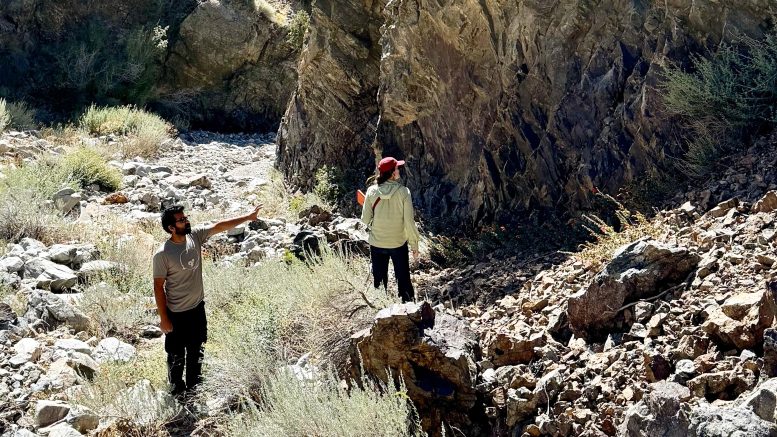
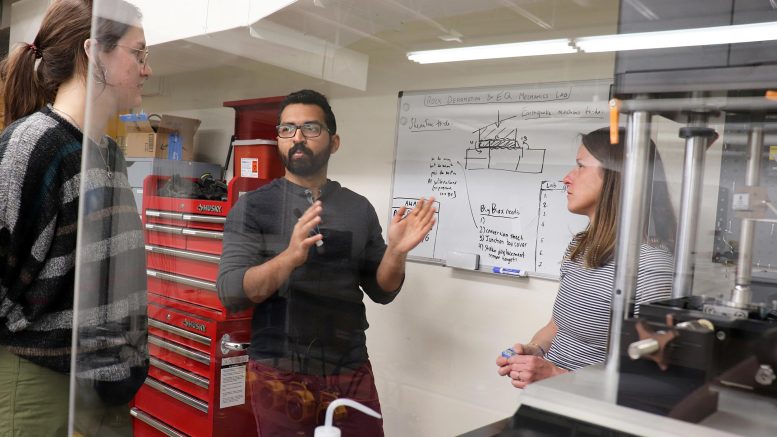
Using rock samples collected from the fault, Shreedharan combined experiments and analysis in his Rock Deformation and Earthquake Mechanics lab with Ault’s investigative expertise in earthquake geology and fault rock textures at USU’s Microscopy Core Facility. Their research revealed significant clues about the Wasatch Fault’s earthquake risk.
“Although the Wasatch Fault dips sharply at Salt Lake City, it curves more gently at depth as it moves west and is probably oriented at a much shallower angle at earthquake depth than expected,” Shreedharan says. “This means that an earthquake rupture could lead to stronger, more intense shaking at the surface — meaning a greater chance of injury and destruction.”
Further, the scientists discovered earthquake slip is possible along the shallowly dipping portion of the Wasatch Fault because the fault rocks themselves are much weaker—worn down and slicker — than the surrounding, undamaged rock.
Billions of years of deformation primed the fault
“It turns out this weak frictional behavior, which we characterized with deformation experiments and microscopy, is a product of deformation that happened more than 1.7 billion years ago when what is now the Wasatch Fault was at even greater depths within the Earth,” Ault says. “Repeated past earthquakes since then have further modified the fault properties through time, priming the fault rocks to fail again in a future event.”
Understanding how one rock is frictionally weaker than another, Shreedharan says, is like comparing ice to sand.
“You can envision how slick rock can slide more easily and at lower angles than a rock with a rough surface,” he says. “This process is happening continuously, though at a very slow pace, under our feet.”
Reference: “Frictional and microstructural evidence for a weak Wasatch fault zone” by Srisharan Shreedharan, Alexis K. Ault and Jordan Jensen, 25 April 2025, Geology.
DOI: 10.1130/G52606.1
The research is supported by the U.S. Geological Survey’s Earthquake Hazards Program.
Never miss a breakthrough: Join the SciTechDaily newsletter.
Follow us on Google and Google News.
15 Comments
Fantastic
Watch for San Jose, California with a 8.5 plus magnitude !
It’s going to happen, it’s just a matter of ‘When’??
Based on what evidence?
Hello Mary-Ann. I’m happy to see you still writing. Greetings from Mary Ann. I used to clean for you. I hope you and your family are happy and well 💖
It NEEDS to be way bigger than that… We’ve got ALL these mountains that HAVE GOT to be cleaned out of ALL the damn people living up in them!! I’m praying it happens SOON especially with all these people STILL moving here from out of state.. MOSTLY from California!! I can’t wait to see ALL of our mountains slide with ALL the people out of our mountains!!!
What you desire for others, will come to you. To whom do you pray?
What is it about Californians that bothers you so much?
Do you not care that those are human life in danger and that those are other peoples family that you pray to hurt, you need to pray for yourself and I’ll pray for your salvation good luck godspeed
Agree! And people move on mountains and cliffs in salt lake with sandy ground to be better than all the little people below it’s a matter of time before it all comes tumbling down
You are a sad person. To live in hate is no way to live. Be careful with what you wish, because you may be the one to receive it.
Maybe Utah’s building codes need re-appraising? Most post-1970 buildings in NZ are built to accommodate living with earthquakes in the Shakey Isles.
Is Hillsboro Oregon on a fault line? Will we have severe damage or break off if the big one hits? What part of Oregon area in general to Portland is the safest
Can the Yellowstone Super Volcanco trigger the Wasatch Earthquake or vice versa? I expect Mag 10 earthquake and if such an event occur, could that event trigger the San Andreas fault and/or New Madrid fault? That’s what’s keeping me up.
Crack hard,deep and long.