
A new review suggests the primitive streak evolved independently in mammals and birds, and mammalian body plans may form without it, prompting calls to rethink the “14-day rule” in embryo research.
In their publication in Science, Professor Guojun Sheng (Kumamoto University, Japan), Professor Alfonso Martinez Arias (Universidad Pompeu Fabra, Spain) and Professor Ann Sutherland (University of Virginia Health System, USA) offer a phylogenetic and ontogenetic overview of the primitive streak and its role in mediating amniote (vertebrate animals that develop on land) gastrulation, and discuss the implications of embryonic stem cell-based models of early mammalian embryogenesis on the function of this structure.
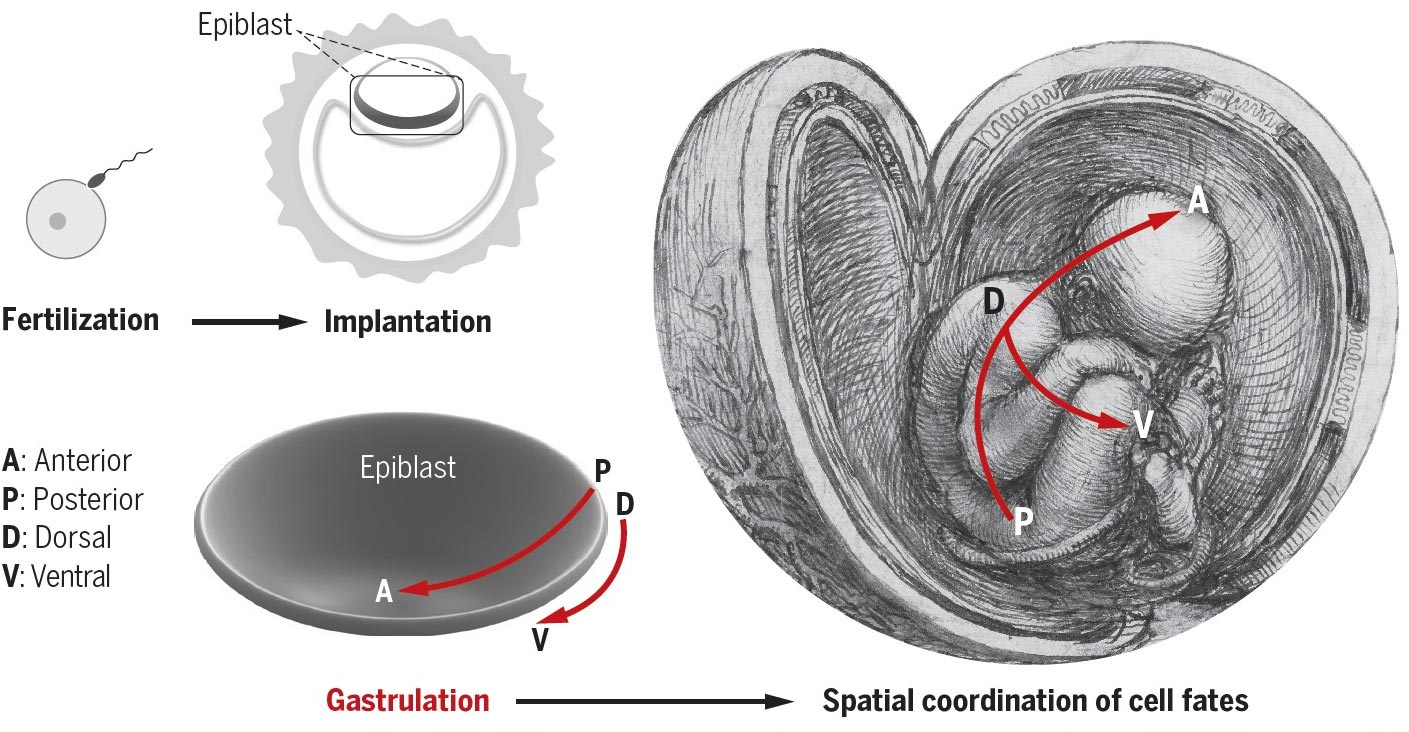
Most animals are bilaterally symmetrical and are organized using two basic coordinate systems. The first gives cells spatial identities along the anteroposterior (head-to-tail) and dorsoventral (back-to-front) axes. The second organizes cells into groups (i.e., germ layers).
In most animals, including humans, there are three germ layers: the ectoderm (source of the skin, nervous system, eyes, etc.), the mesoderm (source of the muscles, bones, vessels, etc.) and the endoderm (source of the intestines, lungs, liver, pancreas, etc.)
The Journey of Gastrulating Cells
One of the most critical periods of development happens when a small number of pluripotent and dividing cells initiate the differentiation process in these two coordinate systems. In human development, this occurs at approximately two weeks after fertilization through a process called gastrulation and is associated with an embryonic structure called the primitive streak—a structure in early development that initiates bilateral symmetry and germ layer formation.
Like a boulder rolling down the side of a mountain, a gastrulating cell embarks on a journal of no return, culminating in its terminal differentiation into one of several hundred cell lineages that make up human tissues and organs.
With technical breakthroughs in rejuvenating differentiated cells back into a naïve state pioneered by scientists like John Gurdon and Shinya Yamanaka (2012 Nobel Prize winners), researchers worldwide are now able to grow pluripotent, pre-gastrulation human (and other mammalian) cells in the lab, and through stepwise addition of biochemical cues, guide these cells to differentiate into any one of hundreds of cell lineages. However, cultivating these cells into functioning tissues or organs has rarely been successful.
One reason for this failure is that organogenesis (the process of organ formation) in vivo starts immediately after gastrulation when cells of different germ layer origins and spatial coordinate identities cooperate in making rudimentary organs. Through subsequent reciprocal interactions, these cells undergo organ- and species-specific proliferation, three-dimensional organization, and terminal differentiation before reaching functional maturity. Reproducing (recapitulating) such organ rudiments in vitro therefore has become the holy grail in stem cell biology and regenerative medicine research.
The Primitive Streak’s Evolutionary Diversity
Achieving this would require recapitulation of gastrulation and its associated primitive streak. However, neither gastrulation nor the primitive streak has been rigorously analyzed in human development, and comparative views of animal gastrulation and the primitive streak in the literature are often incorrectly portrayed.
Now, through a systematic review of previous research, Prof. Sheng and colleagues provide evidence that the primitive streak is not a conserved feature in amniote development, and that mammalian and avian primitive streaks evolved independently, utilizing different supra-cellular mechanisms that lead to their morphological emergence.
The researchers stress that, in addition to mediating the emergence of germ layers from the epiblast (pluripotent cells), the main role of gastrulation is to confer newly formed cells in each germ layer a coordinate system to organize primary cell fates and the primordia of organs and tissues that are relative to each other spatially.
Re-evaluating the “14-Day Rule” in Embryo Research
Their analyses of different biomechanical parameters between multiple in vivo and in vitro models predict that a rudimentary mammalian body plan can form in the absence of a primitive streak. They also suggest that the “14-day rule” (where a human embryo cannot be cultured 14 days past fertilization or after the appearance of the primitive streak), which is currently used in many countries as the key ethical oversight in human embryological research, should be re-assessed and an alternative landmark be selected through a consensual discussion between different stakeholders to ensure scientific and ethical rigor.
Reference: “The primitive streak and cellular principles of building an amniote body through gastrulation” by Guojun Sheng, Alfonso Martinez Arias and Ann Sutherland, 3 December 2021, Science.
DOI: 10.1126/science.abg1727
Never miss a breakthrough: Join the SciTechDaily newsletter.
Follow us on Google and Google News.