

Towels and bed sheets serve different purposes and thus require different washing frequencies.
Towels, absorbing skin cells and microbes, need washing every few days, especially since they retain dampness longer, promoting bacteria and mold growth. Bed sheets, while also collecting debris, generally require weekly washing unless daily activities demand more frequent cleaning.
Washing Frequency for Bed Linens and Towels
Opinions vary widely on how often towels and bed sheets should be washed. Some debate whether a few days or a few weeks is ideal, but one survey from the United Kingdom revealed that nearly half of single men admitted to not washing their sheets for up to four months.
Clearly, four months is far too long — but what is the right frequency?
Towels and bed linens serve different purposes, so they require different washing schedules. Sheets can typically be washed every one to two weeks, but towels should be laundered more frequently, ideally every three to four days.
After all, is there anything better than the crisp comfort of freshly cleaned sheets or the soft scent of a newly washed towel?
The Right Frequency for Washing Towels
When you dry yourself, you deposit thousands of skin cells and millions of microbes onto the towel. And because you use your towel to dry yourself after a shower or bath, your towel is regularly damp.
You also deposit a hefty amount of dead skin, microbes, sweat, and oils onto your sheets every night. But unless you’re a prolific night sweater, your bedding doesn’t get wet after a night’s sleep.
Towels are also made of a thicker material than sheets and therefore tend to stay damp for longer.
So what is it about the dampness that causes a problem? Wet towels are a breeding ground for bacteria and molds. Molds especially love damp environments. Although mold won’t necessarily be visible (you would need significant growth to be able to see it) this can lead to an unpleasant smell.
As well as odors, exposure to these microbes in your towels and sheets can cause asthma, allergic skin irritations, or other skin infections.
Ideal Washing Practices and Temperatures
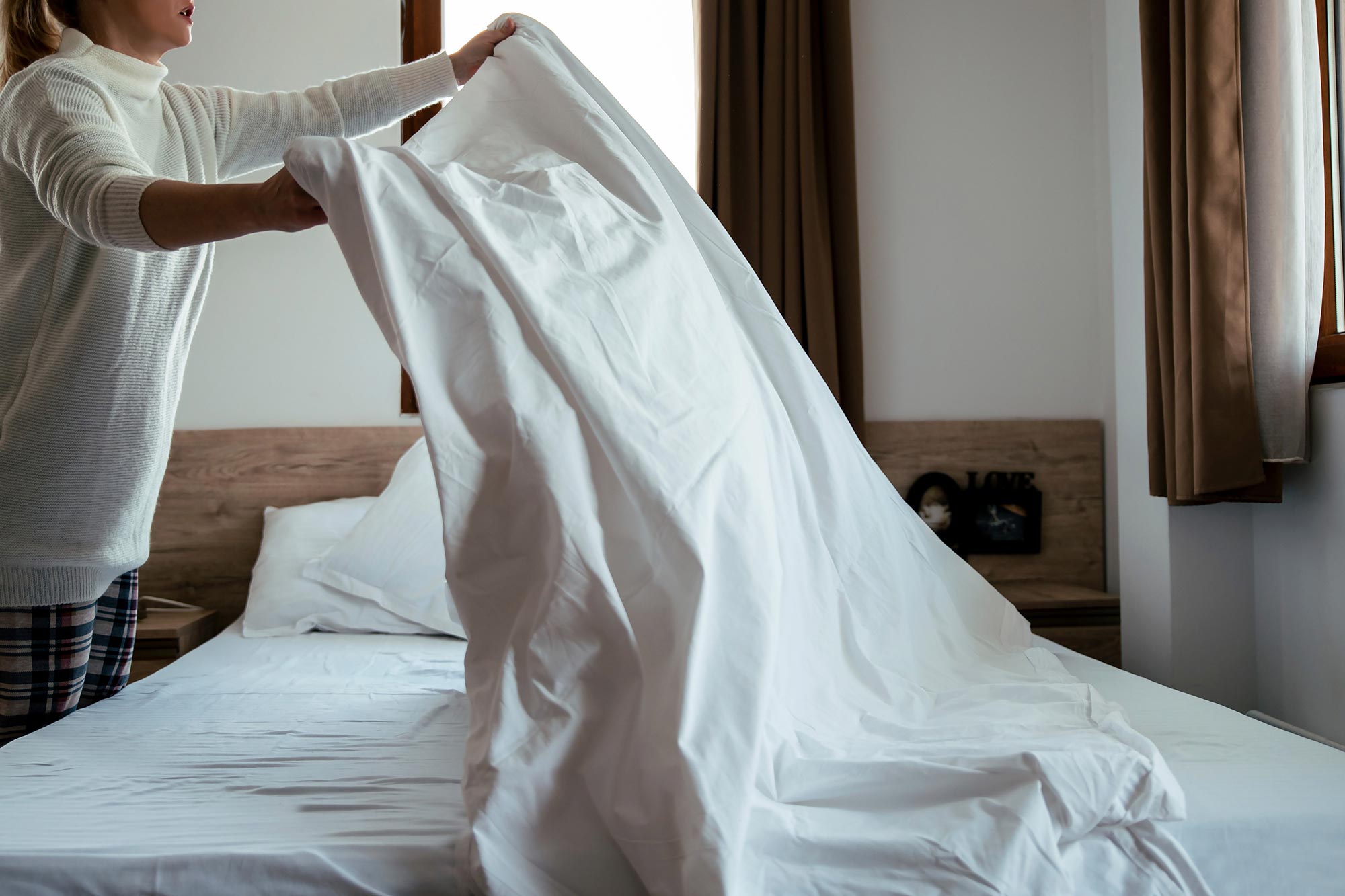
For bedding, it really depends on factors such as whether you have a bath or shower just before going to bed, or if you fall into bed after a long, sweaty day and have your shower in the morning. You will need to wash your sheets more regularly in the latter case. As a rule of thumb, once a week or every two weeks should be fine.
Towels should ideally be washed more regularly – perhaps every few days – while your facecloth should be cleaned after every use. Because it gets completely wet, it will be wet for a longer time, and retain more skin cells and microbes.
Wash your towels at a high temperature (for example, 65°C) as that will kill many microbes. If you are conscious of saving energy, you can use a lower temperature and add a cup of vinegar to the wash. The vinegar will kill microbes and prevent bad smells from developing.
Clean your washing machine regularly and dry the fold in the rubber after every wash, as this is another place microbes like to grow.
Dealing With Persistent Towel Odors
What if you regularly wash your towels, but they still smell bad? One of the reasons for this pong could be that you’ve left them in the washing machine too long after the wash. Especially if it was a warm wash cycle, the time they’re warm and damp will allow microbes to happily grow. Under lab conditions, the number of these bacteria can double every 30 minutes.
It’s important to hang your towel out to dry after use and not to leave towels in the washing machine after the cycle has finished. If possible, hang your towels and bedding out in the sun. That will dry them quickly and thoroughly and will foster that lovely fresh, clean cotton smell. Using a dryer is a good alternative if the weather is bad, but outdoors in the sun is always better if possible.
Also, even if your towel is going to be washed, don’t throw a wet towel into the laundry basket, as the damp, dirty towel will be an ideal place for microbes to breed. By the time you get to doing your washing, the towel and the other laundry around it may have acquired a bad smell. And it can be difficult to get your towels smelling fresh again.

The Reality of Self-Cleaning Fabrics
Some companies sell “quick-dry” towels or “self-cleaning” towels and bedding. Quick-dry towels are made from synthetic materials that are weaved in a way to allow them to dry quickly. This would help prevent the growth of microbes and the bad smells that develop when towels are damp for long periods of time.
But the notion of self-cleaning products is more complicated. Most of these products contain nanosilver or copper, antibacterial metals that kill microorganisms. The antibacterial compounds will stop the growth of bacteria and can be useful to limit smells and reduce the frequency with which you need to clean your sheets and towels.
However, they’re not going to remove dirt like oils, skin flakes, and sweat. So as much as I would love the idea of sheets and towels that clean themselves, that’s not exactly what happens.
Also, excessive use of antimicrobials such as nanosilver can lead to microbes becoming resistant to them.
Written by Rietie Venter, Associate Professor, Clinical and Health Sciences, University of South Australia.
Adapted from an article originally published in The Conversation.
Never miss a breakthrough: Join the SciTechDaily newsletter.
Follow us on Google and Google News.
5 Comments
Where’s the science? I’m just seeing a lot of laundry opinions here. Unfortunately disappointing article.
I pop in to SciTechDaily now and again to see if they’ve become more than a left leaning opinion or questionable science site. Everytime I am dissappointed.
“Left leaning”- as in thought-out?
A website that doesn’t follow a rigid political or ideological line of thought is a GOOD thing.
I, too, would like to see the science here. Where I live, there is a rainy season and a dry season – how does this affect towels and sheets? What are the actual figures on towel- or sheet-induced asthma or skin disorders? I have never seen any actual data supporting this kind of claim. If you change your sheets every three weeks, what are your actual added risks (as determined by real data from real research), as opposed to changing every two weeks?
This article looks like opinions based on “educated guesses”. But educated guesses are still just guesses, and are wrong more often than not.