
Diverse Forests Sustain Bees and Improve Ecosystem Resilience
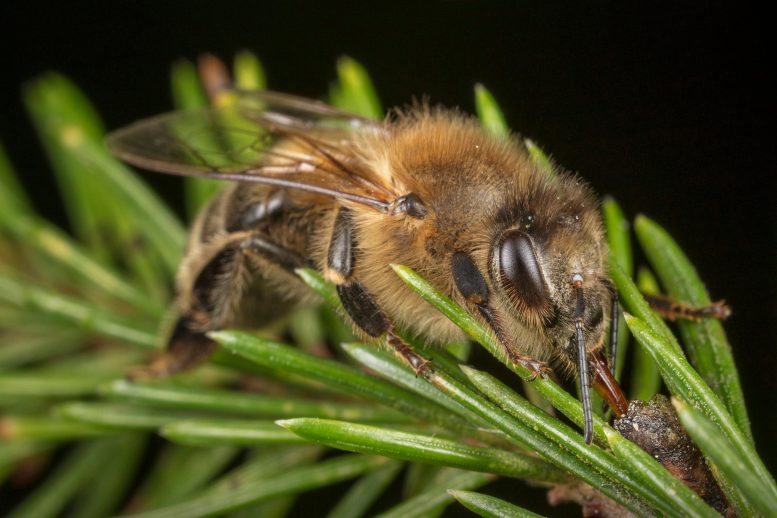
The western honeybee (Apis mellifera) is typically thought of as inhabiting flowering meadows, however, its original habitat was actually woodland, which provides nesting sites in tree cavities. A recent study conducted by researchers at Julius-Maximilians-Universität Würzburg (JMU) explored the suitability of contemporary deciduous forests as foraging grounds for these busy insects.
For this purpose, Benjamin Rutschmann and Patrick Kohl installed twelve normally-sized honeybee colonies in observation hives across the Steigerwald – the respective proportion of forest in the surroundings varied for each bee colony. The two scientists conduct research at JMU in the Chair of Animal Ecology and Tropical Biology (Zoology III), which is headed by Professor Ingolf Steffan-Dewenter. The latter was also involved in the study, which has recently appeared in the Journal of Applied Ecology.
Eavesdropping on Bee Dances
Honeybees communicate via the so-called waggle dance. The team analyzed a total of 2022 of these dances video recorded across the bees’ main foraging season, from March to August. Because the bees communicate the approximate location of a food source to their conspecifics during these dances, the scientist were able to draw conclusions about foraging distances and habitat preferences. The surprising result was that the bees used the forest far less than expected based on its contribution to landcover. Colonies that lived deep in the forest often had to travel long distances to find food.
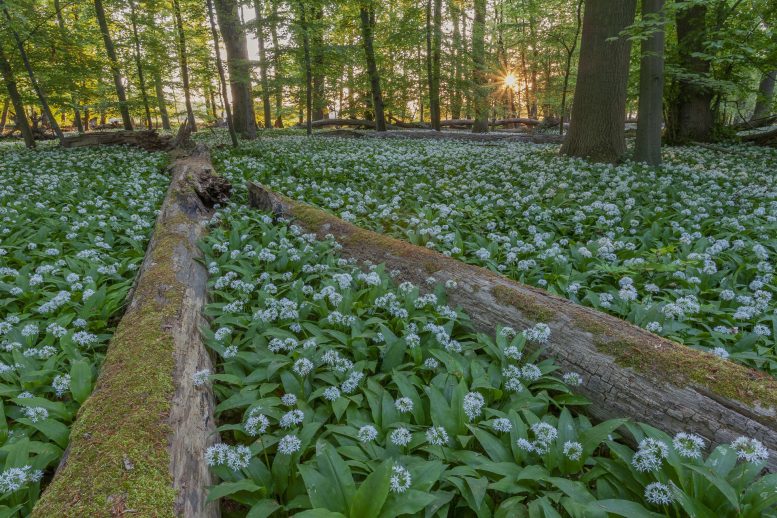
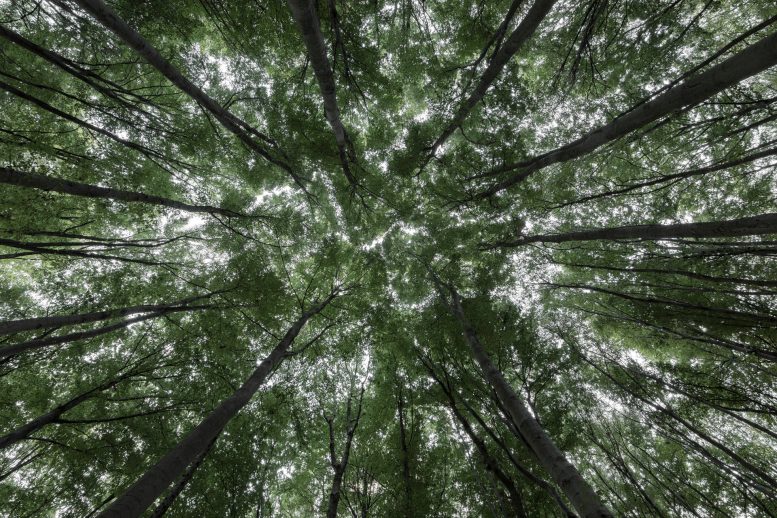
“Especially in late summer, the supply of pollen in the forest was not guaranteed or insufficient, besides this being an especially critical time for the bee colonies and their brood,” says Rutschmann. One of the main reasons for this, he says, is the tree species beech, which makes up more than 40 percent of the tree population in the Steigerwald: “Beech forests are dark, there is not much growing on the ground. Hardly any plants can cope with the light conditions in beech forests after the canopy closes, so a diverse herb layer that would be so important for bees is missing,” according to the biologist.
Bees Need More Diverse Forests
Honeydew or flowering tree species, such as linden, black locust, and chestnut, or shrubs such as blackberry and raspberry, do provide bees with an important source of carbohydrates and, in some cases, pollen as a source of protein during short periods of the year; however, bees need a balanced food supply throughout the season. “For a more bee-friendly environment, forests should be diversified with insect-pollinated trees – cherry, linden, maple, willow, horse chestnut, or sweet chestnut,” Rutschmann advises. Allowing secondary succession in forest gaps, the natural return of flora and fauna typical of a site could help.
As if the lack of food were not enough of a problem, wild honeybee colonies in managed forests are also hampered by the low availability of tree hollows.
In a possible next step, the comparison with other European forest areas with different tree species composition and management could be investigated: “Especially the comparison with protected areas, where greater disturbances occur, would be interesting,” says Benjamin Rutschmann. More natural disturbance and less optimization for timber production should not only increase floral diversity in the forest but also improve the chances of survival of wild-living honeybee colonies.
Not Only Honeybees Benefit
So, honeybees need a more diverse forest as a habitat. Once established, they also contribute significantly to biodiversity conservation in return. After all, the overwhelming majority of plants depend on cross-pollination. The honeybee, in turn, is one of the most important pollinators, along with numerous other species of wild bees.
A more diverse forest benefits not only the honeybee but ultimately the forest itself – a diverse ecosystem is a healthy ecosystem and less susceptible to pest infestation, for example. “Converting forests to species-rich mixed deciduous forests not only promotes biodiversity, but also adaptation to future climate conditions,” emphasizes Ingolf Steffan-Dewenter.
Reference: “Foraging distances, habitat preferences and seasonal colony performance of honeybees in Central European forest landscapes” by Benjamin Rutschmann, Patrick L. Kohl and Ingolf Steffan-Dewenter, 10 April 2023, Journal of Applied Ecology.
DOI: 10.1111/1365-2664.14389
Never miss a breakthrough: Join the SciTechDaily newsletter.
Follow us on Google and Google News.