
Close Menu
    Facebook X (Twitter) Instagram
    SciTechDaily
    • Biology
    • Chemistry
    • Earth
    • Health
    • Physics
    • Science
    • Space
    • Technology
    Facebook X (Twitter) Pinterest YouTube RSS
    SciTechDaily
    Home»Space»The Solar Wind Across Our Solar System [Infographic]
    Space

    The Solar Wind Across Our Solar System [Infographic]

    By NASA’s Goddard Space Flight CenterAugust 1, 2021No Comments2 Mins Read
    Facebook Twitter Pinterest Telegram LinkedIn WhatsApp Email Reddit
    Share
    Facebook Twitter LinkedIn Pinterest Telegram Email Reddit
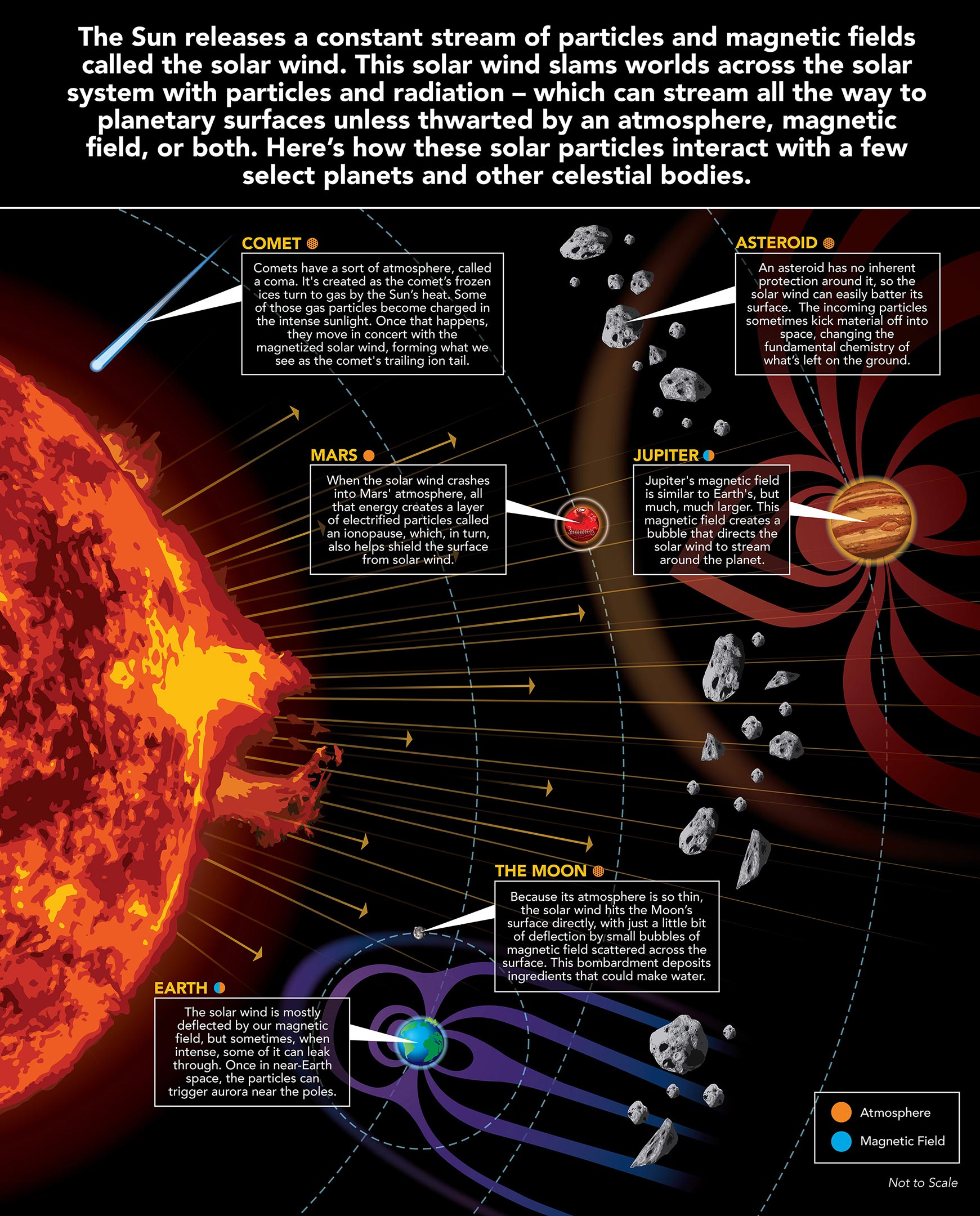
    Solar Wind Across Our Solar System
    Solar Wind. Credit: NASA’s Goddard Space Flight Center/Mary Pat Hrybyk-Keith

    The Sun releases a constant stream of particles and magnetic fields called the solar wind. This solar wind slams worlds across the solar system with particles and radiation – which can stream all the way to planetary surfaces unless thwarted by an atmosphere, magnetic field, or both. Here’s how these solar particles interact with a few select planets and other celestial bodies.

    Earth

    The solar wind is mostly deflected by our magnetic field, but sometimes, when intense, some of it can leak through. Once in near-Earth space, the particles can trigger aurora near the poles.

    Earth’s Moon

    Because its atmosphere is so thin, the solar wind hits the Moon’s surface directly, with just a little bit of deflection by small bubbles of magnetic field scattered across the surface. This bombardment deposits ingredients that could make water.

    Asteroids

    An asteroid has no inherent protection around it, so the solar wind can easily batter its surface. The incoming particles sometimes kick material off into space, changing the fundamental chemistry of what’s left on the ground.

    Comets

    Comets have a sort of atmosphere, called a coma. It’s created as the comet’s frozen ices turn to gas by the Sun’s heat. Some of those gas particles become charged in the intense sunlight. Once that happens, they move in concert with the magnetized solar wind, forming what we see as the comet’s trailing ion tail.

    Mars

    When the solar wind crashes into Mars’ atmosphere, all that energy creates a layer of electrified particles called an ionopause, which, in turn, also helps shield the surface from solar wind.

    Jupiter

    Jupiter’s magnetic field is similar to Earth’s, but much, much larger. This magnetic field creates a bubble that directs the solar wind to stream around the planet.

    Never miss a breakthrough: Join the SciTechDaily newsletter.
    Follow us on Google and Google News.

    NASA NASA Goddard Space Flight Center Solar System Solar Wind Sun
    Share. Facebook Twitter Pinterest LinkedIn Email Reddit

    Related Articles

    NASA’s Parker Solar Probe: The Fastest Spacecraft Ever Just Skimmed the Sun at 430,000 MPH

    NASA’s PUNCH Mission: Tracking Solar Storms With an 8,000-Mile Virtual Telescope

    NASA’s PUNCH Is About to Capture Solar Storms Like Never Before

    Massive Solar Storm Unleashes Mysterious New Radiation Belts

    NASA Just Found the Sun’s Secret Warning Before Massive Solar Flares

    NASA’s Parker Solar Probe: The Fastest Human-Made Object Just “Touched” the Sun and Shattered Records

    NASA’s TRACERS Mission Hits Major Milestone With Twin Spacecraft Completion

    NASA’s CODEX Ready To Unlock Solar Wind Mysteries From the ISS

    NASA Confirms Solar Maximum: Brace for Massive Flares and Epic Geomagnetic Storms

    Leave A Reply Cancel Reply

    • Facebook
    • Twitter
    • Pinterest
    • YouTube

    Don't Miss a Discovery

    Subscribe for the Latest in Science & Tech!

    Trending News

    Monster Storms on Jupiter Unleash Lightning Beyond Anything on Earth

    Scientists Create “Liquid Gears” That Spin Without Touching

    The Simple Habit That Could Help Prevent Cancer

    Millions Take These IBS Drugs, But a New Study Finds Serious Risks

    Scientists Unlock Hidden Secrets of 2,300-Year-Old Mummies Using Cutting-Edge CT Scanner

    Bread Might Be Making You Gain Weight Even Without Eating More Calories

    Scientists Discover Massive Magma Reservoir Beneath Tuscany

    Europe’s Most Active Volcano Just Got Stranger – Here’s Why Scientists Are Rethinking It

    Follow SciTechDaily
    • Facebook
    • Twitter
    • YouTube
    • Pinterest
    • Newsletter
    • RSS
    SciTech News
    • Biology News
    • Chemistry News
    • Earth News
    • Health News
    • Physics News
    • Science News
    • Space News
    • Technology News
    Recent Posts
    • Scientists Discover Plants “Scream” – We Just Couldn’t Hear Them Until Now
    • 25-Year Study Uncovers Hidden Paths and Early Warning Signs of Blood Cancer
    • Not Just Snoring – New Research Reveals Sleep Apnea May Be Damaging Your Muscles
    • Scientists Discover a Surprising Reason Intermittent Fasting Extends Life
    • Scientists Discover a New Meteor Shower From a Mysterious Crumbling Asteroid
    Copyright © 1998 - 2026 SciTechDaily. All Rights Reserved.
    • Science News
    • About
    • Contact
    • Editorial Board
    • Privacy Policy
    • Terms of Use

    Type above and press Enter to search. Press Esc to cancel.