
Close Menu
    Facebook X (Twitter) Instagram
    SciTechDaily
    • Biology
    • Chemistry
    • Earth
    • Health
    • Physics
    • Science
    • Space
    • Technology
    Facebook X (Twitter) Pinterest YouTube RSS
    SciTechDaily
    Home»Biology»The World’s Smallest Universal Joints in Unprecedented Resolution
    Biology

    The World’s Smallest Universal Joints in Unprecedented Resolution

    By Osaka UniversityDecember 24, 2019No Comments3 Mins Read
    Facebook Twitter Pinterest Telegram LinkedIn WhatsApp Email Reddit
    Share
    Facebook Twitter LinkedIn Pinterest Telegram Email Reddit
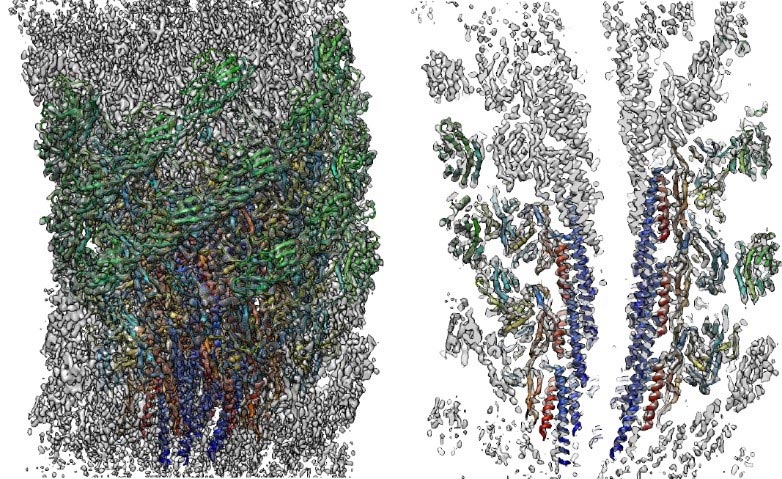
    Native Supercoiled Flagellar Hook
    Three dimensional density map and atomic model of the native supercoiled flagellar hook revealed by cryoEM image analysis. Left: side view; right: a central section. Credit: Osaka University

    Researchers at Osaka University used electron cryomicroscopy to solve the structure of an essential component of the bacterial flagellum with unprecedented resolution, with important implications for new antibiotics and future nanobots.

    Researchers at Osaka University unveiled the most complete picture of an essential component of the bacterial flagellum to date, the “universal joint” used for transmitting rotary power. This research may help scientists design new antimicrobial agents that target this critical structure, or biomimetic self-propelled nanomachines inspired by the natural system.
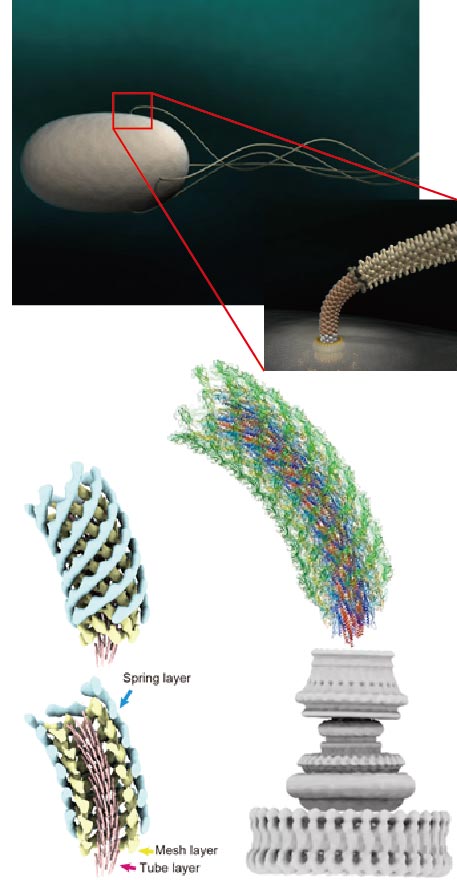
    Worlds Smallest Universal Joints
    Computer graphic representation of the bacterial cell and flagella (top left) and its hook connecting the motor and filament (top right). Three-layered tube model of the hook structure (bottom left) and atomic model of the entire hook on top of the flagellar motor (bottom right). Credit: Osaka University

    Many bacteria have the ability to propel themselves toward food and away from predators using a whip-like “tail” called the flagellum. These flagella are surprisingly complex rotating machines, consisting of several interoperative assemblies and culminating in the long filament propeller outside the cell. The energy for the rotation originates in the basal body inside the cytoplasm, which serves as a motor. However, to consistently transfer torque to the filament with ever-changing orientation, a special mechanism is required, known in the engineering field as a “universal joint.” This is a coupling device that connects rigid rods even when their axes are not always pointing in the same direction. Bacteria have evolved a highly efficient part called the hook that acts as a minuscule universal joint much smaller than those we can fabricate.

    Of course, scientists have long wondered about the exact structure of flagella, either to copy the design for futuristic robots that can move autonomously around the human body, or else for targeted attacks on bacteria with new antibiotic drugs. While most of the flagellum has been imaged using electron microscopes, it has been very difficult to capture with existing methods the fragile hook section, which is known to be a short, helical assembly that forms a supercoiled tubular structure.

    Now, researchers at Osaka University have used improved techniques of electron cryomicroscopy (cryoEM) to precisely image this supercoiled section of the flagellum that has been thought extremely difficult to analyze, to a 3.6 Å resolution that allowed atomic model building. CryoEM, which was the subject of the 2017 Nobel Prize in Chemistry, allows rapidly frozen biological samples to be imaged while they are still in their natural configurations. Even so, the new analysis still required particle-level calculations to reconstruct the most likely structure from the data. “It was thought impossible to look into such a high level of detail for the structure of the hook in its functional state, but we succeeded using cryoEM single-particle analysis,” first author Takayuki Kato says.

    This work may have very important implications for fighting infections because the motility behavior of bacteria can greatly influence their chances of becoming virulent. “Bacterial motility is deeply involved in pathogenicity, and the revealed structure can lead directly to the development of new antibiotics,” senior author Keiichi Namba explains.

    Reference: “Structure of the native supercoiled flagellar hook as a universal joint” by Takayuki Kato, Fumiaki Makino, Tomoko Miyata, Péter Horváth and Keiichi Namba, 22 November 2019, Nature Communications.
    DOI: 10.1038/s41467-019-13252-9

    Never miss a breakthrough: Join the SciTechDaily newsletter.
    Follow us on Google and Google News.

    Bacteria Biochemistry Biomechanics Cell Biology University of Osaka
    Share. Facebook Twitter Pinterest LinkedIn Email Reddit

    Related Articles

    Bacteria Can Tell the Time With Internal Biological Clocks

    Fat Bacteria? Skinny Bacteria? There’s a Reason Microbes Stay in Shape

    Evolutionary Insight: New Connection Discovered Between Primordial Organisms and Complex Life

    Alien Microorganism Research Shows Humans and Other Mammals Could Struggle to Fight Space Germs

    Beneath the Ocean’s Surface, a Virus Is Hijacking the Most Abundant Organism on Earth

    Researchers Have Found a Way to Control Bacteria to Transport Microscopic Cargo

    ‘Poison Arrows’ Launched by Warring Bacteria Could Lead to New Antibiotics

    ‘Butterfly Effect’ in a Protein Molecule – Changing Just 3 Atoms Causes Big Effect

    Natural Toxins Combined With Synthetic Drugs Could Disarm Cancer, Drug-Resistant Bacteria

    Leave A Reply Cancel Reply

    • Facebook
    • Twitter
    • Pinterest
    • YouTube

    Don't Miss a Discovery

    Subscribe for the Latest in Science & Tech!

    Trending News

    Largest-Ever Study Finds Medicinal Cannabis Ineffective for Anxiety, Depression, PTSD

    250-Million-Year-Old Egg Solves One of Evolution’s Biggest Mysteries

    Living With Roommates Might Be Changing Your Gut Microbiome Without You Knowing

    Century-Old Cleaning Chemical Linked to 500% Increased Risk of Parkinson’s Disease

    What if Your Memories Never Happened? Physicists Take a New Look at the Boltzmann Brain Paradox

    One of the Universe’s Largest Stars May Be Getting Ready To Explode

    Scientists Discover Enzyme That Could Supercharge Ozempic-Like Weight Loss Drugs

    Popular Sweetener Linked to DNA Damage – “It’s Something You Should Not Be Eating”

    Follow SciTechDaily
    • Facebook
    • Twitter
    • YouTube
    • Pinterest
    • Newsletter
    • RSS
    SciTech News
    • Biology News
    • Chemistry News
    • Earth News
    • Health News
    • Physics News
    • Science News
    • Space News
    • Technology News
    Recent Posts
    • The Surprising Diet Rule That Makes “Good” Parasites Work
    • This Simple Blood Test Could Outperform “Bad Cholesterol” in Preventing Heart Disease
    • Scientists Uncover Potential Brain Risks of Popular Fish Oil Supplements
    • Scientists Prove There Are Just Six Degrees of Separation in a Social Network
    • Bee Bacteria Could Fix a Major Flaw in Plant-Based Milk
    Copyright © 1998 - 2026 SciTechDaily. All Rights Reserved.
    • Science News
    • About
    • Contact
    • Editorial Board
    • Privacy Policy
    • Terms of Use

    Type above and press Enter to search. Press Esc to cancel.