

Tiny magnetic bacteria that live in tightly bound groups are showing scientists how life might have evolved complex, multicellular forms. These rare bacteria can’t survive alone – they depend on one another, with each cell playing a specialized role.
Unlike other microbes, they divide as an entire group, and researchers now know that the individual cells aren’t genetically identical. This discovery reveals surprising complexity and offers a glimpse into the possible early steps life on Earth took toward becoming the diverse, multicellular ecosystems we see today.
Bacteria That Live Like Multicellular Organisms
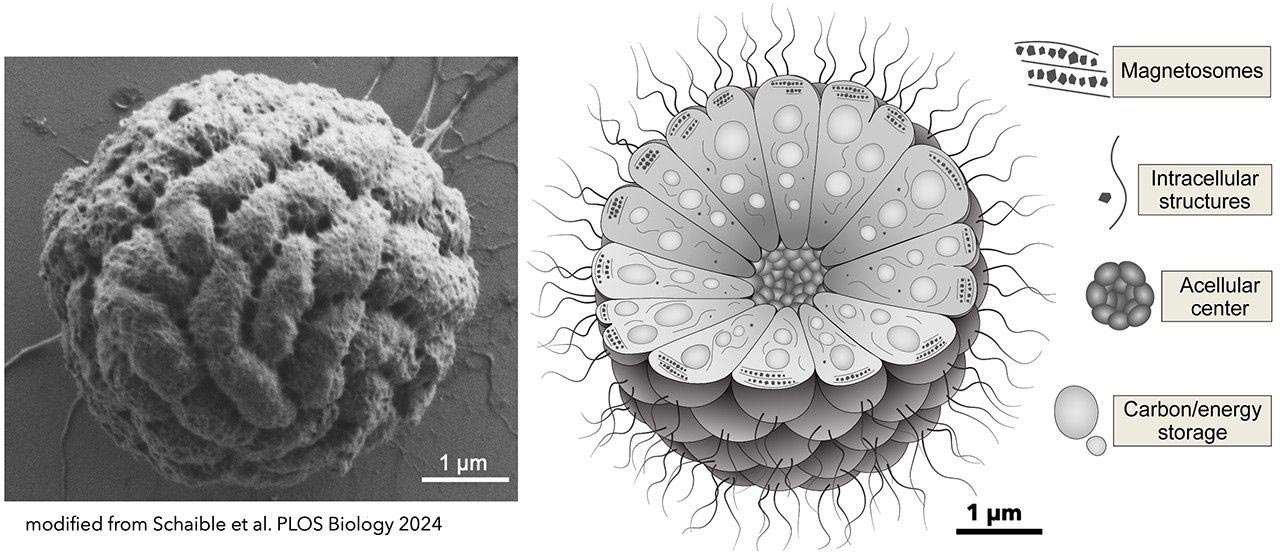
In a recent NASA-supported study, scientists uncovered new details about a rare type of bacteria that live and function together like a single multicellular organism. These microbes are the only known bacteria that survive exclusively in tightly connected groups, and studying them could help researchers better understand how complex life evolved on Earth.
These bacteria are called multicellular magnetotactic bacteria (MMB). As their name suggests, they are magnetotactic – meaning they use tiny, internal magnetic structures like compass needles to navigate along Earth’s magnetic field. What makes them even more unusual is how they live: MMB form stable, coordinated clusters of cells that some scientists believe show signs of obligate multicellularity – a condition where individual cells cannot survive on their own and must live as part of the group. This rare trait is the main focus of the new research.
Dependent by Design: Obligate Multicellularity
In biology, obligate means that an organism requires something for survival. In this case, it means that single cells of MMB cannot survive on their own. Instead, cells live as a consortium of multiple cells that behave in many ways like a single multicellular organism. This requirement to live together means that when MMB reproduce, they do so by replicating all the cells in the consortium at once, doubling the total number of cells. This large group of cells then splits into two identical consortia.
MMB are the only example of bacteria that are known to live like this. Many other bacteria clump together as simple aggregates of single cells. For instance, cyanobacteria clump together in colonies and form structures like stromatolites or biofilms that are visible to the naked eye. However, unlike MMB, these cyanobacteria can also survive as single, individual cells.

Different Genes, Different Jobs
In the new study, scientists have revealed even more complexity in the relationships between MMB cells. First, contrary to long-held assumptions, individual cells within MMB consortia are not genetically identical, they differ slightly in their genetic blueprint. Further, cells within a consortium exhibit different and complementary behavior in terms of their metabolism.
Each cell in an MMB consortium has a role that contributes to the survival of the entire group. This behavior is similar to how individual cells within multicellular organisms behave.
For example, human bodies are made up of tens of trillions of cells. These cells differentiate into specific cell types with different functions. Bone cells are not the same as blood cells. Fat cells that store energy are different from the nerve cells that store and transmit information. Each cell has a role to play, and together they make up a single living body.
Why MMB Matter for Evolution
The evolution of multicellularity is one of the major transitions in the history life on our planet and had profound effects on Earth’s biosphere. In the wake of its appearance, life developed novel strategies for survival that led to entirely new ecosystems. As the only example of bacteria that exhibit obligate multicellularity, MMB provide an important example of possible mechanisms behind this profound step in life’s evolutionary history on Earth.
Reference: “Multicellular magnetotactic bacteria are genetically heterogeneous consortia with metabolically differentiated cells” by George A. Schaible, Zackary J. Jay, John Cliff, Frederik Schulz, Colin Gauvin, Danielle Goudeau, Rex R. Malmstrom, S. Emil Ruff, Virginia Edgcomb and Roland Hatzenpichler, 11 July 2024, PLOS Biology.
DOI: 10.1371/journal.pbio.3002638
This research was supported through the NASA Exobiology program and the Future Investigators in NASA Earth and Space Science and Technology (FINESST) program.
Never miss a breakthrough: Join the SciTechDaily newsletter.
Follow us on Google and Google News.