

Researchers have developed an optical computing system that performs feature extraction for quantitative trading with unprecedentedly low latency.
Many advanced artificial intelligence (AI) systems, including those used in surgical robotics and high-speed financial trading, rely on processing large streams of raw data to identify important features almost instantly. However, traditional digital processors are reaching their physical limits. These electronic systems struggle to deliver the speed and data capacity that next-generation, data-heavy applications demand, resulting in slower performance and higher latency.
Researchers believe the key to overcoming these limitations may come from using light instead of electricity. This emerging approach, known as optical computing, uses light to carry out complex computations with extraordinary speed. One of the most promising technologies in this field involves optical diffraction operators, thin, plate-like components that calculate as light travels through them.
These systems are highly energy-efficient and capable of handling multiple data streams simultaneously. Yet, achieving operating speeds above 10 GHz has proven difficult because it requires extremely stable, coherent light, which is challenging to maintain.
A team led by Professor Hongwei Chen at Tsinghua University, China, has now developed an innovative solution to this challenge. As detailed in Advanced Photonics Nexus, the researchers created an optical feature extraction engine (OFE2) designed to perform optical-based data analysis across a range of real-world applications.
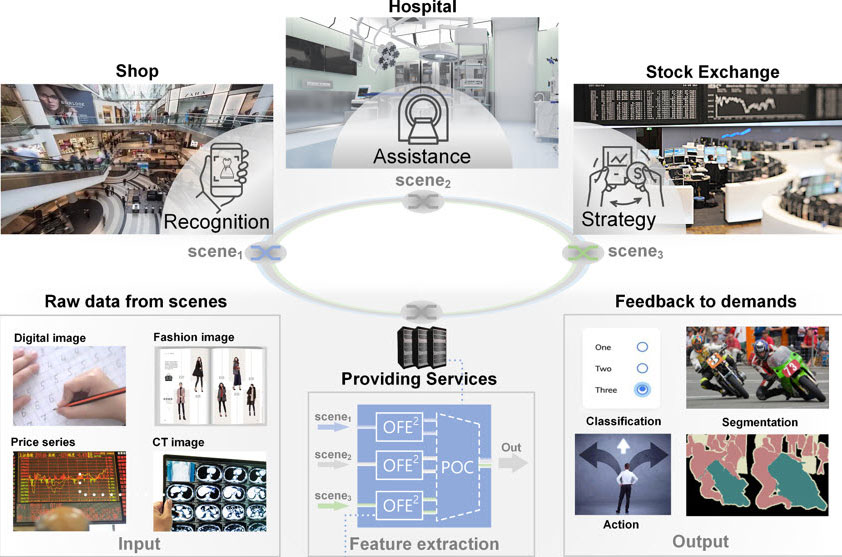
A core innovation lies in the OFE2 data preparation module. Providing high-speed and parallel optical signals for optical cores operating in a coherent environment is highly challenging, as using fiber-based components for power splitting and delay introduces strong phase perturbations. The team solved this by developing an integrated on-chip system with tunable power splitters and precise delay lines. This module effectively de-serializes the data stream by sampling the input signal into multiple stable parallel branches. Moreover, an adjustable integrated phase array allows OFE2 to be reconfigured as necessary.
Harnessing Light for Real-Time Computation
Once the data is prepared, the optical waves pass through the diffraction operator. The process can be mathematically modeled as a matrix-vector multiplication that performs feature extraction. The key to this operation is how the diffracted light forms a focused ‘bright spot’ at the output, which can be partially deflected toward a specific output port by adjusting the phase of the parallel input lights. This movement and the corresponding changes in output power allow OFE2 to effectively capture features related to the input signal’s variations over time.
Operating at a rate of 12.5 GHz, OFE2 can perform a single matrix-vector multiplication in less than 250.5 ps—the shortest latency among similar optical computing implementations. “We firmly believe this work provides a significant benchmark for advancing integrated optical diffraction computing to exceed a 10 GHz rate in real-world applications,” says Chen.
The research team successfully demonstrated the capability of the proposed system across diverse tasks. For image processing, OFE2 was able to extract edge features from input images, creating two complementary ‘relief and engraving’ feature maps. The features generated by OFE2 led to better performance in image classification and increased pixel accuracy in semantic segmentation (such as identifying organs in computed tomography scans). Notably, the AI networks using OFE2 required fewer electronic parameters than a baseline one, proving that optical pre-processing can lead to lighter and more efficient hybrid AI systems.
High-Speed Trading at the Speed of Light
In addition, the team obtained similar results for a digital trading task, where OFE2 received time-series market data and proposed profitable trading actions based on an optimized strategy. In this task, traders input real-time price signals into the OFE2. After prior training, the optimally configured OFE2 generates output signals that can be directly converted into buy or sell actions through a simple decision process, achieving stable profitability. Since the entire process is executed at the speed of light, it offers a significant latency advantage, allowing profits to be captured with minimal delay.
Taken together, these results point toward a new paradigm in which the most intense computational burdens are shifted from power-hungry electronics to ultrafast, low-energy photonics, leading to a new generation of real-time, decision-making AI systems. “The advancements presented in our study push integrated diffraction operators to a higher rate, providing support for compute-intensive services in areas such as image recognition, assisted healthcare, and digital finance. We look forward to collaborating with partners who have data-intensive computational needs,” concludes Chen.
Reference: “High-speed and low-latency optical feature extraction engine based on diffraction operators” by Run Sun, Yuemin Li, Tingzhao Fu, Yuyao Huang, Wencan Liu, Zhenmin Du, Sigang Yang and Hongwei Chen, 8 October 2025, Advanced Photonics Nexus.
DOI: 10.1117/1.APN.4.5.056012
Never miss a breakthrough: Join the SciTechDaily newsletter.
Follow us on Google and Google News.
2 Comments
And another clever invention by unthinking scientists that will be used to harm civil liberties and human society. At least Einstein had the excuse that he was worried that Hitler might get the atom bomb when he triggered the nuclear arms race through his letter to Roosevelt in 1939.
A new generation of real-time, decision-making AI systems.
VERY GOOD. Based on the Topological Vortex Theory architecture, it is possible blurring physics-computation boundaries—e.g., solving PDEs via spacetime vortex fields.
Through vortex quantization (Γ = nκ) and the BKT transition mechanism, Topological Vortex Theory (TVT) bridges the gap between quantum mechanics and classical physics, reflects a progression from concrete physical phenomena to abstract mathematical modeling and, ultimately, to interdisciplinary unification.
——Excerpted from https://t.pineal.cn/blogs/4569/An-Overview-of-the-Development-of-Topological-Vortex-Theory-TVT.