

When nutrients run low, hair follicle stem cells can stop making hair and help repair the skin instead. A drop in the amino acid serine triggers this switch, accelerating wound healing.
Human skin relies on two main groups of adult stem cells: epidermal stem cells and hair follicle stem cells. Under normal conditions, each group has a clear assignment. Epidermal stem cells maintain the surface of the skin, while hair follicle stem cells support hair growth.
Researchers at Rockefeller University have shown that this division of labor is not permanent. When the skin is damaged, hair follicle stem cells (HFSCs) can shift away from hair production and help repair injured tissue instead. The question scientists wanted to answer was how these cells know when to change course.
A Cellular Stress Signal Guides the Switch
The same research group has now identified the signal that prompts hair follicle stem cells to stop growing hair and focus on healing. That signal is known as the integrated stress response (ISR), a built in system that helps cells manage limited resources by conserving energy and prioritizing essential functions.
In skin tissue, this stress response is closely tied to serine, a non-essential amino acid found in everyday foods such as meat, grains, and milk. In a study published in Cell Metabolism, researchers showed that when serine levels drop, the ISR turns on and hair follicle stem cells slow down hair production. If an injury occurs at the same time as low serine levels, the ISR becomes even more active, shutting down hair growth and redirecting cellular effort toward repairing the skin. This shift helps wounds heal more quickly.
“Serine deprivation triggers a highly sensitive cellular ‘dial’ that fine tunes the cell’s fate—towards skin and away from hair,” says first author Jesse Novak, a current MD-PhD student at Weill Cornell’s Tri-Institutional MD-PhD Program and former Ph.D. student in Rockefeller’s Robin Chemers Neustein Laboratory of Mammalian Cell Biology and Development, led by Elaine Fuchs. “Our findings suggest that we might be able to speed up the healing of skin wounds by manipulating serine levels through diet or medications.”
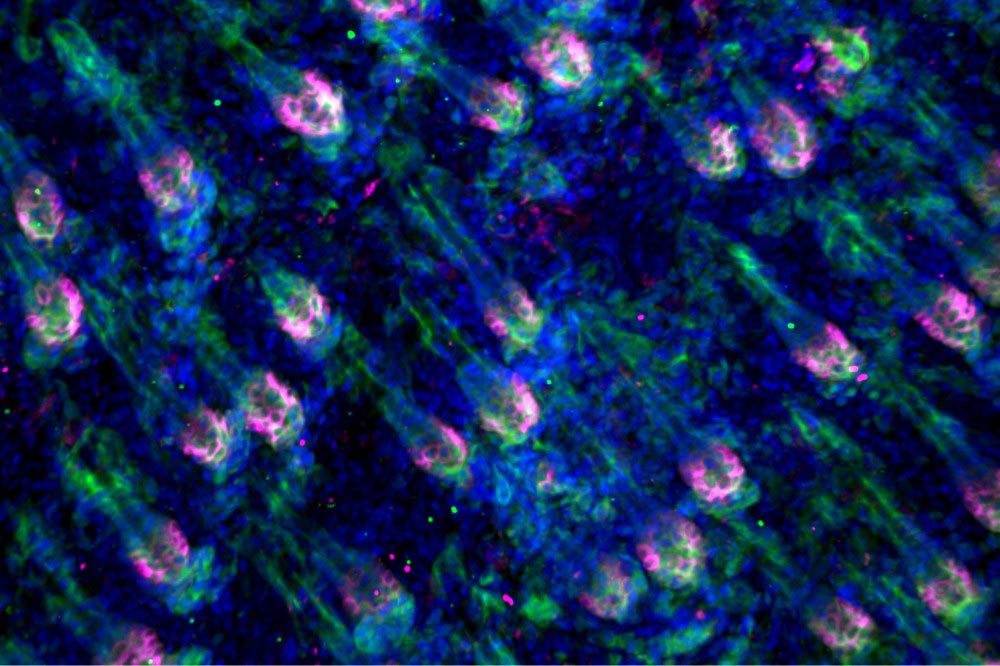
When Hair Stem Cells Step In
Adult tissues depend on stem cell populations that carefully balance cell growth, specialization, and replacement to maintain homeostasis, or normal functioning, while also responding to injury. Despite their importance, the metabolic needs of these cells are still not well understood. Novak designed the current study to identify which metabolic factors support stem cells during everyday maintenance and how those factors change when injury forces hair follicle stem cells to take on new roles.
“Most skin wounds that we get are from abrasions, which destroy the upper part of the skin. That area is home to a pool of stem cells that normally takes charge in wound repair. But when these cells are destroyed, it forces hair follicle stem cells to take the lead in repair,” Novak says. “Knowing that, we thought that tracking these skin cells through wound healing presented a very good model for testing if and how metabolites are regulating this process overall.”
Clues From Cancer Research
Earlier work from the Fuchs laboratory revealed that pre-cancerous skin stem cells can become dependent on serine circulating in the body. By limiting serine through diet, researchers found that these cells could be stopped from progressing into full cancer. Those findings showed that serine plays a major role in regulating cell behavior and helped motivate trials that tested serine-free diets as potential cancer treatments.
What remained unclear was how reducing serine might affect healthy tissue. To address that gap, Novak focused his research on understanding how normal stem cells respond when serine availability changes.
Testing Stress and Injury Together
To explore this, the research team exposed hair follicle stem cells to metabolic stress in two ways. In some mice, serine was removed from the diet. In others, genetic methods were used to block hair follicle stem cells from producing serine on their own.
The experiments showed that serine is in constant communication with the ISR, which activates when tissue conditions become unstable. When serine levels drop, hair follicle stem cells reduce hair growth, an energy intensive process.
The researchers then examined what happens during wound healing. They found that injury alone activates the ISR in hair follicle stem cells. When injury and serine deficiency occur together, the response is even stronger, sharply reducing hair regeneration while favoring skin repair. In this way, the ISR acts as a gauge of overall stress and adjusts regeneration priorities accordingly.
“No one likes to lose hair, but when it comes down to survival in stressful times, repairing the epidermis takes precedence,” says Fuchs. “A missing patch of hair isn’t a threat to an animal, but an unhealed wound is.”
Limits to Boosting Hair Growth
The researchers also asked whether increasing serine levels could push stem cells in the opposite direction and boost hair growth. Their results suggest that this is unlikely. The body tightly controls how much serine circulates in the bloodstream. When Novak fed mice six times the normal amount of serine, blood levels increased by only about 50%.
“However, we did see that if we prevented a stem cell from making its own serine and replenished its losses through a high-serine diet, we were able to partially rescue hair regeneration,” Novak adds.
What Comes Next
Future research will explore whether wound healing can be accelerated by reducing dietary serine or by using medications that influence serine levels or ISR activity. The team also plans to study other amino acids to determine whether serine plays a unique role or is part of a broader metabolic system.
“Overall, the ability of stem cells to make cell fate decisions based upon the levels of stress they experience is likely to have broad implications for how tissues optimize their regenerative capacities in times where resources are scarce,” says Fuchs.
Reference: “The integrated stress response fine-tunes stem cell fate decisions upon serine deprivation and tissue injury” by Jesse S.S. Novak, Lisa Polak, Sanjeethan C. Baksh, Douglas W. Barrows, Marina Schernthanner, Benjamin T. Jackson, Elizabeth A.N. Thompson, Anita Gola, M. Deniz Abdusselamoglu, Alain R. Bonny, Kevin A.U. Gonzales, Julia S. Brunner, Anna E. Bridgeman, Katie S. Stewart, Lynette Hidalgo, June Dela Cruz-Racelis, Ji-Dung Luo, Shiri Gur-Cohen, H. Amalia Pasolli, Thomas S. Carroll, Lydia W.S. Finley and Elaine Fuchs, 12 June 2025, Cell Metabolism.
DOI: 10.1016/j.cmet.2025.05.010
Never miss a breakthrough: Join the SciTechDaily newsletter.
Follow us on Google and Google News.