

Scientists have developed a breakthrough coronagraph that could finally allow us to see Earth-like exoplanets hidden in the blinding glare of their stars.
By using a clever optical technique to isolate and remove starlight, the device opens the door to capturing actual images of distant worlds — even those below traditional telescope resolution limits. This could drastically improve our ability to detect potential signs of life beyond Earth and reshape the future of exoplanet exploration.
Toward Imaging Distant Worlds
Researchers have developed a new type of coronagraph — an optical device that blocks out intense light — which could make it possible to directly image exoplanets that are normally hidden in the glare of their parent stars. This innovation could help scientists spot planets beyond our solar system that current telescopes can’t resolve, offering new ways to search for signs of life elsewhere in the universe.
“Earth-like planets in the habitable zone — the region around a star where temperatures could allow liquid water to exist — can easily be up to a billion times dimmer than their host star,” said research team leader Nico Deshler from the University of Arizona. “This makes them difficult to detect because their faint light is overwhelmed by the star’s brightness. Our new coronagraph design siphons away starlight that might obscure exoplanet light before capturing an image.”
Pushing Quantum Limits in Detection
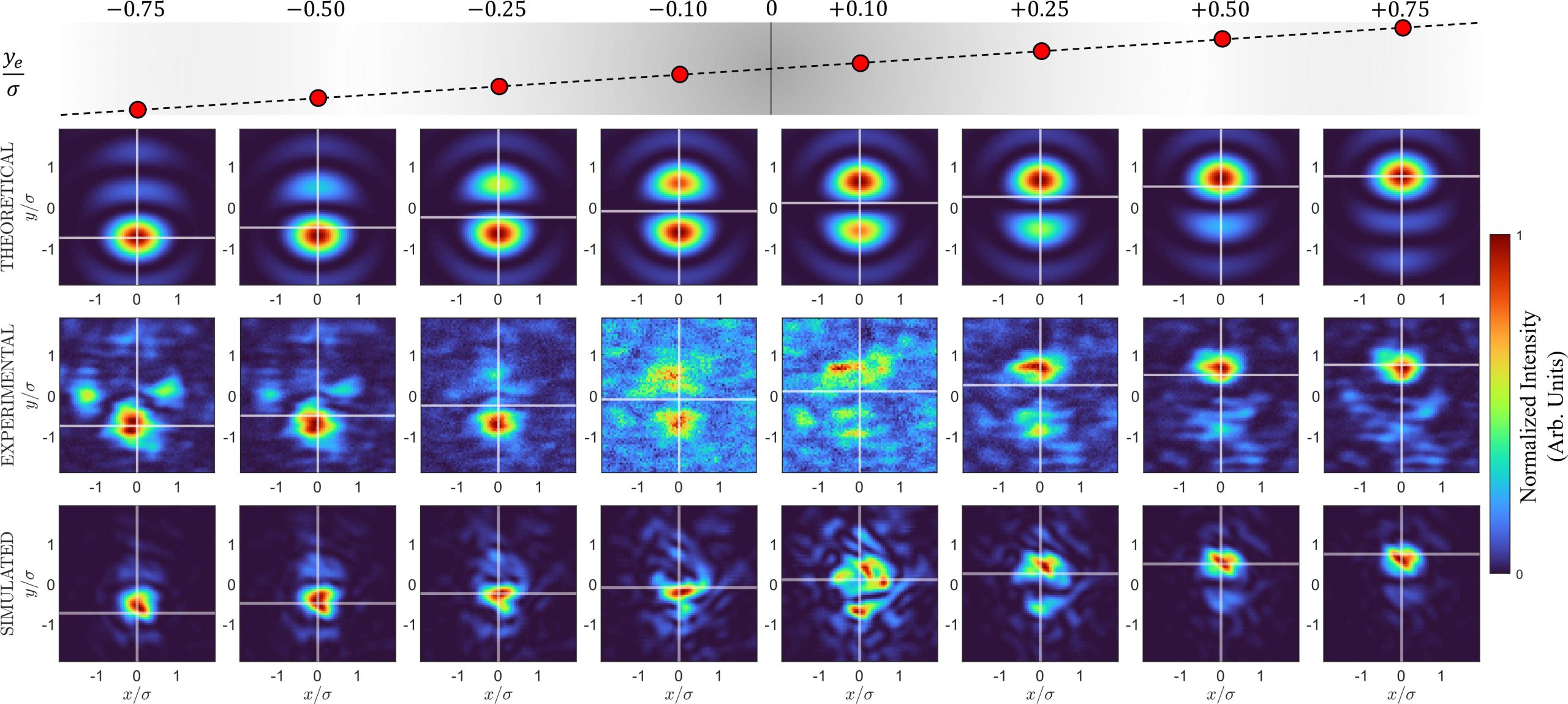
Writing in Optica, the journal of the Optica Publishing Group, the team showed that their device could theoretically reach the fundamental limits of exoplanet detection set by quantum optics. In lab tests, they were also able to pinpoint the positions of artificial exoplanets located much closer to their host star than a telescope would normally be able to resolve — up to 50 times closer than standard resolution limits allow.
“Compared to other coronagraph designs, ours promises to supply more information about so-called sub-diffraction exoplanets – those which lie below the resolution limits of the telescope,” said Deshler. “This could allow us to potentially detect biosignatures and discover the presence of life among the stars.”
The video shows theoretical and experimental results from using the new method for direct imaging measurements of an artificial exoplanet (white crosshairs) passing in front of a simulated star. The new coronagraph design made it possible to estimate the position of artificial exoplanets with distances from their host star up to 50 times smaller than what the telescope’s resolution limit would normally allow. Credit: Nico Deshler, University of Arizona
Challenges in Direct Observation
Optically analyzing exoplanets poses a formidable challenge because, at astronomical scales, they are often too close to their parent star for current telescopes to resolve. Exoplanets can also be orders of magnitude dimmer than their host star. Although astronomers have developed various ways to indirectly infer the presence of a planet around a prospective star, directly observing exoplanets in images would be ideal.
With NASA’s next-generation space telescope, the Habitable Worlds Observatory (HWO), being dedicated to exoplanet science, many coronagraph designs have emerged, each with different practical and theoretical performance trade-offs. At the same time, recent work has shown that traditional notions of resolution for telescopes do not reflect fundamental limits and can be circumvented with careful optical pre-processing.
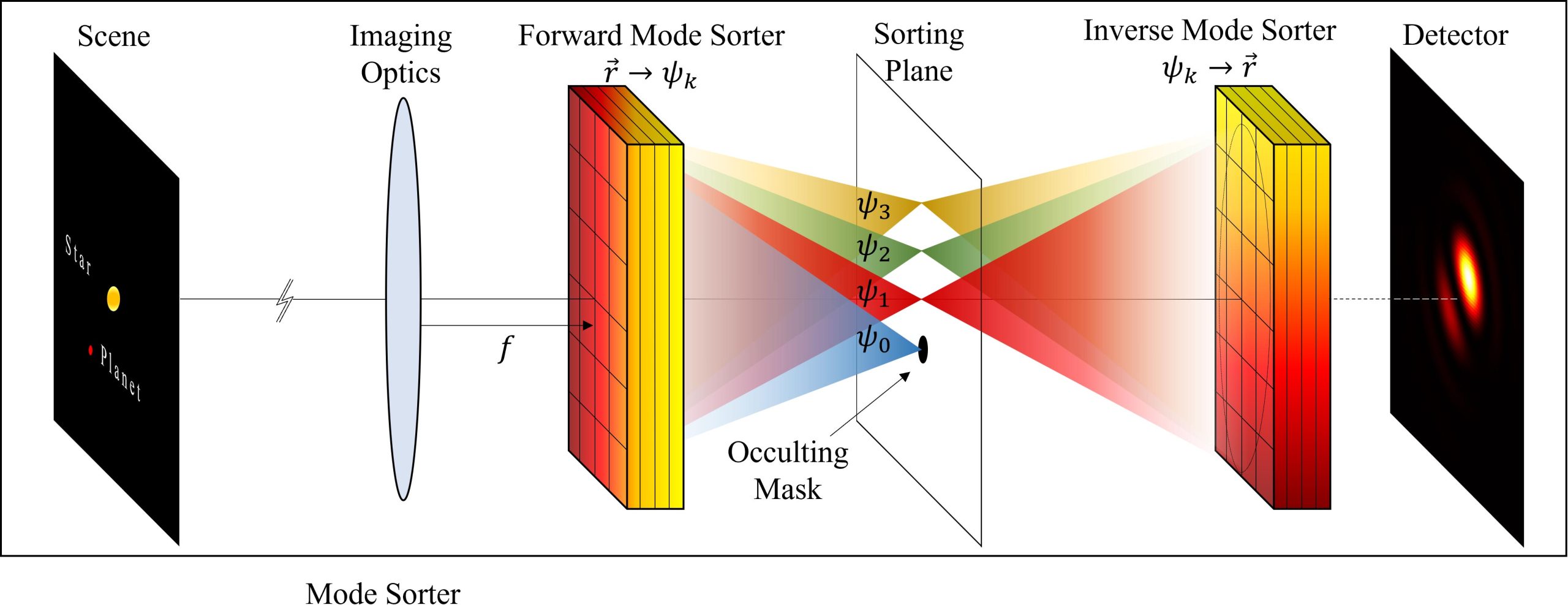
Inspired by these developments, the researchers decided to use a spatial mode sorter available in their lab to develop an improved coronagraph that theoretically rejects all the light from an on-axis star while achieving maximal throughput of an off-axis exoplanet.
Filtering Light Like Musical Notes
Much like piano notes emit different acoustic frequencies, light sources in space excite different spatial modes — unique shapes and patterns of oscillation — depending on their position. The researchers separated these different modes using a mode sorter to isolate and eliminate light from a star and an inverse mode sorter to recompose the optical field after the starlight is rejected. This made it possible to capture an image of the exoplanet without the star.
“Our coronagraph directly captures an image of the exoplanet, as opposed to measuring only the quantity of light from the exoplanet without any spatial orientation,” said Deshler. “Images can provide context and composition information that can be used to determine exoplanet orbits and identify other objects that scatter light from a star such as exozodiacal dust clouds.”
Experimental Imaging in the Lab
After configuring their coronagraph in the lab, the researchers constructed an artificial star-exoplanet scene in which the exoplanet was positioned close enough to the star to be unresolvable with a traditional telescope. The contrast ratio between the star and the planet was set to 1000:1.
The researchers scanned the position of the exoplanet to simulate an orbit where the planet traverses in front of the star and then tried to determine its position in each frame. The images captured with their experimental setup incorporating the new coronagraph allowed them to estimate the position of the exoplanet at sub-diffraction planet-star separations.
Tackling Crosstalk and Optical Noise
The researchers are working to improve the mode sorter to reduce crosstalk, a type of interference in which light leaks across different optical modes. For scenes with moderate contrast levels, crosstalk is not very problematic. However, the extreme contrasts found in exoplanet science would require a very high-fidelity spatial mode sorter to sufficiently isolate light from the star.
The researchers say that this proof-of-principle experiment could inspire further exploration of optical pre-processing with spatial mode sorters in future astronomical instrumentation. For example, the spatial mode filtering methods they used could address more complex scenarios, such as treating stars as extended objects, and may also lead to new imaging methods for quantum sensing, medical imaging and communications.
Reference: “Experimental demonstration of a quantum-optimal coronagraph using spatial mode sorters” by Amit Ashok, Nico Deshler, Saikat Guha and Itay Ozer, 19 April 2025, Optica.
DOI: 10.1364/OPTICA.545414
Never miss a breakthrough: Join the SciTechDaily newsletter.
Follow us on Google and Google News.