
A forgotten immune organ may hold surprising clues about disease risk, aging, and treatment success.
Researchers at Aarhus University are challenging long-standing assumptions about the immune system. Their findings suggest that a small organ, once thought to stop working early in adulthood, continues to influence cancer risk, cardiovascular disease, and how well patients respond to modern cancer therapies.
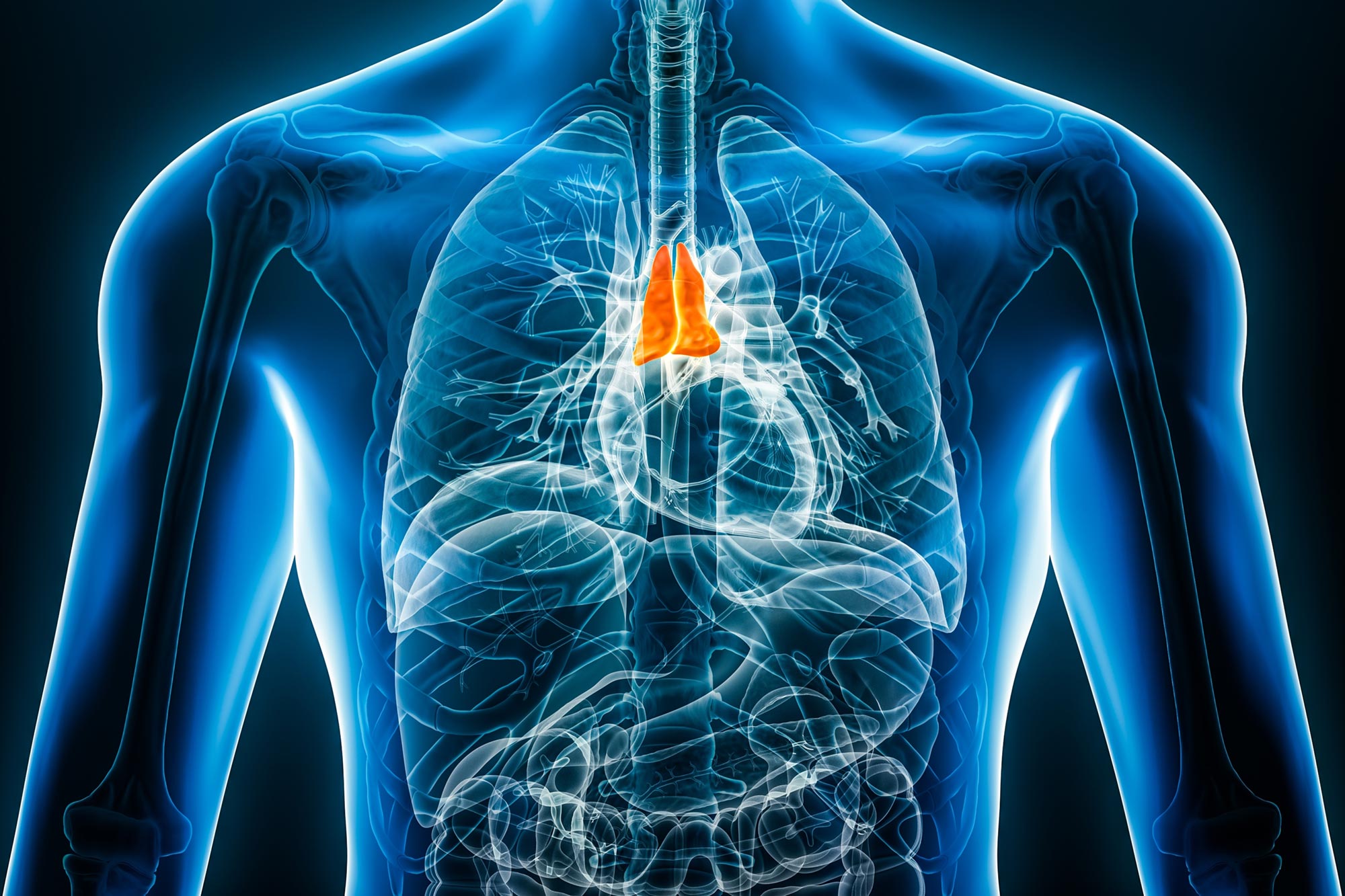
That organ is the thymus, located behind the breastbone. It may now take on a more prominent role in how scientists understand immunity, cancer treatment, and heart disease risk.
The thymus is responsible for maturing T cells, which are essential for fighting infections and disease. It gradually shrinks with age, and scientists have long believed it becomes inactive in early adulthood, producing no new T cells after that point. However, two new studies from Aarhus University, published in Nature, challenge that idea.
Nicolai Birkbak, a professor at the Department of Clinical Medicine at Aarhus University and the Department of Molecular Medicine at Aarhus University Hospital, and one of the researchers behind the studies, explains: “This is significant and potentially paradigm-shifting new knowledge. It challenges the prevailing view that the thymus has no importance in adult life. On the contrary, our studies show that a healthy thymus may be crucial both for disease risk and for how well you respond to cancer treatments.”
Influences cancer patients’ chances of recovery
“This is significant and potentially paradigm-shifting new knowledge. It challenges the prevailing view that the thymus has no importance in adult life. On the contrary, our studies show that a healthy thymus may be crucial both for disease risk and for how well you respond to cancer treatments,” he explains.
In one of the studies, researchers focused on cancer patients receiving immunotherapy, a treatment that activates the body’s own T cells to attack tumors. The results show a clear link between thymus health and treatment outcomes. Patients with better-preserved thymus function responded more effectively to therapy.
“Our study shows a marked difference in how patients respond to immunotherapy – those with well-preserved thymus function respond better and live longer.”
According to Birkbak, these findings could influence how doctors approach treatment decisions in the future.
“Our studies show that it is important to consider the patient’s overall immunological status, and not focus solely on the tumor, when deciding which treatments to offer.”
Shrinks faster with an unhealthy lifestyle
The research also highlights the role of lifestyle in how quickly the thymus declines. Factors such as smoking, obesity, and low physical activity appear to accelerate its shrinkage, which may limit the body’s ability to produce new T cells.
“Our studies show significant differences in the rate at which the thymus shrinks – both between sexes, but especially in relation to lifestyle factors such as smoking, obesity, and low levels of physical activity. A thymus with low function is associated with an increased risk of early death and of developing cancer or cardiovascular disease.”
At the same time, these findings point to new possibilities for prevention and early intervention. Researchers suggest it may one day be possible to identify individuals whose thymus is declining more rapidly and explore ways to slow that process.
“It opens new perspectives. In the long term, it may become relevant to identify individuals with rapid thymus decline and investigate whether it is possible to slow or influence the process, thereby reducing the risk of developing serious diseases such as cardiovascular disease or cancer. This could potentially improve their ability to receive treatment if they are affected.”
Together with his colleagues, Birkbak hopes this research will lead to a deeper understanding of how the immune system changes over time and what that means for disease risk and treatment strategies.
References: “Thymic health and immunotherapy outcomes in patients with cancer” by Simon Bernatz, Vasco Prudente, Suraj Pai, Asbjørn K. Attermann, Alessandro Di Federico, Andrew Rowan, Selvaraju Veeriah, Lars Dyrskjøt, Leonard Nürnberg, Joao V. Alessi, Patrick A. Ott, Elad Sharon, Allan Hackshaw, Nicholas McGranahan, Christopher Abbosh, Raymond H. Mak, Danielle Bitterman, Mark Awad, Biagio Ricciuti, Charles Swanton, Mariam Jamal-Hanjani, Nicolai J. Birkbak and Hugo J. W. L. Aerts, 18 March 2026, Nature.
DOI: 10.1038/s41586-026-10243-x
“Thymic health consequences in adults” by Simon Bernatz, Vasco Prudente, Suraj Pai, Asbjørn K. Attermann, Yumeng Cao, Jiachen Chen, Asya Lyass, Borek Foldyna, Leonard Nürnberg, Keno Bressem, Christopher Abbosh, Charles Swanton, Mariam Jamal-Hanjani, Michael T. Lu, Joanne M. Murabito, Kathryn L. Lunetta, Nicolai J. Birkbak and Hugo J. W. L. Aerts, 18 March 2026, Nature.
DOI: 10.1038/s41586-026-10242-y
Funding: Novo Nordisk Foundation and the Lundbeck Foundation. Additional funding has been provided by the NIH, the ERC and others.
Never miss a breakthrough: Join the SciTechDaily newsletter.
Follow us on Google and Google News.
2 Comments
Kayden Aaron Waltower
This would all be great… Unfortunately for the regular human being on this planet… The most wealthy will receive all of these life saving treatments while the rest of us die… Thanks science!