

Close Menu
    Facebook X (Twitter) Instagram
    SciTechDaily
    • Biology
    • Chemistry
    • Earth
    • Health
    • Physics
    • Science
    • Space
    • Technology
    Facebook X (Twitter) Pinterest YouTube RSS
    SciTechDaily
    Home»Technology»This New Ultrathin Sensor Could Save Your Lungs – And the Climate
    Technology

    This New Ultrathin Sensor Could Save Your Lungs – And the Climate

    By Theresa Duque, Lawrence Berkeley National LaboratoryMarch 29, 2021No Comments3 Mins Read
    Facebook Twitter Pinterest Telegram LinkedIn WhatsApp Email Reddit
    Share
    Facebook Twitter LinkedIn Pinterest Telegram Email Reddit
    Fitness Sensor Tracker Concept
    The new 2D sensor is flexible and transparent, making the technology a likely candidate for wearable environmental and health monitoring sensors.

    Atomically thin device developed by scientists at Berkeley Lab and UC Berkeley could turn your smartphone into a supersmart gas sensor.

    Nitrogen dioxide, an air pollutant emitted by fossil fuel-powered cars and gas-burning stoves is not only bad for the climate – it’s bad for our health. Long-term exposure to NO2 has been linked to increased heart disease, respiratory diseases such as asthma, and infections.

    Nitrogen dioxide is odorless and invisible – so you need a special sensor that can accurately detect hazardous concentrations of the toxic gas. But most currently available sensors are energy-intensive as they usually must operate at high temperatures to achieve suitable performance.

    An ultrathin sensor, developed by a team of researchers from Berkeley Lab and UC Berkeley, could be the answer.

    In their paper published in the journal Nano Letters, the research team reported an atomically thin “2D” sensor that works at room temperature and thus consumes less power than conventional sensors.

    The researchers say that the new 2D sensor – which is constructed from a monolayer alloy of rhenium niobium disulfide – also boasts superior chemical specificity and recovery time.
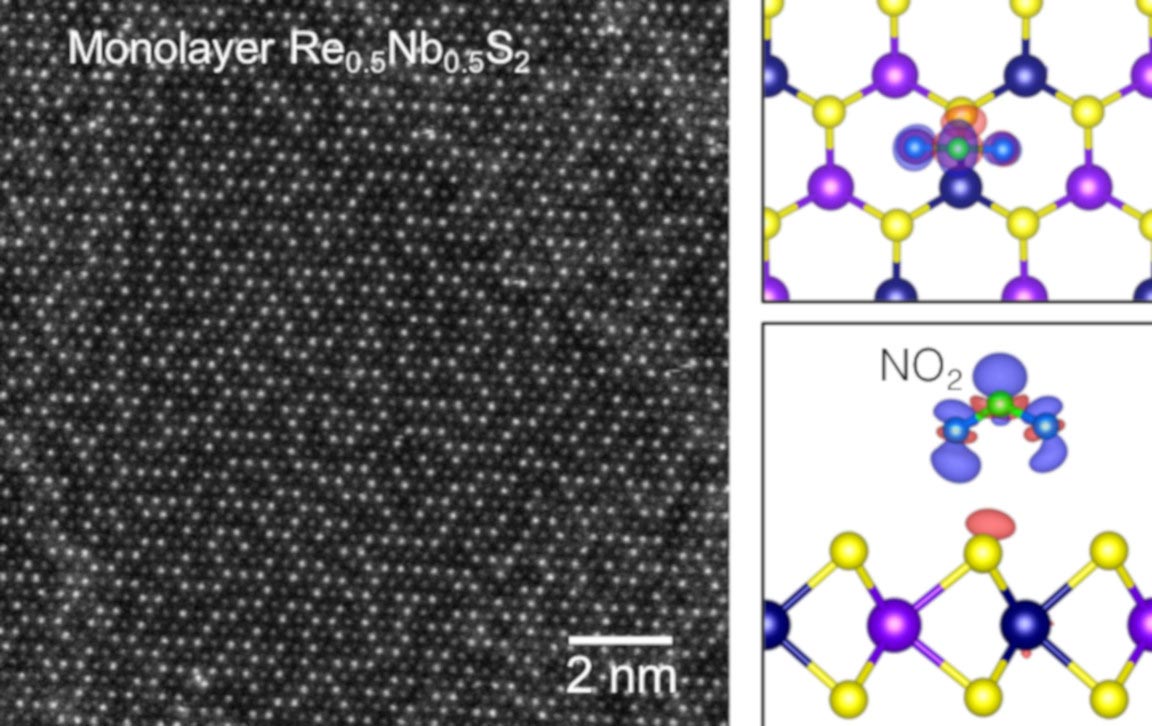
    Bilayer Trilayer Sensor
    Left: Atomic-resolution electron microscopy image of the bilayer and trilayer regions of Re0.5Nb0.5S2 revealing its stacking order. Right: Real-space charge transfer plot showing the charge transfer from Re0.5Nb0.5S2 to the NO2 molecule. Color key: Re shown in navy; Nb in violet; S in yellow; N in green; H in gray; O in blue; and C in red. Credit: Alex Zettl/Berkeley Lab

    Superior Performance Compared to Existing Materials

    Unlike other 2D devices made from materials such as graphene, the new 2D sensor electrically responds selectively to nitrogen dioxide molecules, with minimal response to other toxic gases such as ammonia and formaldehyde. Additionally, the new 2D sensor is able to detect ultralow concentrations of nitrogen dioxide of at least 50 parts per billion, said Amin Azizi, a postdoctoral scholar from UC Berkeley and lead author of the current study.

    Once a sensor based on molybdenum disulfide or carbon nanotubes has detected nitrogen dioxide, it can take hours to recover to its original state at room temperature. “But our sensor takes just a few minutes,” Azizi said.

    The new sensor isn’t just ultrathin – it’s also flexible and transparent, which makes it a great candidate for wearable environmental and health monitoring sensors. “If nitrogen dioxide levels in the local environment exceed 50 parts per billion, that can be very dangerous for someone with asthma, but right now, personal nitrogen dioxide gas sensors are impractical,” Azizi said. Their sensor, if integrated into smartphones or other wearable electronics, could fill that gap, he added.

    Reference: “High-Performance Atomically-Thin Room-Temperature NO2 Sensor” by Amin Azizi, Mehmet Dogan, Hu Long, Jeffrey D. Cain, Kyunghoon Lee, Rahmatollah Eskandari, Alessandro Varieschi, Emily C. Glazer, Marvin L. Cohen and Alex Zettl, 17 July 2020, Nano Letters.
    DOI: 10.1021/acs.nanolett.0c02221

    Berkeley Lab postdoctoral researcher and co-author Mehmet Dogan relied on the Cori supercomputer at the National Energy Research Scientific Computing Center (NERSC), a supercomputing user facility at Berkeley Lab, to theoretically identify the underlying sensing mechanism.

    Alex Zettl and Marvin Cohen, faculty scientists in Berkeley Lab’s Materials Sciences Division and professors of physics at UC Berkeley, co-led the study.

    Never miss a breakthrough: Join the SciTechDaily newsletter.
    Follow us on Google and Google News.

    Lawrence Berkeley National Laboratory Nanotechnology Sensor
    Share. Facebook Twitter Pinterest LinkedIn Email Reddit

    Related Articles

    Researchers Develop Peptoid Nanosheets that Mimic Natural Antibodies

    Improving Magnetic Memory by Controlling Spin Orientation

    Researchers Develop First Fully Integrated Nanosystem for Artificial Photosynthesis

    Black Titanium Dioxide Nanoparticles Could Play Key Role in Clean Energy Photocatalysis

    HARPES Technique Reveals Ferromagnetic Secrets of Dilute Magnetic Semiconductors

    Generator Produces Electricity by Harnessing the Piezoelectric Properties of Biological Material

    Cost Effective Sensor Measures Fruits’ Ripeness

    DSRS Triples Microbial Production of Diesel Fuel

    Mapping the Pathways of Electrical Charge From Molecule to Molecule

    Leave A Reply Cancel Reply

    • Facebook
    • Twitter
    • Pinterest
    • YouTube

    Don't Miss a Discovery

    Subscribe for the Latest in Science & Tech!

    Trending News

    Even Occasional Binge Drinking May Triple Liver Damage Risk

    Liftoff! NASA’s Artemis II Launch Sends Astronauts Around the Moon for First Time in 50 Years

    Scientists Discover New Way To Eliminate “Zombie Cells” Driving Aging

    This New Quantum Theory Could Change Everything We Know About the Big Bang

    This One Vitamin May Help Protect Your Brain From Dementia Years Later

    Stopping Weight-Loss Drugs Like Ozempic Can Quickly Erase Heart Benefits

    A 500-Million-Year-Old Surprise Is Forcing Scientists to Rethink Spider Evolution

    Coffee and Blood Pressure: What You Need To Know Before Your Next Cup

    Follow SciTechDaily
    • Facebook
    • Twitter
    • YouTube
    • Pinterest
    • Newsletter
    • RSS
    SciTech News
    • Biology News
    • Chemistry News
    • Earth News
    • Health News
    • Physics News
    • Science News
    • Space News
    • Technology News
    Recent Posts
    • Scientists Discover Cancer Tumors Are “Addicted” to This Common Antioxidant
    • Tiny 436-Million-Year-Old Fish Fossil Rewrites the Origins of Vertebrates
    • 1,800 Miles Down: Scientists Uncover Mysterious Movements at the Edge of Earth’s Core
    • Scientists Uncover Earth’s Hidden “Gold Kitchen” Beneath the Ocean Floor
    • You Don’t Need To Be Rich: New Study Reveals a Simple Life Is the Real Secret to Happiness
    Copyright © 1998 - 2026 SciTechDaily. All Rights Reserved.
    • Science News
    • About
    • Contact
    • Editorial Board
    • Privacy Policy
    • Terms of Use

    Type above and press Enter to search. Press Esc to cancel.