
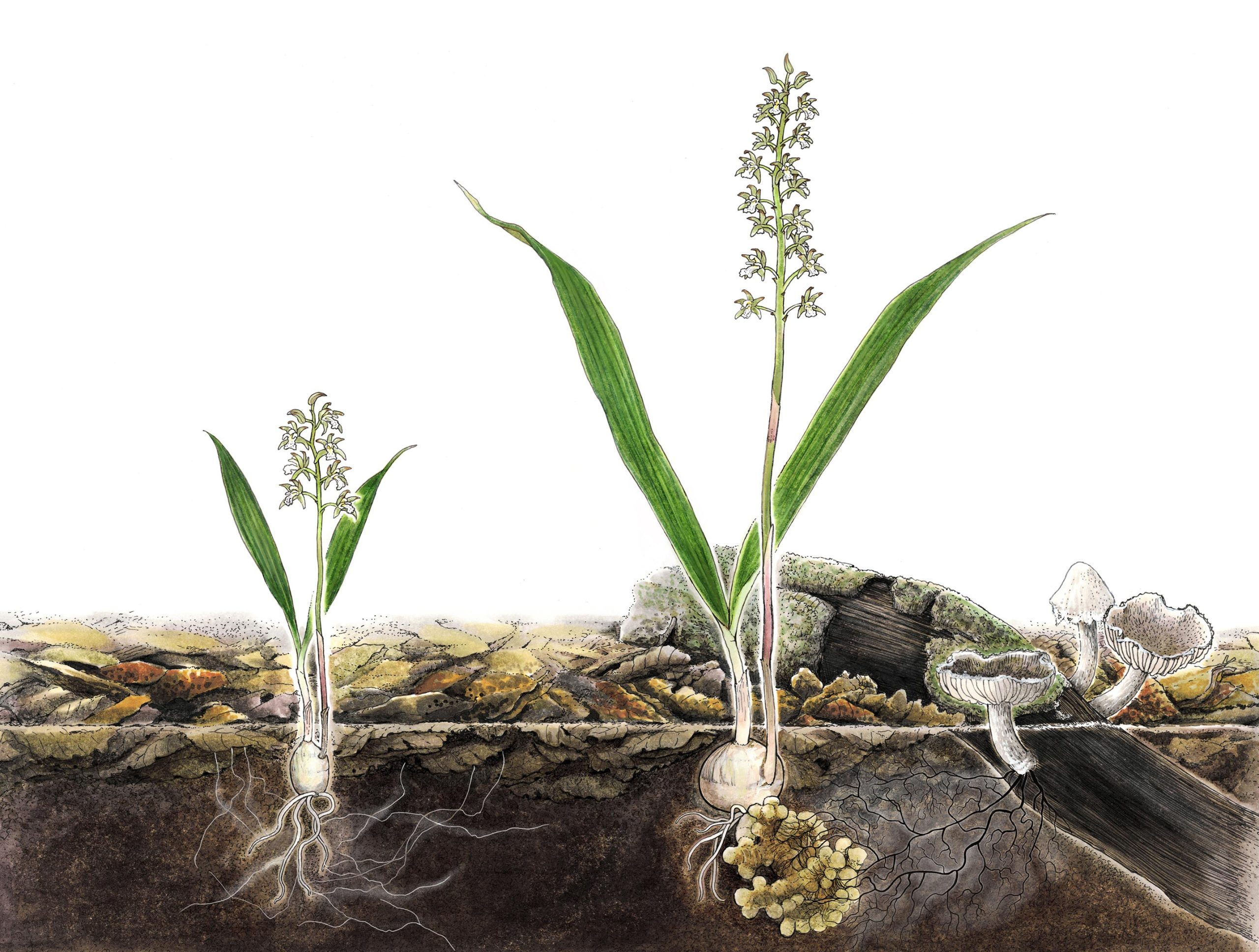
Some orchids have evolved a unique parasitic lifestyle, abandoning full reliance on photosynthesis in favor of extracting nutrients from fungi. Oreorchis patens serves as a fascinating case, capable of both photosynthesis and fungal parasitism.
Researchers discovered that when these orchids grow near decaying wood, they shift to fungi that decompose the wood, boosting their size and reproductive success. However, only a small percentage of orchids can take advantage of this, as it depends on specific environmental conditions. This research sheds light on the complex and opportunistic survival strategies of orchids, hinting at deeper ecological mysteries.
Mysterious Orchid-Fungus Symbiosis
Most orchids form a symbiotic relationship with fungi in their roots, exchanging sugars produced through photosynthesis for essential water and minerals. However, some orchids have abandoned photosynthesis altogether, relying entirely on fungi for their nutrients.
Botanist Kenji Suetsugu of Kobe University has long been fascinated by this phenomenon, “I’ve always been intrigued by how orchids turn parasitic. Why would a plant give up its reliance on photosynthesis and instead ‘steal’ from fungi?”
The orchid Oreorchis patens provides a unique opportunity to explore this question. As a partial parasite, it can photosynthesize but also supplements its nutrition by drawing up to half of its nutrients from fungi. Scientists have been investigating whether this parasitism simply compensates for nutritional gaps or if it offers additional advantages.
Suetsugu explains, “I noticed that Oreorchis patens sometimes grows unusual coral-shaped rootstalks, a trait reminiscent of orchids fully relying on fungi. I thought that this would allow me to compare plants with these organs to those with normal roots, quantify how much extra nutrients they might be gaining, and determine whether that extra translates into enhanced growth or reproductive success.”
Rotten Wood and a Surprising Nutrient Boost
In a paper published today (February 19) in The Plant Journal, the Kobe University team shows that when the orchid happens to grow close to rotten wood, it shifts its fungal symbionts to those that decompose the wood and significantly increases the amount of nutrients it takes from them — without ceasing to employ photosynthesis. As a result, the plants are bigger and produce more flowers.
“In short, these orchids aren’t merely substituting for diminished photosynthesis, they’re boosting their overall nutrient budget. This clear, adaptive link between fungal parasitism and improved plant vigor is, to me, the most thrilling aspect of our discovery, as it provides a concrete ecological explanation for why a photosynthetic plant might choose this path,” says Suetsugu.

Why Don’t More Orchids Do This?
But then, why do only less than 10% of these orchids exhibit this behavior? The answer might be found in the fact that the researchers could only see parasitic individuals near fallen and rotting tree trunks. Becoming a parasite means that the orchids need to switch from their usual symbionts to different fungi that can handle the increased nutritional load. But appropriate fungi only occur when there is fallen wood and only in certain stages of the decomposition process. In other words, the orchids become parasitic only when they can, not whenever they need to, and this opportunity does not present itself often.
Unanswered Questions and Future Research
Many questions are still left open, such as what triggers the orchids to develop the coral-like rootstalks and whether environmental factors influence the amount of nutrients the plants take from the fungi.
Suetsugu explains his wider outlook: “This work is part of a broader effort to unravel the continuum from photosynthesis to complete parasitism. Ultimately, I hope such discoveries will deepen our understanding of the diverse strategies orchids employ to balance different lifestyles, thereby aiding in the preservation of the incredible diversity of these plants in our forests.”
Reference: “Subterranean morphology underpins the degree of mycoheterotrophy, mycorrhizal associations, and plant vigor in a green orchid Oreorchis patens” by Kenji Suetsugu and Hidehito Okada, 19 February 2025, The Plant Journal.
DOI: 10.1111/tpj.70045
This research was funded by the Japan Society for the Promotion of Science (grant 17H05016), the Japan Science and Technology Agency (grant JPMJPR21D6) and the Research Institute for Humanity and Nature.
Never miss a breakthrough: Join the SciTechDaily newsletter.
Follow us on Google and Google News.