
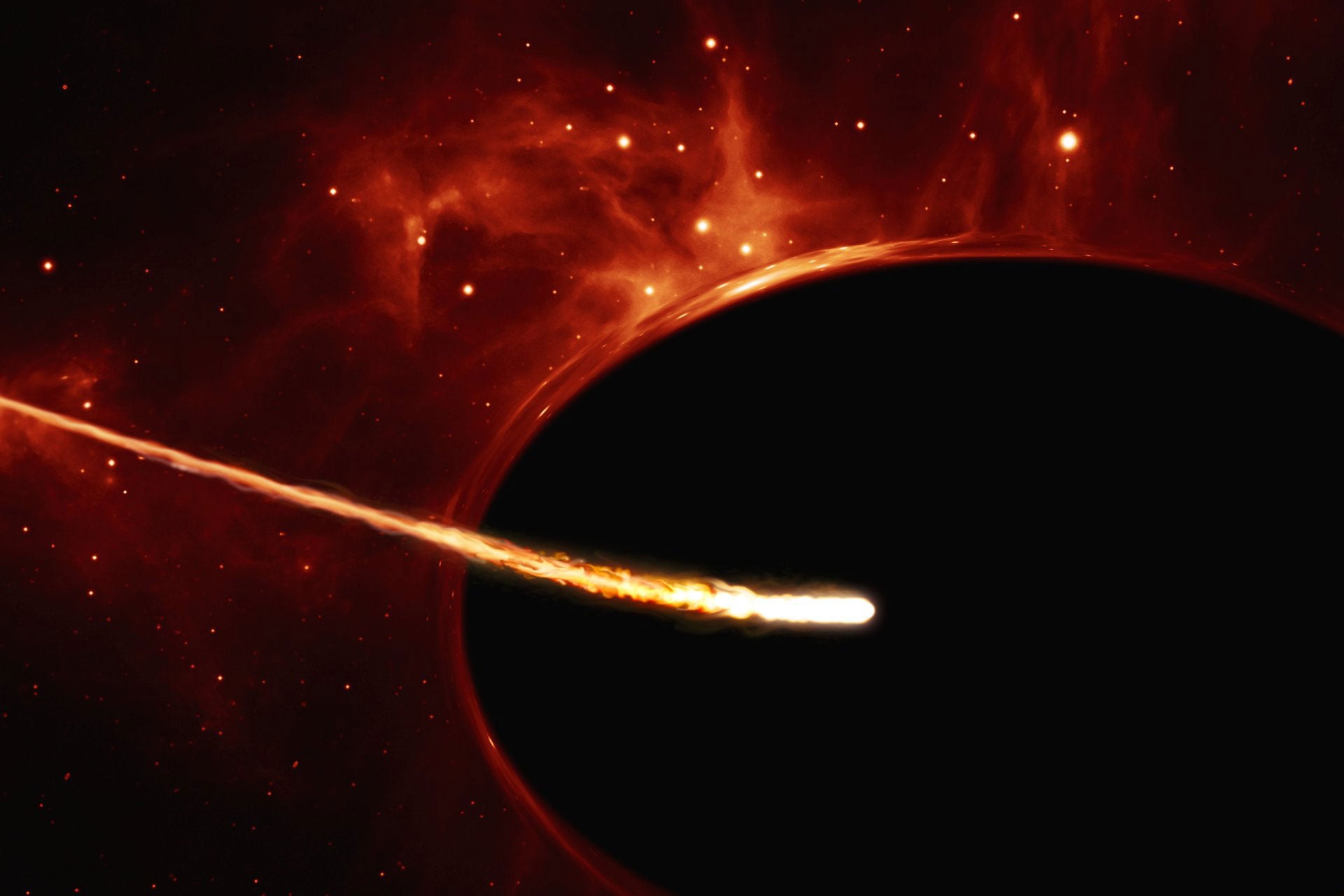
A fast-moving star near the Milky Way’s central black hole could test gravity under unusually extreme conditions.
General relativity provides a remarkably precise description of gravity, but most everyday calculations do not require it. Newton’s law of universal gravitation is accurate enough to guide spacecraft across the solar system and describe the motion of most stars circling Sag A*, the supermassive black hole at the Milky Way’s center.
Einstein’s theory predicts effects that Newton’s does not, including gravitational waves, yet the two models produce nearly identical results in many situations. Distinguishing general relativity from other relativistic theories of gravity is even harder because their predictions differ only under extreme conditions. A recently identified star may offer a rare opportunity to test those boundaries.
A star enters gravity’s extreme regime
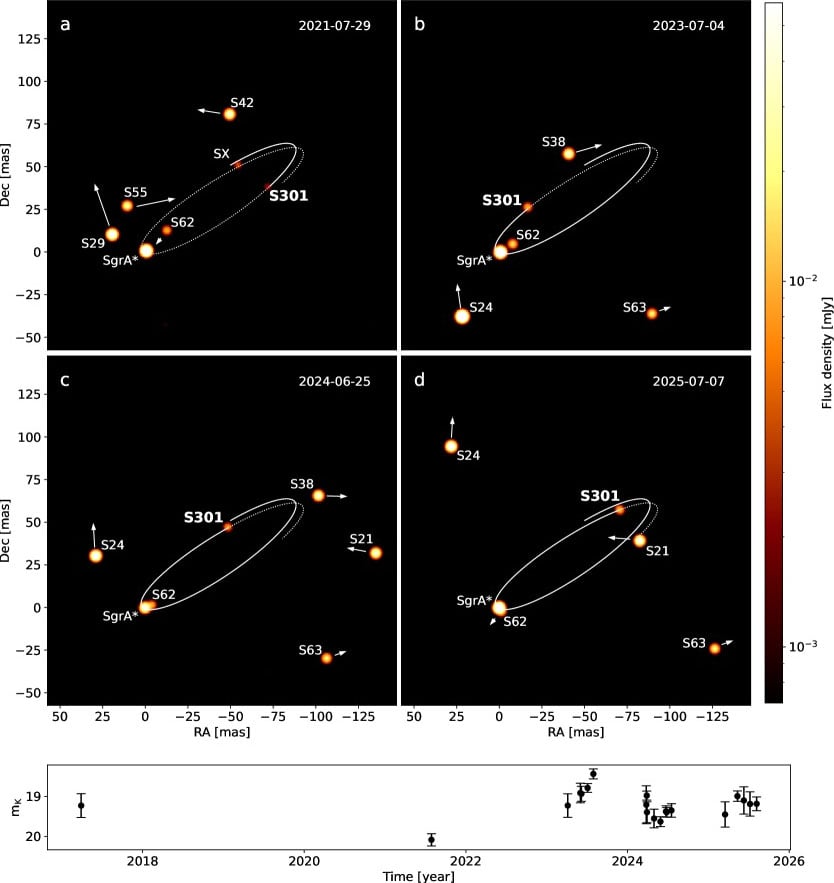
The star is called S301 because it is the 301st recognized member of the S-stars, a group that orbits Sag A*. Slightly more massive than the Sun, S301 completes one orbit every 8.7 years, the shortest period known for any S-star, and follows a highly elongated path.
At its closest point, it passes within roughly 140 Sag A* radii, equivalent to about 24 AU. If Sag A* replaced the Sun, its event horizon would lie just inside Mercury’s orbit, while S301 at its nearest approach would travel between the orbits of Uranus and Neptune. At that point, the star would reach more than 8% of the speed of light.
Its orbit magnifies relativistic effects
This makes S301 the most relativistic star we have observed. It will allow us to test some of the limits of general relativity. For example, we have already observed that the orbit of S301 precesses. We’ve observed orbital precession in the motion of Mercury.
It was one of the classic tests of GR. But the precession of Mercury is tiny. The difference in motion between Einstein’s prediction and Newton’s is less than the span of a human heartbeat with each orbit. For S301, its perihelion advances about 2° with each orbit.
This motion is so extreme that secondary relativistic effects come into play. For example, gravitational redshift and the transverse Doppler effect. We’ve observed these effects in the lab, but S301 gives us a chance to study them in nature. But more significantly, in time we can use S301 to study alternatives to general relativity.
Future telescopes could test deeper theories
One of the big difficulties with GR is that it doesn’t play well with quantum theory. There are several models that try to unify the two, but they only differ from GR in extreme cases. Some of these differences might be seen at relativistic speeds, since the effects are at the order of (v/c)2 or (v/c)3.
The effects of the black hole’s spin and its interaction with the rotation of the star also come into play on these orders of magnitude. Future large telescopes such as the Giant Magellan Telescope (GMT) will be able to observe the spectra of S301 with enough precision to measure second- and third-order effects.
For now, however, observing S301 remains a challenge. The center of our galaxy is veiled in cloud and dust, meaning we can’t observe it in optical light. Since S301 is a Sun-like star, it isn’t particularly bright, even in the infrared. We can observe its motion, but we can’t yet gather any significant spectral data.
But as with all things relativity, it’s only a matter of time.
Reference: “Discovery of a star sensitive to the spin of Sgr A*” by K. Abd El Dayem, R. Abuter, N. Aimar, P. Amaro-Seoane, A. Berdeu, J. -P. Berger, G. Bourdarot, W. Brandner, A. Burkert, D. Calderon, C. Correia, J. Cuadra, R. Davies, D. Defrere, L. Delit, A. Drescher, F. Eisenhauer, L. Esteras Otal, M. Fabricius, H. Feuchtgruber, N. M. Foerster Schreiber, A. Foschi, P. Garcia, R. Garcia Lopez, A. Generozov, R. Genzel, S. Gillessen, F. Gonte, X. Haubois, S. F. Hoenig, M. Houlle, S. Joharle, A. Kaufer, J. Kammerer, P. Kervella, J. Kolb, L. Kreidberg, L. Labadie, S. Lacour, O. Lai, R. Laugier, J. -B. Le Bouquin, J. Leftley, B. Lopez, D. Lutz, F. Mang, A. Merand, F. Millour, M. Montarges, N. Morujao, H. Nowacki, M. Nowak, S. Oberti, J. Osorno, T. Ott, T. Paumard, C. Paladini, H. B. Perets, K. Perraut, G. Perrin, R. Petrov, P. O. Petrucci, T. Piran, N. Pourre, S. Rabien, D. C. Ribeiro, S. Robbe-Dubois, M. Sadun Bordoni, J. Sanchez Bermudez, D. Santos, R. Sari, J. Sauter, S. Scheithauer, J. Scigliuto, J. Shangguan, T. T. Shimizu, F. Soulez, J. Stadler, C. Straubmeier, E. Sturm, M. Subroweit, C. Sykes, L. J. Tacconi, P. Thevenet, I. Urso, F. Vincent, J. Woillez and G. Zins, July 13, 2026, arXiv.
DOI: 2607.12664
Adapted from an article originally published in UniverseToday.
Never miss a breakthrough: Join the SciTechDaily newsletter.
Follow us on Google and Google News.
4 Comments
Мошенники вы все, легко могу доказать, если дадите слово.. но КАК можно пользоваться фальш-формулами древних мошенников ЭйнШтейн-НьюТОН.. сегодня!???.. не понимаю.. не стыдно? лжецы? Автор Научной ОФП в 200 лет жизни.
“Мы неожид. открыли необычную Черную или Чёрную дыру!?.. а вчера не заметили???? с этой аппаратуроцой? 2 миллиона Профи на деньгах и любителей-болтунов??? Лапша на уши народам и невеж. Фараонам 21 века…. перепугавшися неадеквата-Тарарампа-трампа.. ну и цивилизация лжецов .. Стыдно за нас перед ВЕЧНЫМИ цивилизациями космоса. МД АФС.
Fantastic
Есть теория Спираль Бытия, там проблема последнего парсека рассматривается синхронизацией параметров. Такие звездные процессы невозможно рассматривать через одно лишь взаимодействие масс. Притяжение как естественная сила, работает на всех масштабах, без посредников, напрямую, но пространство это дискретные промежутки взаимодействия, где время более сложное явление, чем привыкли считать. Это полное термодинамическое преобразование материи. И СМЧД, не окончательная форма. Все что происходит, это поиск термодинамически стабильного состояния. ОТО считая что Единая Вселенная имеет вечное пространство с временем, при делении на фрагменты, для тел и систем, продолжало делить только массу, и масса теряет лицо. Спираль Бытия строит из единой частицы со своей масса, свое время, и свой размер и промежутки взаимодействия. И Не надо больше ничего лишнего.