

A pivotal wrist bone in birds appears earlier in theropods. This could shift views on how flight evolved.
An analysis of two theropod dinosaur fossils reveals they possessed a type of wrist bone that is considered essential for flight in birds.
This discovery by a team of researchers led by James Napoli, from the Department of Anatomical Sciences in the Renaissance School of Medicine at Stony Brook University, counters previous research that concluded theropods did not have a bird-like carpal bone, or pisiform. Their finding, published in Nature, opens the possibility that the evolution of flight in dinosaurs was “all in the wrist.”
How the pisiform functions in modern birds
For a long time, scientists were uncertain about the identity of a particular carpal bone in the bird wrist, until it was confirmed to be the pisiform. Originally a sesamoid bone, similar in nature to a kneecap, the pisiform had shifted from its initial location in the wrist to take the place of another carpal bone known as the ulnare. In living birds, this new position helps form a joint system that enables the wing to fold automatically when the elbow bends.
The pisiform’s distinctive V-shaped notch also plays a structural role, helping it grip the hand bones securely and prevent dislocation during flight. As a result, the pisiform is a key component of the bird forelimb and is vital for effective flight mechanics.
The dinosaur fossils examined in this study included a troodontid, a bird-like predator related to the Velociraptor, and an oviraptorid, an unusual omnivorous dinosaur with a long neck and a beak but no teeth.
CT scans reveal migrated wrist bones
The researchers were able to identify the pisiform bone in theropod dinosaurs thanks to the exceptional preservation of the fossil specimens and the use of high-resolution CT scanning, which allowed them to digitally separate and examine the wrist bones in detail. These fossils were studied through a collaborative agreement with the American Museum of Natural History and the Mongolian Academy of Sciences.
The resulting 3D visualizations clearly show that small, bead-like wrist bones are in fact migrated pisiforms—the first ever recognized in non-avian dinosaurs—captured at an evolutionary midpoint in their development.
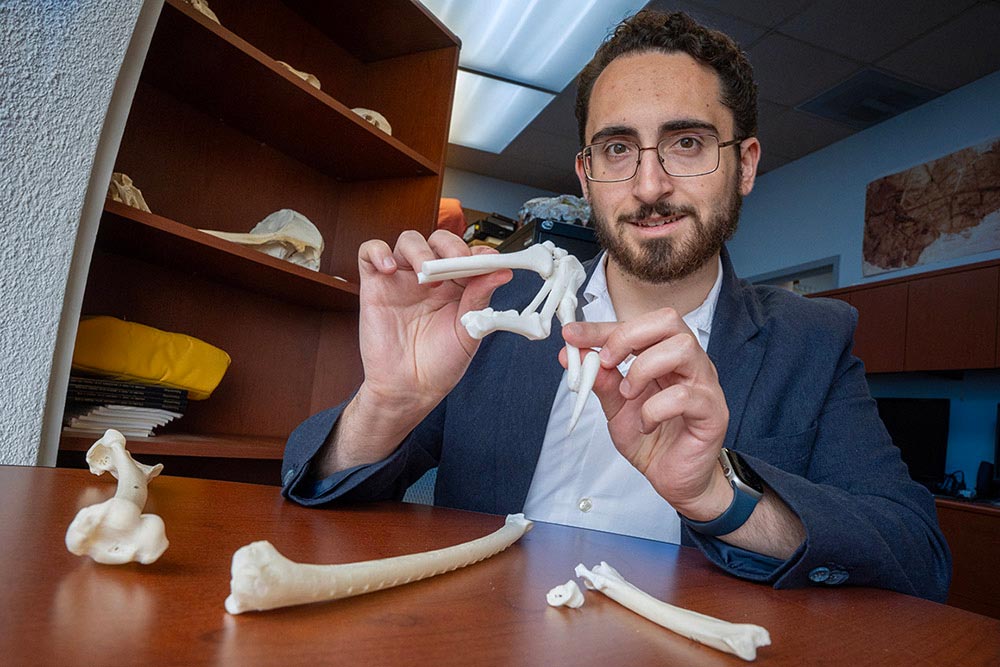
“We believe this is the first time a migrated pisiform in a non-bird meat-eating dinosaur has been identified,” said Napoli, lead author, a vertebrate paleontologist and evolutionary biologist, and research instructor in the Department of Anatomical Sciences.
“While we currently do not know precisely how many times dinosaurs learned to fly, it is intriguing that experimentation with flight in these creatures appears only after the pisiform migrated into the wrist joint. Therefore, it is possible that this established the automated mechanisms found in current living birds, though we would need to test this hypothesis with more research and analysis of dinosaur wrist bones,” he explained.
Pisiform shift traces back to Pennaraptora
Putting their findings in evolutionary context, they determined that the pisiform moved into its bird-like position not within birds but by the origin of a group called Pennaraptora — a group of theropod dinosaurs that includes dromaeosaurids like the Velociraptor, troodontids, and oviraptorosaurs. Overall, this is the group of dinosaurs in which bird-like traits such as feathered wings began to appear, and in which flight evolved at least twice, and possibly up to five times.
Napoli and co-authors write that their results “make clear that the topological and functional replacement of the ulnare by the pisiform occurred much deeper in theropod history than has been previously understood and was a stepwise process… Over the past few decades, our knowledge of theropod dinosaur anatomy and evolution has increased exponentially, much of it revealing that classically ‘avian’ traits such as thin-walled bones, an enlarged brain, and feathers, all characterize more inclusive groups of theropod dinosaurs. Our results suggest that the construction of the avian wrist is no exception and follows topological patterns laid down by the origin of Pennaraptora.”
Reference: “Reorganization of the theropod wrist preceded the origin of avian flight” by James G. Napoli, Matteo Fabbri, Alexander A. Ruebenstahl, Jingmai K. O’Connor, Bhart-Anjan S. Bhullar and Mark A. Norell, 9 July 2025, Nature.
DOI: 10.1038/s41586-025-09232-3
Never miss a breakthrough: Join the SciTechDaily newsletter.
Follow us on Google and Google News.