
Scientists in Korea achieved the first experimental realization of bound states in the continuum in a single resonator, opening doors to ultra-efficient wave control for future tech.
A research team from POSTECH (Pohang University of Science and Technology) and Jeonbuk National University has achieved a groundbreaking feat: the complete confinement of mechanical waves within a single resonator—something long considered theoretically impossible. Their study, published on April 3 in Physical Review Letters, represents a significant advance in solving the century-old puzzle of bound states in the continuum (BIC).
Resonance, the amplification of waves at specific frequencies, underpins many everyday technologies, including smartphones, ultrasound imaging, and radio systems. However, conventional resonators gradually dissipate energy, requiring continuous input to sustain their operation.
Nearly 100 years ago, Nobel Prize winners John von Neumann and Eugene Wigner introduced a radical idea: under specific conditions, it might be possible for waves to remain confined indefinitely, without leaking energy. These so-called bound states in the continuum (BIC) are akin to whirlpools that stay fixed in place, even as a river flows around them. Yet for decades, scientists assumed such states could not exist within a compact, single-resonator system—until now.
Achieving BIC in a Single Resonator
Now, the research team has broken this long-standing theoretical boundary by successfully realizing BIC in a single particle.
Using a system of cylindrical granular particles—small solid rods made of quartz—the researchers built a highly tunable mechanical platform. By precisely adjusting how the cylinders touch each other, they could control the way mechanical waves interact at the contact boundaries.
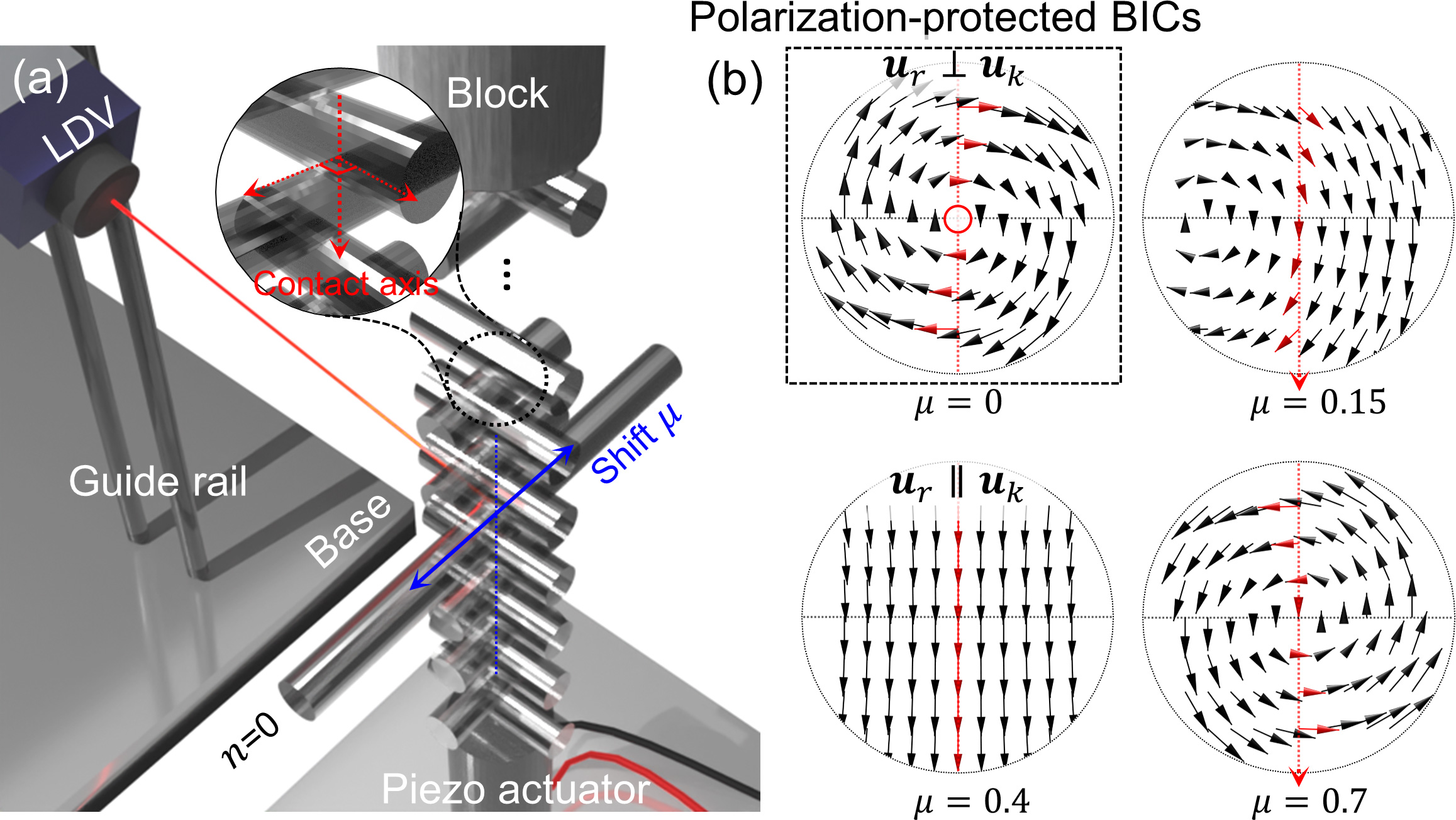
Under special alignment, a wave mode became fully confined within a single cylinder without any energy escaping into the surrounding structure. This so-called polarization-protected BIC was not just theoretical—it was observed in real experiments. Even more remarkably, the system achieved quality factors (Q-factors) over 1,000, a measure of how efficiently a resonator stores energy with minimal loss.
What happens when many of these special cylinders are connected in a chain? The team discovered that the trapped wave modes could extend throughout the chain without dispersing—a phenomenon known as a flat band.
“It’s like tossing a stone into a still pond and seeing the ripples remain motionless, vibrating only in place,” said lead author Dr. Yeongtae Jang. “Even though the system allows wave motion, the energy doesn’t spread—it stays perfectly confined.” This behavior is described as a Bound Band in the Continuum (BBIC) and opens new possibilities for energy harvesting, ultra-sensitive sensors, and even advanced communications.
Implications and Future Applications
“We have broken a long-standing theoretical boundary,” said Professor Junsuk Rho, who leads the research. “While this is still in the fundamental research phase, the implications are significant—from low-loss energy devices to next-generation sensing and signal technologies.”
Reference: “Bound States to Bands in the Continuum in Cylindrical Granular Crystals” by Yeongtae Jang, Seokwoo Kim, Dongwoo Lee, Eunho Kim and Junsuk Rho, 3 April 2025, Physical Review Letters.
DOI: 10.1103/PhysRevLett.134.136901
This research was supported by the Mid-Career Research Program of the National Research Foundation of Korea (NRF), funded by the Ministry of Science and ICT, as well as the POSCO-POSTECH-RIST Convergence Research Center.
Never miss a breakthrough: Join the SciTechDaily newsletter.
Follow us on Google and Google News.
8 Comments
This just goes to show us again impossible is never final. The Wright Brothers were ridiculed before they succeeded. “Experts” had extensive evidence that breaking the sound barrier would be fatal to the pilot. I could go on.
I wonder what answers we will find on the way to the Light speed “barrier” that will open entirely new avenues around “impossible” and “infinite”?
Keep the faith.
we could re-interpret BICs in content of the idea that space is not passive
1. continuum as a dynamic space potential field
2.Bound state as a localized space potential structure
3. BIC = destructive interference in the space potential gradients
I have a tough time visualizing this.
You drop the pebble in the pond and then what?
Does the ripple only go out a little way and then stop completely or is the crest of the wave rising and falling in that ring around the pebble?
A video or an illustration would help here.
https://arxiv.org/pdf/2410.16209 is the preprint, I gather.
The complete confinement of mechanical waves within a single resonator—something long considered theoretically impossible.
WHY?
1. Is Physical Review Letters a publication that respects science?
2. Why does physics today enjoy the convenience brought by ideal fluids for work, life, and engineering simulations, but reject the existence of ideal fluids?
3. Why does physics today reject the possibility of using time and space as initial conditions, despite the fact that scientific research and physical experiments cannot be separated from space and time?
4. Why is physics today so obsessed with ignoring time and space, searching everywhere for so-called God and Devil particles?
Scientific research guided by correct theories can enable researchers to think more. According to the of topological vortex theory, what humans can observe and feel are things that can directly or indirectly spin locking with human senses.
If scientists are interested, please browse https://scitechdaily.com/microscope-spacecrafts-most-precise-test-of-key-component-of-the-theory-of-general-relativity/#comment-869260.
Ask the researchers:
1. What is the difference between dynamic geometric shapes and physical reality?
2. Why can mathematics become the language of science?
This is extremely exciting. However, I’ll wait for other teams to duplicate their results before I pop the champagne.