
Close Menu
    Facebook X (Twitter) Instagram
    SciTechDaily
    • Biology
    • Chemistry
    • Earth
    • Health
    • Physics
    • Science
    • Space
    • Technology
    Facebook X (Twitter) Pinterest YouTube RSS
    SciTechDaily
    Home»Space»Three Recent Black Hole Events and How They Shape Our Universe
    Space

    Three Recent Black Hole Events and How They Shape Our Universe

    By Helen Thompson, Smithsonian MagazineMay 20, 2014No Comments3 Mins Read
    Facebook Twitter Pinterest Telegram LinkedIn WhatsApp Email Reddit
    Share
    Facebook Twitter LinkedIn Pinterest Telegram Email Reddit

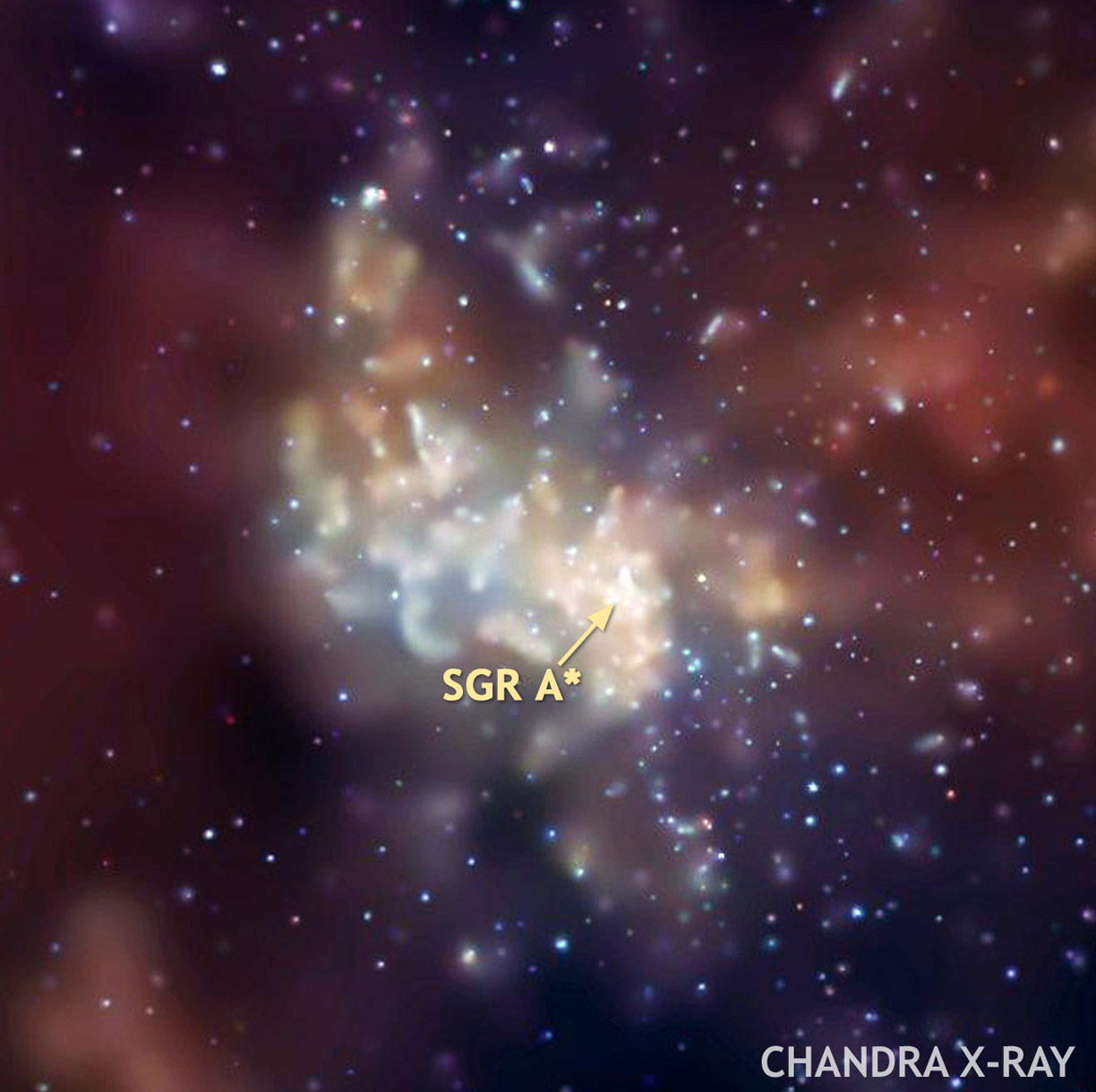
    A combination of infrared and X-ray observations indicates that a surplus of massive Stars has formed from a large disk of gas around Sagittarius A*. Credit: X-ray: NASA/CXC/MIT/F.K.Baganoff
    Three Recent Black Hole Events and How They Shape Our Universe
    A combination of infrared and X-ray observations indicates that a surplus of massive Stars has formed from a large disk of gas around Sagittarius A*. Credit: X-ray: NASA/CXC/MIT/F.K.Baganoff

    A new article from the Smithsonian Magazine takes a look at three recent black hole events and how they shape our universe.

    Near the middle of the Milky Way, there lives a supermassive black hole called Sagittarius A* (Sgr A) that any day now might eat a gas cloud (called G2) that’s floating towards it at 5 million miles per hour. Here on Earth, we have a front-row seat to this extremely rare galactic event that will have ripple effects throughout our galaxy.

    “As it veers toward the black hole, the doomed cloud will shred and stretch into a piece of string over 100 billion miles long,” explains Dan Evans, an astronomer at the Harvard-Smithsonian Center for Astrophysics in Boston. Evans spoke at Smithsonian’s Future Is Here conference today and gave attendees a tour of black hole events in our galaxy.

    First, what exactly is a black hole? It’s a spot in space where a huge amount of matter is extremely compressed and the gravitational forces around this spot of matter are so strong that they trap light, hence the name. “Black holes are extremely simple and extremely powerful,” he says. Astronomers characterize black holes based on three key factors: mass, spin, and electrical charge. On the other hand, a black hole feeding on matter emits the same amount of energy as one billion trillion hydrogen bombs per second. This is called accretion, and here’s a simulation of what that might look like:

    When a black hole eats matter, scientists expect to see fireworks: sparks of X-ray radiation. Sagittarius A* piques the interest of scientists because it can tell us about how black holes feed. “We know that the black hole used to eat a lot more in our Milky Way galaxy. But, that was hundreds, thousands, or even millions of years ago. We’ve never had the technology to actually see something get shredded by a black hole before,” says Evans. “It will be the first time in our history that we will actually see a black hole swallow.” But, there’s debate as to whether G2 is a dust cloud or in fact a star, which could survive the collision. Sadly, that would mean no fireworks display.

    Evans studies black holes through stunning images snapped by the Chandra X-Ray Observatory, which detects X-ray radiation waves to reveal black hole signatures across the universe.

    In another galaxy amusingly dubbed “Death Star,” Evans and his colleagues found that a jet of particles, electrons, and protons, shooting through a black hole in one galaxy was destroying another. “It’s an extraordinary event of galactic violence,” says Evans.

    Humans can’t see black holes with the naked eye, but thanks to a scientific effort to link radio telescopes across the planet to make a giant telescope, that might change. “With a telescope of that size they expect to produce the first image of a black hole’s silhouette,” says Evans. “For the first time, we could actually see a black hole with our own eyes.”

    Never miss a breakthrough: Join the SciTechDaily newsletter.
    Follow us on Google and Google News.

    Astronomy Astrophysics Black Hole Harvard-Smithsonian Center for Astrophysics
    Share. Facebook Twitter Pinterest LinkedIn Email Reddit

    Related Articles

    Black Hole Lights Up Years After Ripping Star to Shreds – “We’ve Never Seen Anything Like This Before”

    Scientists Have Spotted the Farthest Galaxy Ever – It May Be Home to the Oldest Stars in the Universe

    Astronomers Discover Four Enormous Bubbles Caused by Giant Black Holes

    Astronomers Spy Quartet of Enormous Cavities From Giant Black Holes

    Astronomers Use “X-Ray Magnifying Glass” To Enhance View of Distant Black Holes

    Astronomers Spot Unusual, Enormous Rings Around a Black Hole

    Telescopes Unite in Unprecedented Observations of Famous Black Hole Across the Entire Electromagnetic Spectrum

    Massive X-ray Jet – Extending for 160,000 Light-Years – Spied From Supermassive Black Hole in Early Universe

    Astronomers Detect a Supermassive Black Hole on the Move – Unusual Motion Thus Far Unexplained

    Leave A Reply Cancel Reply

    • Facebook
    • Twitter
    • Pinterest
    • YouTube

    Don't Miss a Discovery

    Subscribe for the Latest in Science & Tech!

    Trending News

    Could Low Vitamin D Be Making Your Pain Worse?

    Scientists Discover Once-Weekly Workout That Melts Belly Fat Surprisingly Effectively

    Scientists Just Tested a Thruster Powerful Enough for Human Missions to Mars

    Doctors Say Your Ice Pack Might Be Making Injuries Worse

    Scientists Discover 43-Foot Sea Reptile Twice the Size of a Great White Shark

    Bees and Birds Are Drinking Alcohol From Flowers

    Scientists Discover How Obesity May Trigger Alzheimer’s Disease

    Scientists Confirm Alcohol Causes Widespread Health Damage

    Follow SciTechDaily
    • Facebook
    • Twitter
    • YouTube
    • Pinterest
    • Newsletter
    • RSS
    SciTech News
    • Biology News
    • Chemistry News
    • Earth News
    • Health News
    • Physics News
    • Science News
    • Space News
    • Technology News
    Recent Posts
    • People Who Stop Ozempic Often Don’t Gain the Weight Back
    • Why More People in Their 30s Are Suddenly Getting Colon Cancer
    • Scientists Discover Sperm Seem To Bypass a Fundamental Law of Physics
    • The Secret Behind Indigenous Andeans’ “Digestive Superpower” May Be Potatoes
    • Archaeologists Discover Mysterious Artificial Island Older Than Stonehenge in Scotland
    Copyright © 1998 - 2026 SciTechDaily. All Rights Reserved.
    • Science News
    • About
    • Contact
    • Editorial Board
    • Privacy Policy
    • Terms of Use

    Type above and press Enter to search. Press Esc to cancel.