
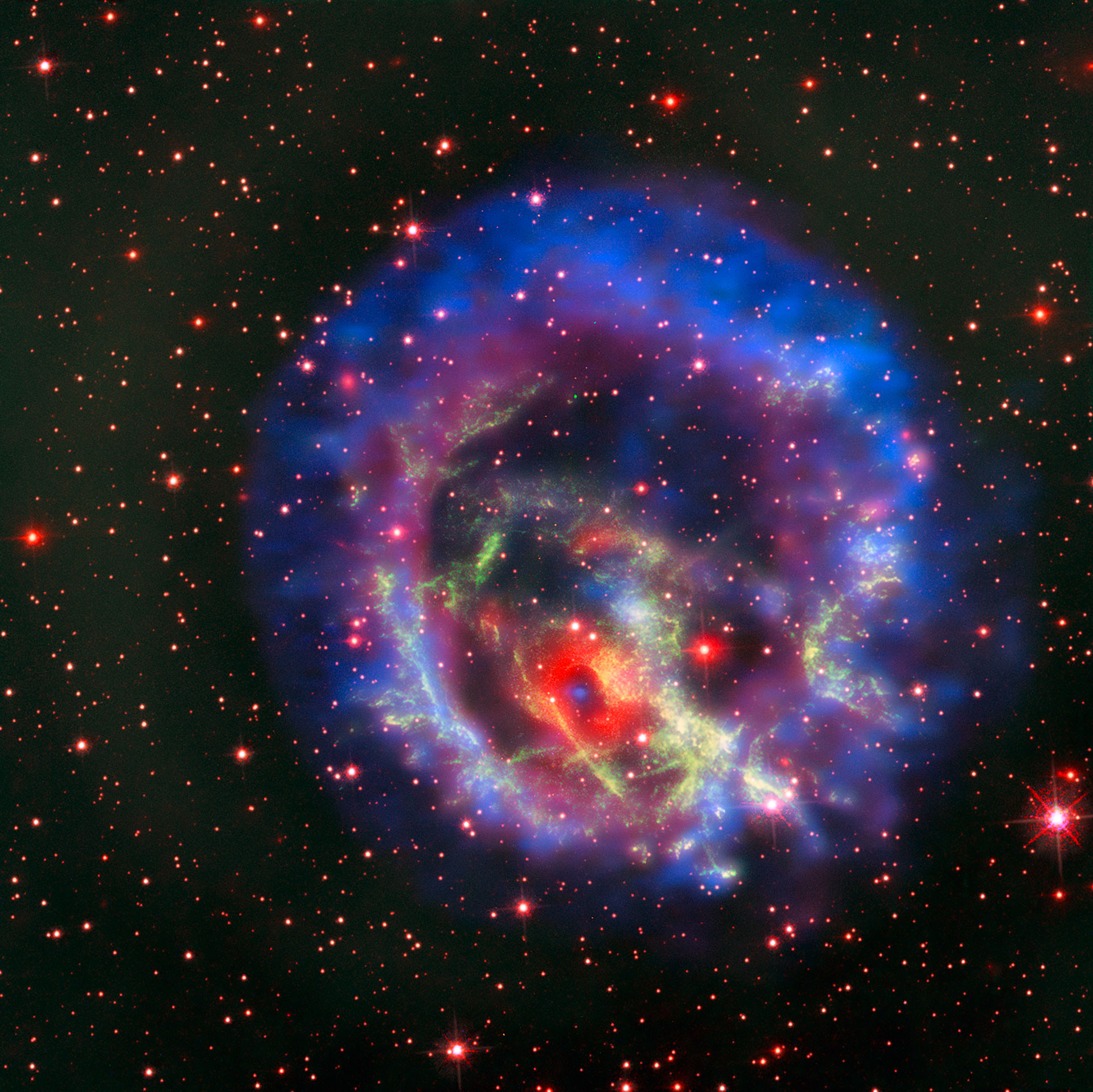
Using new data from the PREX experiment on neutron-rich lead atoms, researchers estimate that neutron stars could be significantly larger than previously though.
When a massive star dies, first there is a supernova explosion. Then, what’s left over becomes either a black hole or a neutron star.
That neutron star is the densest celestial body that astronomers can observe, with a mass about 1.4 times the size of the sun. However, there is still little known about these impressive objects. Now, a Florida State University researcher has published a piece[1] in Physical Review Letters arguing that new measurements related to the neutron skin of a lead nucleus may require scientists to rethink theories regarding the overall size of neutron stars.
In short, neutron stars may be larger than scientists previously predicted.
“The dimension of that skin, how it extends further, is something that correlates with the size of the neutron star,” said Jorge Piekarewicz, a Robert O. Lawton Professor of Physics.
Piekarewicz and his colleagues have calculated that a new measurement of the thickness of the neutron skin of lead implies a radius between 13.25 and 14.25 kilometers (8.23 and 8.85 miles) for an average neutron star. Based on earlier experiments on the neutron skin, other theories put the average size of neutron stars at about 10 to 12 kilometers (6.2 to 7.5 miles).
Measuring Atomic Skins to Size Cosmic Giants
Piekarewicz’s work complements a study[2], also published in Physical Review Letters, by physicists with the Lead Radius Experiment (PREX) at the Thomas Jefferson National Accelerator Facility. The PREX team conducted experiments that allowed them to measure the thickness of the neutron skin of a lead nucleus at 0.28 femtometers — or 0.28 trillionths of a millimeter.
An atomic nucleus consists of neutrons and protons. If neutrons outnumber the protons in the nucleus, the extra neutrons form a layer around the center of the nucleus. That layer of pure neutrons is called the skin.
It’s the thickness of that skin that has captivated both experimental and theoretical physicists because it may shed light on the overall size and structure of a neutron star. And though the experiment was done on lead, the physics is applicable to neutron stars — objects that are a quintillion (or trillion-million) times larger than the atomic nucleus.
Translating Nuclear Physics to Neutron Star Models
Piekarewicz used the results reported by the PREX team to calculate the new overall measurements of neutron stars.
“There is no experiment that we can carry out in the laboratory that can probe the structure of the neutron star,” Piekarewicz said. “A neutron star is such an exotic object that we have not been able to recreate it in the lab. So, anything that can be done in the lab to constrain or inform us about the properties of a neutron star is very helpful.”
The new results from the PREX team were larger than previous experiments, which of course affects the overall theory and calculations related to neutron stars. Piekarewicz said there is still more work to be done on the subject and new advances in technology are constantly adding to scientists’ understanding of space.
“It’s pushing the frontiers of knowledge,” he said. “We all want to know where we’ve come from, what the universe is made of and what’s the ultimate fate of the universe.”
References:
“Implications of PREX-2 on the Equation of State of Neutron-Rich Matter” by Brendan T. Reed, F. J. Fattoyev, C. J. Horowitz and J. Piekarewicz, 27 April 2021, Physical Review Letters.
DOI: 10.1103/PhysRevLett.126.172503
“Accurate Determination of the Neutron Skin Thickness of 208Pb through Parity-Violation in Electron Scattering” by D. Adhikari et al. (PREX Collaboration), 27 April 2021, Physical Review Letters.
DOI: 10.1103/PhysRevLett.126.172502
Piekarewicz’s co-authors are Brendan Reed and Charles Horowitz from Indiana University and Farrukh Fattoyev from Manhattan College.
This work is funded by the Department of Energy.
Never miss a breakthrough: Join the SciTechDaily newsletter.
Follow us on Google and Google News.
1 Comment
Neuton Stars are possible to stay at different energy ĺevels corresponding to difference in the ŕadii,being higher the energy level lower is the value of radius for same mass.Namely,take a standard calcùlation in which neutron star with 1.4 solar mass exist,,in three energy levels or quantized states of radii of 12Km,13.25Km and 14.25Km represent respectively for values of reenergy contained in quantized energy levels present in lowering order.But,radius having vaĺues more than these for the radius of same standard 1.4 solar mass is possible though has no fixed vaĺue of energy or energy level and fluctuates among certain limits.