
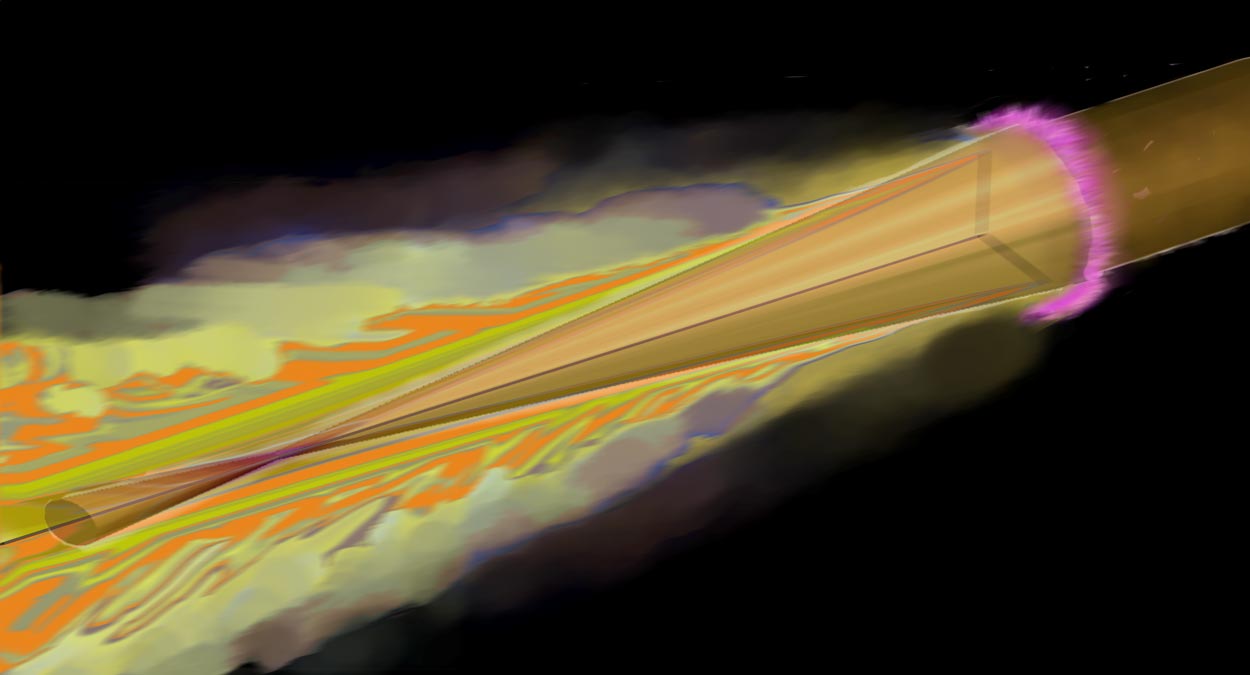
Using a novel laser method, scientists mimicked the extreme environments of stars and planets, enhancing our understanding of astrophysical phenomena and supporting nuclear fusion research.
Extreme conditions prevail inside stars and planets. The pressure reaches millions of bars, and it can be several million degrees hot. Sophisticated methods make it possible to create such states of matter in the laboratory – albeit only for the blink of an eye and in a tiny volume. So far, this has required the world’s most powerful lasers, such as the National Ignition Facility (NIF) in California. But there are only a few of these light giants, and the opportunities for experiments are correspondingly rare.
A research team led by the Helmholtz-Zentrum Dresden-Rossendorf (HZDR), together with colleagues from the European XFEL, has now succeeded in creating and observing extreme conditions with a much smaller laser. At the heart of the new technology is a copper wire, finer than a human hair, as the group reports in the journal Nature Communications.
Exploring Extreme Conditions in the Lab
So far, experts have been firing extremely high-energy laser flashes at a material sample, usually a thin foil. This causes the material on the surface to heat up suddenly. This creates a shock wave that races through the sample. It compresses the material and heats it up. For a few nanoseconds, conditions arise like those in the interior of a planet or in the shell of a star. The tiny time window is sufficient to study the phenomenon using special measuring techniques, such as the ultra-strong X-ray flashes of the European XFEL in Schenefeld near Hamburg, Germany.
Advancements in X-ray Measurement Techniques
Here, at Europe’s most powerful X-ray laser, the HZDR leads an international user consortium called HIBEF – Helmholtz International Beamline for Extreme Fields. Among other things, this consortium operates a laser at the High Energy Density (HED-HIBEF) experimental station, which generates ultra-short pulses that do not have particularly high energy – only about one joule. However, at 30 femtoseconds, they are so short that they achieve an output of 100 terawatts. The research team used this laser at HED-HIBEF to fire at a thin copper wire, just 25 micrometers thick
“Then we were able to use the strong X-ray flashes from the European XFEL to observe what was happening inside the wire,” explains Dr. Alejandro Laso Garcia, lead author of the paper. “This combination of short-pulse laser and X-ray laser is unique in the world. It was only thanks to the high quality and sensitivity of the X-ray beam that we were able to observe an unexpected effect.”
Shock Waves and High-Density States
In several series of measurements, the scientists systematically varied the time interval between the impact of the laser flash and the X-rays shining through. This made it possible to record a detailed “X-ray film” of the event: “First, the laser pulse interacts with the wire and generates a local shock wave that passes through the wire like a detonation and ultimately destroys it,” explains HIBEF department head Dr. Toma Toncian. “But before that, some of the high-energy electrons created when the laser hits, race along the surface of the wire.” These fast electrons heat up the surface of the wire quickly and generate further shock waves. These then run in turn from all sides to the center of the wire. For a brief moment, all the shock waves collide there and generate extremely high pressures and temperatures.
The measurements showed that the density of the copper in the middle of the wire was briefly eight to nine times higher than in “normal”, cold copper. “Our computer simulations suggest that we have reached a pressure of 800 megabars,” says Prof. Thomas Cowan, director of the HZDR Institute of Radiation Physics and initiator of the HIBEF consortium. “That corresponds to 800 million times atmospheric pressure and 200 times the pressure that prevails inside the earth.” The temperature reached was also enormous by terrestrial standards: 100,000 degrees Celsius (180,000 degrees Fahrenheit).
Future Applications in Nuclear Fusion and Astrophysics
These are the conditions that are close to those in the corona of a white dwarf star. “Our method could also be used to achieve conditions like those in the interior of huge gas planets,” emphasizes Laso Garcia. This includes not only well-known giants like Jupiter, but also a large number of distant exoplanets that have been discovered over the past few years. The research team has now also set its sights on wires made of other materials, such as iron and plastic. “Plastic is mainly made of hydrogen and carbon,” says Toncian. “And both elements are found in stars and their corona.”
The new measurement method should not only be useful for astrophysics, but also for another field of research. “Our experiment shows in an impressive way how we can generate very high densities and temperatures in a wide variety of materials,” says Ulf Zastrau, who heads the HED group at the European XFEL. “This will take fusion research an important step further.” Several research teams and start-ups around the world are currently working on a fusion power plant based on high-performance lasers.
The principle: Strong laser flashes hit a fuel capsule made of frozen hydrogen from all sides and ignite it, with more energy coming out than was put in. “With our method, we could observe in detail what happens inside the capsule when it is hit by the laser pulses,” says Cowan, describing future experiments. “We expect that this can have a huge impact on basic research in this area.”
Reference: “Cylindrical compression of thin wires by irradiation with a Joule-class short-pulse laser” by Alejandro Laso Garcia, Long Yang, Victorien Bouffetier, Karen Appel, Carsten Baehtz, Johannes Hagemann, Hauke Höppner, Oliver Humphries, Thomas Kluge, Mikhail Mishchenko, Motoaki Nakatsutsumi, Alexander Pelka, Thomas R. Preston, Lisa Randolph, Ulf Zastrau, Thomas E. Cowan, Lingen Huang and Toma Toncian, 12 September 2024, Nature Communications.
DOI: 10.1038/s41467-024-52232-6
Never miss a breakthrough: Join the SciTechDaily newsletter.
Follow us on Google and Google News.
2 Comments
With the method, they could observe in detail what happens inside the capsule when it is hit by the laser pulses, that can have a huge impact on basic research in this area.
VERY GOOD!
Scientific research guided by correct theories can help humanity avoid detours, failures, and pomposity. Please witness the exemplary collaboration between theoretical physicists and experimentalists:
(1) https://scitechdaily.com/microscope-spacecrafts-most-precise-test-of-key-component-of-the-theory-of-general-relativity/#comment-854286.
(2) https://scitechdaily.com/microscope-spacecrafts-most-precise-test-of-key-component-of-the-theory-of-general-relativity/#comment-858364.
Very interesting… But stupid!