
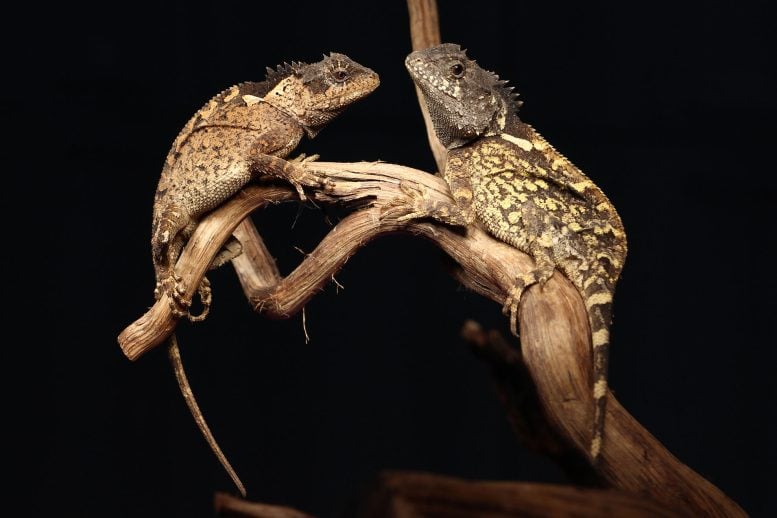
High in the forests of western Thailand, scientists have discovered a tiny new lizard whose striking appearance and unique biology earned it a name worthy of a fantasy dragon.
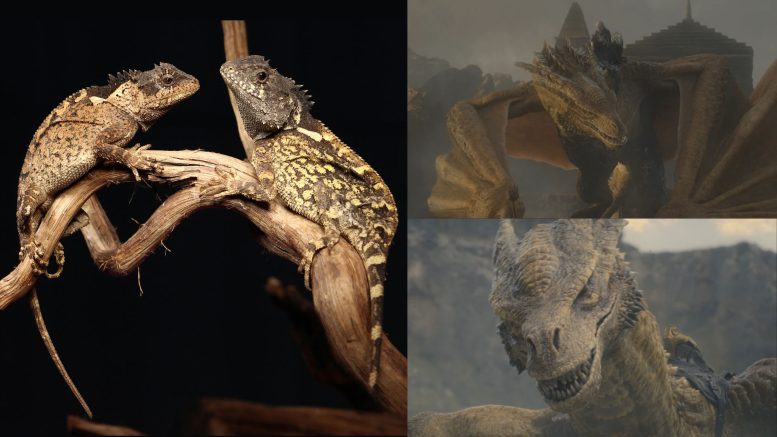
A newly discovered mountain horned dragon, Acanthosaura syrax, was named after Syrax, the yellow dragon ridden by Queen Rhaenyra Targaryen in House of the Dragon. The name reflects several traits the real lizard shares with its fictional namesake, including yellowish green coloring, relatively small size, and high egg production.
That reproductive trait was especially unique. Four of the five females examined were carrying eggs, with clutch sizes ranging from six to 16. The researchers proposed “Syrax mountain horned dragon” as the species’ English common name, along with a Thai name with the same meaning.
A Tiny Dragon With a Fantasy Namesake
Mountain horned dragons belong to the agamid lizard family, the same broad family that includes animals such as bearded dragons. Members of Acanthosaura are found across parts of Southeast Asia and are recognizable by the pointed scales and crests extending along the head, neck, and back. The discovery of A. syrax raises the number of recognized species in the genus to 23.
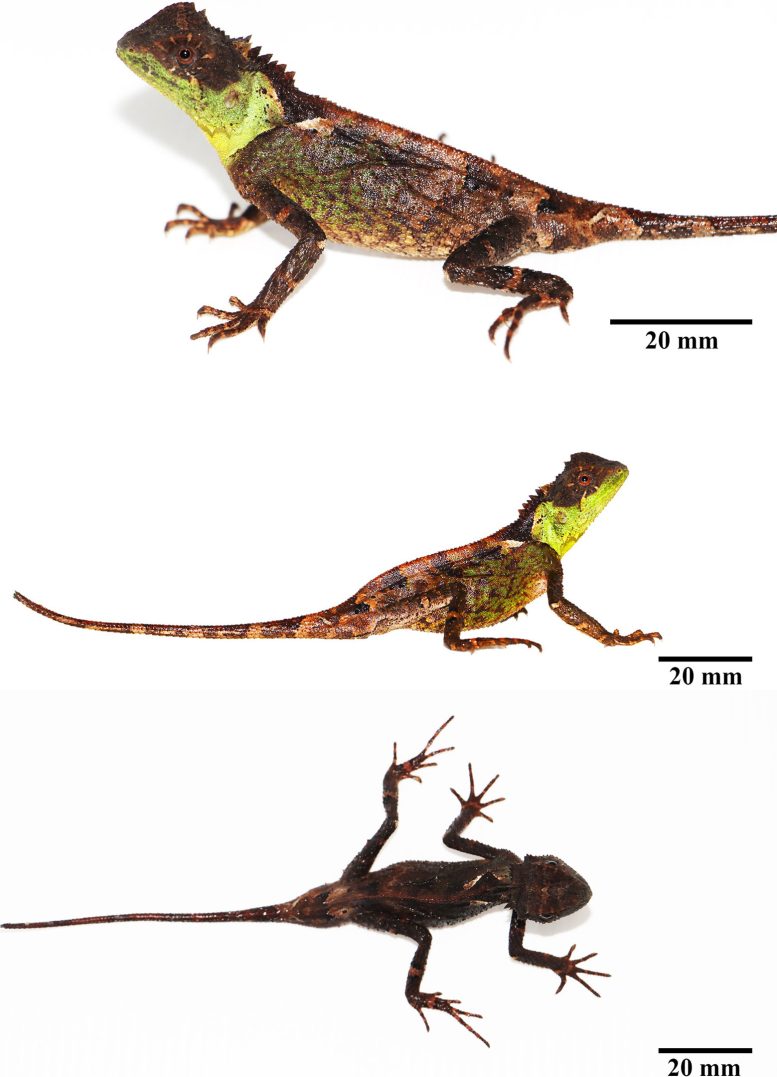
The newly described species takes the miniature theme unusually far. The largest male examined measured only about 69.6 millimeters (2.7 inches) from snout to vent, while the largest female reached 101.2 millimeters (4.0 inches). Females were noticeably larger than males.
Its “horns” are similarly understated. A. syrax has the smallest neck and back crest scales yet documented in the entire genus. Researchers also identified a distinctive dark collar across the neck and found that the species lacks the black patch around the eye seen in several relatives.
Those differences were not judged from appearance alone. The team recorded dozens of anatomical characteristics from eight specimens and compared them with other mountain horned dragons. They also analyzed two mitochondrial genes, ND2 and COI. Both lines of evidence placed the animals in their own evolutionary lineage, distinct from the closely related A. lepidogaster and all other species included in the analysis.
What Makes Acanthosaura syrax Unique
So far, the Syrax mountain horned dragon is known only from Mae Wong National Park in western Thailand, in the Tak-Kamphaeng Phet region. Researchers encountered it mainly in evergreen forest above 1,300 meters (4,265 feet) and did not find it below 1,000 meters (3,281 feet).
That narrow elevational range may help explain how the species remained unrecognized. Mountain environments can divide populations into isolated pockets, effectively creating ecological islands separated by warmer or otherwise unsuitable habitat.
Field observations also provide a glimpse of how the little dragons spend their days. Individuals were seen basking on rocks, fallen logs, shrubs, and even concrete structures during the morning and around midday. Some searched for earthworms near dawn. Later in the day, they sheltered beneath logs and rocks or inside tree cavities. Researchers encountered them most often from the end of the dry season into the early monsoon, roughly from April through mid-June.
About 50 kilometers (31 miles) farther north, the team found the related A. lepidogaster occupying lower, warmer habitats, reinforcing the idea that A. syrax may be closely tied to the cooler conditions of the mountains.
Life in Thailand’s High Mountain Forests
The species’ limited known distribution is also a concern. If A. syrax truly depends on a narrow band of cool, high-elevation forest, habitat loss or further fragmentation could leave its already separated populations increasingly isolated.
The researchers argue that protecting Mae Wong’s mountain forests would benefit far more than one newly named lizard. The area also supports rare wildlife, including the Asian forest tortoise, Oldham’s leaf turtle, and the Indochinese tiger.
They suggest that A. syrax could become a flagship species for these forests, using its distinctive appearance and memorable name to draw attention to a habitat that supports a much broader community of wildlife.
Why the Syrax Mountain Horned Dragon Matters
Thailand’s isolated mountain forests may still contain species that have escaped scientific recognition, particularly animals with small ranges and specialized habitat requirements. The researchers say surveys of neighboring mountain systems could help reveal how far A. syrax actually extends and whether additional hidden reptile diversity remains to be found.
Reference: “Acanthosaura syrax sp. nov., a new species of mountain horned dragon from high-elevation habitats of western Thailand (Squamata, Agamidae)” by Poramad Trivalairat, Krittiya Trivalairat, Nawee Moungkhaek, Simon Caponov and Benchapol Lorsunyaluck, 31 July 2026, ZooKeys.
DOI: 10.3897/zookeys.1287.186636
Never miss a breakthrough: Join the SciTechDaily newsletter.
Follow us on Google and Google News.