
Close Menu
    Facebook X (Twitter) Instagram
    SciTechDaily
    • Biology
    • Chemistry
    • Earth
    • Health
    • Physics
    • Science
    • Space
    • Technology
    Facebook X (Twitter) Pinterest YouTube RSS
    SciTechDaily
    Home»Space»Titanic Asteroid 20x Larger Than Dinosaur-Killer Reshaped Solar System’s Largest Moon
    Space

    Titanic Asteroid 20x Larger Than Dinosaur-Killer Reshaped Solar System’s Largest Moon

    By Kobe UniversitySeptember 3, 2024No Comments5 Mins Read
    Facebook Twitter Pinterest Telegram LinkedIn WhatsApp Email Reddit
    Share
    Facebook Twitter LinkedIn Pinterest Telegram Email Reddit
    Ganymede Asteroid Impact
    Kobe University Naoyuki Hirata was the first to realize that the location of an asteroid impact on Jupiter’s moon Ganymede is almost precisely on the meridian farthest away from Jupiter. This implied that Ganymede had undergone a reorientation of its rotational axis and allowed Hirata to calculate what kind of impact could have caused this to happen. Credit: Naoyuki Hirata

    A colossal asteroid impact on the Jupiter moon Ganymede not only reshaped its physical landscape but may have also altered its rotation, drawing parallels with cataclysmic events on Earth and Pluto.

    Approximately 4 billion years ago, an asteroid hit Ganymede. Now, a Kobe University researcher has discovered that the Solar system’s biggest moon’s axis shifted as a result of the impact. This confirmed that the asteroid was around 20 times larger than the one that ended the age of the dinosaurs on Earth, and caused one of the biggest impacts with clear traces in the Solar System.

    Ganymede: An Unusual Moon

    Ganymede is the largest moon in the Solar System, bigger even than the planet Mercury, and is also interesting for the liquid water oceans beneath its icy surface. Like the Earth’s moon, it is tidally locked, meaning that it always shows the same side to the planet it is orbiting and thus also has a far side. On large parts of its surface, the moon is covered by furrows that form concentric circles around one specific spot, which led researchers in the 1980s to conclude that they are the results of a major impact event.

    “The Jupiter moons Io, Europa, Ganymede, and Callisto all have interesting individual characteristics, but the one that caught my attention was these furrows on Ganymede,” says the Kobe University planetologist Naoyuki Hirata. He continues, “We know that this feature was created by an asteroid impact about 4 billion years ago, but we were unsure how big this impact was and what effect it had on the moon.”
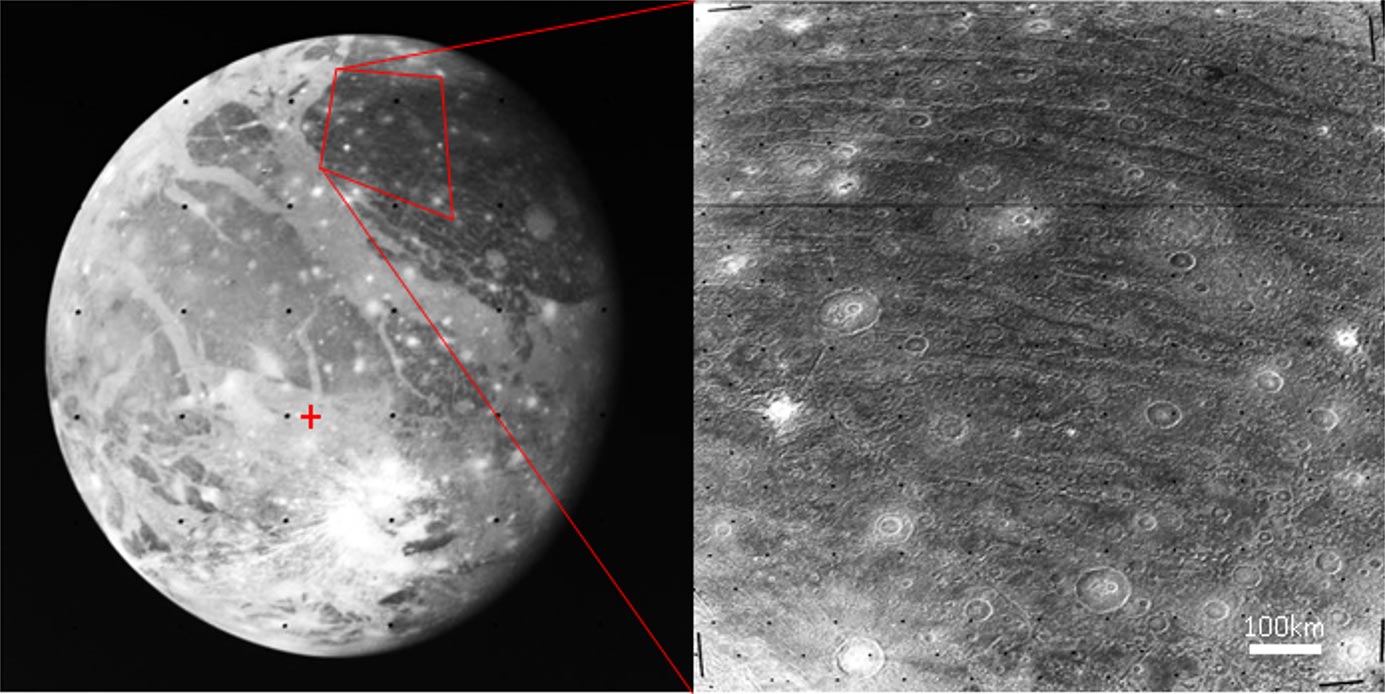
    Ganymede Major Impact Event
    On large parts of its surface, the Jupiter moon Ganymede is covered by furrows (right) that form concentric circles around one specific spot (left, red cross), which led researchers in the 1980s to conclude that they are the results of a major impact event. Credit: Naoyuki Hirata

    The Enigmatic Furrows of Ganymede

    Data from the remote object is scarce making research very difficult, and so Hirata was the first to realize that the purported location of the impact is almost precisely on the meridian farthest away from Jupiter. Drawing from similarities with an impact event on Pluto that caused the dwarf planet’s rotational axis to shift and that we learned about through the New Horizons space probe, this implied that Ganymede, too, had undergone such a reorientation.

    Because Hirata is a specialist in simulating impact events on moons and asteroids, this realization allowed him to calculate what kind of impact could have caused this reorientation to happen.
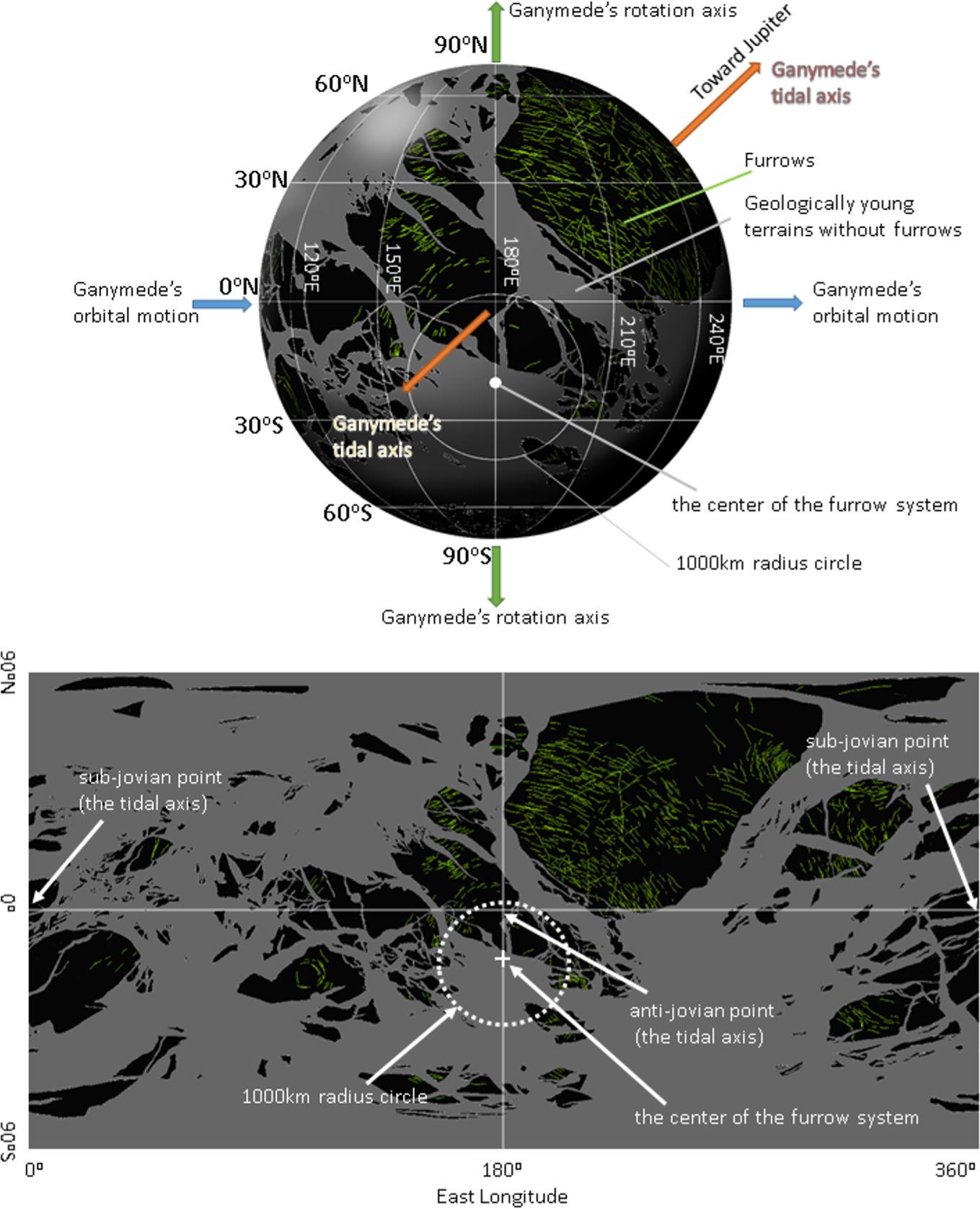
    Ganymede Topography Furrow System
    Distribution of furrows and the location of the center of the furrow system shown in the hemisphere that always faces away from Jupiter (top) and the cylindrical projection map of Ganymede (bottom). The gray regions represent geologically young terrain without furrows. Furrows (green lines) exist only on geologically old terrains (black regions). Credit: Naoyuki Hirata

    Unraveling Ancient Impacts

    In the journal Scientific Reports, the Kobe University researcher now published that the asteroid probably had a diameter of around 300 kilometers, about 20 times as large as the one that hit the Earth 65 million years ago and ended the age of the dinosaurs, and created a transient crater between 1,400 and 1,600 kilometers in diameter. (Transient craters, widely used in lab and computational simulations, are the cavities produced directly after the crater excavation and before material settles in and around the crater.)

    According to his simulations, only an impact of this size would make it likely that the change in the distribution of mass could cause the moon’s rotational axis to shift into its current position. This result holds true irrespective of where on the surface the impact occurred.

    Exploring Ganymede’s Mysteries Further

    “I want to understand the origin and evolution of Ganymede and other Jupiter moons. The giant impact must have had a significant impact on the early evolution of Ganymede, but the thermal and structural effects of the impact on the interior of Ganymede have not yet been investigated at all. I believe that further research applying the internal evolution of ice moons could be carried out next,” explains Hirata.

    Interesting for its subsurface oceans, Ganymede is the final destination of ESA’s JUICE space probe. If everything goes well, the spacecraft will enter orbit around the moon in 2034 and will make observations for six months, sending back a wealth of data that will help answer Hirata’s questions.

    Reference: “Giant impact on early Ganymede and its subsequent reorientation” by Naoyuki Hirata, 3 September 2024, Scientific Reports.
    DOI: 10.1038/s41598-024-69914-2

    This research was funded by the Japan Society for the Promotion of Science (grants 20K14538 and 20H04614) and the Hyogo Science and Technology Association.

    Never miss a breakthrough: Join the SciTechDaily newsletter.
    Follow us on Google and Google News.

    Asteroid Ganymede Jupiter Kobe University Popular
    Share. Facebook Twitter Pinterest LinkedIn Email Reddit

    Related Articles

    NASA’s Juno Celebrates 10 Years With New Infrared View of Mammoth Jovian Moon Ganymede

    Hubble Finds First Evidence of Water Vapor in the Atmosphere of Jupiter’s Moon Ganymede

    “Beautiful!” – Ride With NASA’s Juno Spacecraft As It Flies Past the Solar System’s Biggest Moon and Jupiter

    See the Dramatic First Images NASA’s Juno Spacecraft Captured As It Sailed by the Icy Orb, Ganymede

    Close Encounters of the Jovian Kind: NASA’s Juno to Get a Close Look at Jupiter’s Moon Ganymede

    Jupiter’s Moons Could be Warming Each Other through Tidal Resonance

    Violent Impact May Have Caused Huge Ring-Like Structure on the Surface of Jupiter’s Moon Ganymede

    New Physical Model Explains the Origin of Water in Our Solar System

    NASA’s WISE Uncovers New Clues on Jovian Trojans

    Leave A Reply Cancel Reply

    • Facebook
    • Twitter
    • Pinterest
    • YouTube

    Don't Miss a Discovery

    Subscribe for the Latest in Science & Tech!

    Trending News

    Scientists Uncover Potential Brain Risks of Popular Fish Oil Supplements

    Scientists Discover a Surprising Way To Make Bread Healthier and More Nutritious

    After 60 Years, Scientists Uncover Unexpected Brain Effects of Popular Diabetes Drug Metformin

    New Research Uncovers Hidden Side Effects of Popular Weight-Loss Drugs

    Scientists Rethink Extreme Warming After Surprising Ocean Discovery

    Landmark Study Links Never Marrying to Significantly Higher Cancer Risk

    Researchers Discover Unknown Beetle Species Just Steps From Their Lab

    Largest-Ever Study Finds Medicinal Cannabis Ineffective for Anxiety, Depression, PTSD

    Follow SciTechDaily
    • Facebook
    • Twitter
    • YouTube
    • Pinterest
    • Newsletter
    • RSS
    SciTech News
    • Biology News
    • Chemistry News
    • Earth News
    • Health News
    • Physics News
    • Science News
    • Space News
    • Technology News
    Recent Posts
    • Students Build Dark Matter Detector and Set New Experimental Limits
    • Scientists Discover Caffeine Can Repair Key Memory Circuits After Sleep Loss
    • Strange 65-Foot Dinosaur Discovered in Argentina
    • Researchers Uncover Source of Strange Deformation in Earth’s Largest Continental Rift
    • Scientists Solve Mystery of Where the Colorado River Vanished Millions of Years Ago
    Copyright © 1998 - 2026 SciTechDaily. All Rights Reserved.
    • Science News
    • About
    • Contact
    • Editorial Board
    • Privacy Policy
    • Terms of Use

    Type above and press Enter to search. Press Esc to cancel.