
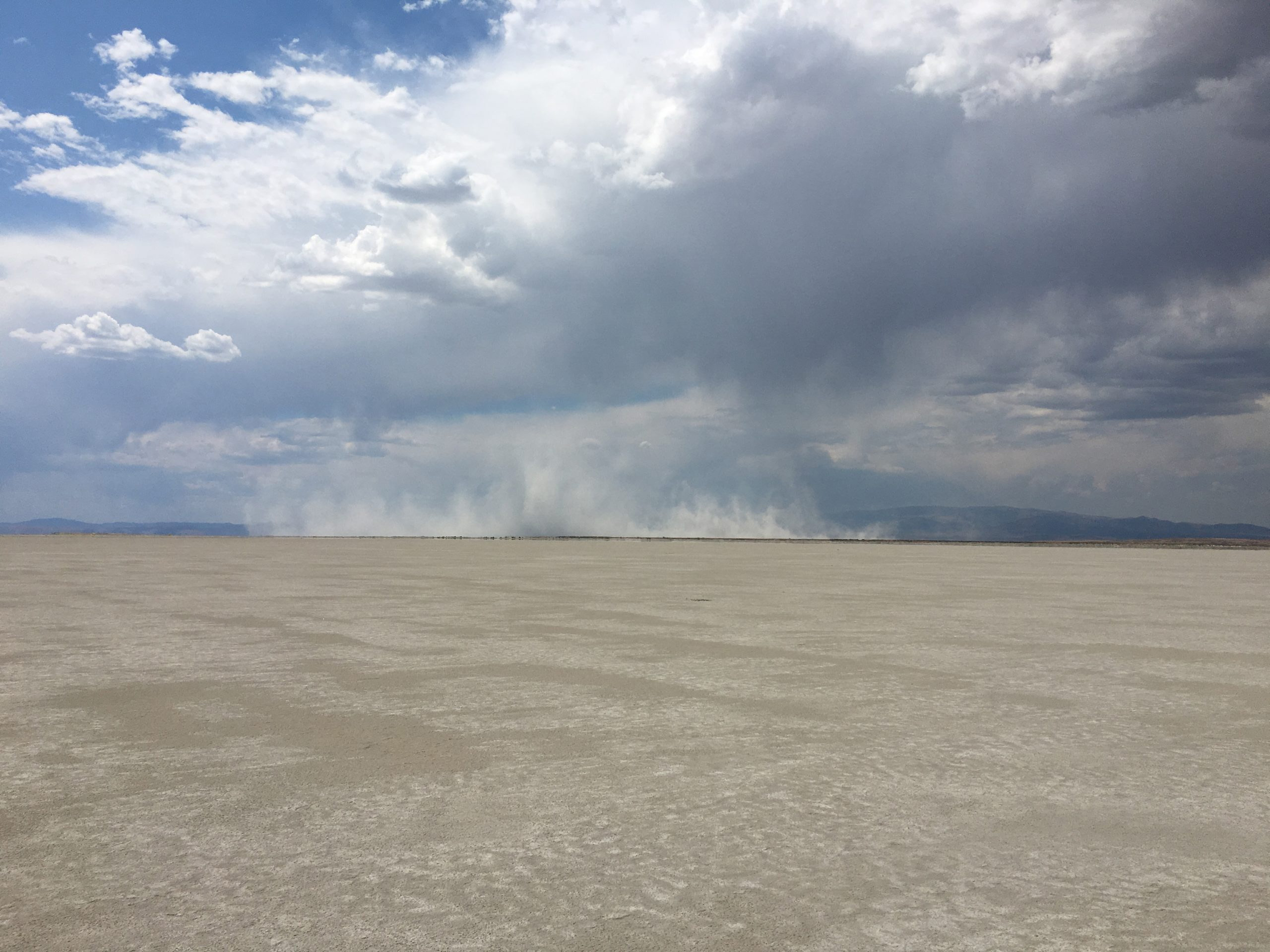
Scientists in Utah have discovered that sediments from the increasingly exposed playa of the lake possess higher ‘oxidative potential,’ suggesting a heightened risk to human health.
As Utah’s Great Salt Lake continues to shrink, revealing more of its dry lakebed, worries are mounting about the dust released from the exposed playa. However, scientists currently lack sufficient data to fully identify the pollutants present in these airborne particles.
Researchers from the University of Utah are attempting to get a handle on this question and the latest findings are concerning.
Sediments in the lake’s exposed playa are potentially more harmful than other major dust sources affecting the Wasatch Front’s air quality, according to a study published online recently in the journal Atmospheric Environment.
These sediments, when aerosolized, show higher levels of reactivity and bioavailability when compared to sediments collected from other spots upwind of Utah’s major population center along the Wasatch Front. Chemical analysis also indicated the presence of numerous metals, and levels of arsenic and lithium that exceed the U.S. Environmental Protection Agency’s soil residential regional screening levels.
Concerns Over Airborne Particulates
“You’re talking about a very large dust source located next to a very large population, and you’ve got elevated levels of manganese, iron, copper, and lead. Lead is a concern for developmental reasons,” said senior author Kerry Kelly, a professor of chemical engineering. “Manganese, iron, and copper, these are transition metals and are known to be very irritating to your lungs. Once you get irritation, that can lead to this whole inflammatory response. And that’s part of the problem with particulate matter and it’s adverse health effects like asthma.”
The Great Salt Lake is a terminal body receiving runoff from a vast drainage basin spanning northern Utah and parts of three other states. Metals from natural sources and human disturbances are pushed into the lake from inflows or atmospheric deposition, and these materials accumulate in the lakebed. The potential for harmful dust pollution has become a priority for Utah state officials, who issued a list of priorities aimed at tackling the problem.
Another recent study led by sociology professor Sara Grineski found dust from the lakebed disproportionately affects disadvantaged neighborhoods in Salt Lake County.
Studies on Lakebed Sediments
In a separate forthcoming study led by U biologist Michael Werner’s lab, another team of researchers characterized levels of toxic metals deposited in submerged lakebed sediments sampled during the lake’s record low-water year of 2021, noting how these levels have changed since the years of Utah’s mining era. Concentrations of some metals, such as lead and zinc, appear to have decreased, likely a reflection of the decline in the region’s mining activity, while mercury levels surprisingly have increased.
Researchers cautioned that they can’t conclude whether these pollutants are actually being blown into populated areas during wind events because the monitoring equipment to capture that dust has yet to be adequately deployed downwind of the lake. Most high-wind events arrive from the southwest, blowing for several hours off the lake north into Weber or Box Elder County, before shifting to the south as the front passes through.
To conduct the published study, Kerry Kelly’s lab, which specializes in air quality, teamed up with researchers in the U’s College of Science. They examined previously collected sediment samples from the Great Salt Lake, comparing them with sediments from other dust sources in the Great Basin, namely Sevier Lake, Fish Springs Lake, and West Desert in western Utah and Tule Lake in northeastern California. These places are known to contribute to dust pollution reaching Salt Lake City.
In recent years, co-author Kevin Perry, a professor of atmospheric sciences, has systematically gathered exposed lakebed sediments, logging hundreds of miles on a bike. His prior research has identified “hotspots” on the playa that appear to be enriched with potentially toxic elements.
Only 9% of the exposed lakebed, or 175 square kilometers (about 43,000 acres), is emitting dust from areas where lakebed crusts are disturbed, according to Perry. The rest of the playa is covered in a natural hardened layer that keeps the sediments in place. Perry’s ongoing research examines what happens to the playa crusts over time. He said his initial findings indicate the broken layers reset fairly easily, suggesting the playa’s threat to air quality may not be as dire as previously thought.
Oxidative Potential and Health Risks
The latest study is the first to analyze the dust’s “oxidative potential,” a measure of its ability to react with oxygen.
“When you breathe in something that’s really reactive, it’s going to interact with the cells inside your lungs and it’s going to cause damage,” Kelly said.
In the lab, the team aerosolized the sediment samples to isolate the particles that are small enough to inhale and lodge in lung tissue, those smaller than 10 micrometers or PM10.
These particles were captured on filters and further analyzed using a method called inductively coupled mass plasma mass spectrometry to determine their elemental makeup and other tests to determine their oxidative potential (OP) and bioaccessibility.
“We devised a way to dissolve the metals using increasingly caustic acids to figure out at what level these metals leaching from the particles,” Perry said. “It turns out that the dust from Great Salt Lake has more leachable metals that are bioavailable than we would wish.”
Meanwhile, high OP was detected in dust associated with certain metals, including copper, manganese, iron, and aluminum.
Reference: “Assessing the oxidative potential of dust from great salt Lake” by Reuben Attah, Kamaljeet Kaur, Kevin D. Perry, Diego P. Fernandez and Kerry E. Kelly, 8 August 2024, Atmospheric Environment.
DOI: 10.1016/j.atmosenv.2024.120728
The study was funded by the U.S. National Science Foundation, the Wilkes Center for Climate Science & Policy, and the University of Utah.
Never miss a breakthrough: Join the SciTechDaily newsletter.
Follow us on Google and Google News.
2 Comments
Utah residents face change and rather than prevent the inevitable, be prepared to live without the lake. Screwball ideas are already afloat to bring water to replace what is being lost, worsening the stewardship of water. Greedy folks already squander this precious resource at the expense of fellow man.
I am not so concerned that there are contaminated blowing in the air as I am about the hype about them. No one knows the levels (ppm) but many are sounding alarms about it anyway. No matter where you go on the earth there are some level of everything. For example the concrete in our sidewalks and houses has a certain level of radioactivity but no one is panicking about it because it is so low that it is not harmful. Until levels of contaminate in the lake dust are published, I choose to believe that concern is apropoganda pushed by environmentalists.