
Close Menu
    Facebook X (Twitter) Instagram
    SciTechDaily
    • Biology
    • Chemistry
    • Earth
    • Health
    • Physics
    • Science
    • Space
    • Technology
    Facebook X (Twitter) Pinterest YouTube RSS
    SciTechDaily
    Home»Earth»Turkey’s Cotton Castle – World’s Largest Deposit of Travertine
    Earth

    Turkey’s Cotton Castle – World’s Largest Deposit of Travertine

    By Sara E. Pratt, NASA Earth ObservatoryNovember 25, 2021No Comments3 Mins Read
    Facebook Twitter Pinterest Telegram LinkedIn WhatsApp Email Reddit
    Share
    Facebook Twitter LinkedIn Pinterest Telegram Email Reddit
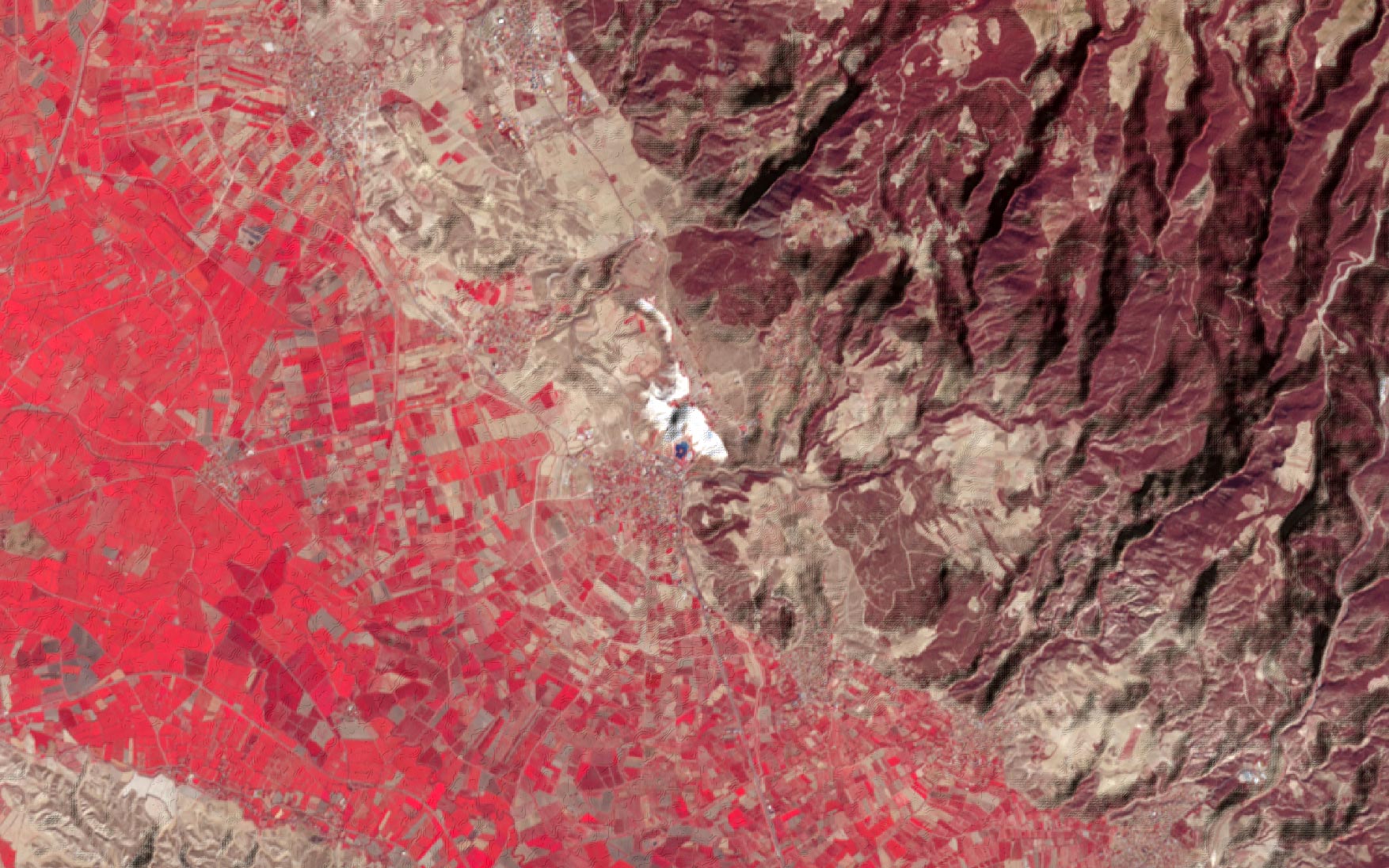
    Pamukkale Turkey 2021 Annotated
    Pamukkale Turkey, October 9, 2021

    The hot springs at Pamukkale, Turkey, have produced the world’s largest deposit of travertine.

    The hot springs and thermal pools at Pamukkale, Turkey, have been a spiritual, cultural, and recreational destination for thousands of years. In the second century B.C., the ancient Greco-Roman city of Hierapolis was built atop the terraces of travertine, a type of rock that forms when calcium carbonate precipitates from hot water. At the nearby Cleopatra’s Pools, visitors can swim among broken columns that collapsed during the Laodikeia earthquake in the early seventh century C.E. Hierapolis-Pamukkale was designated a UNESCO World Heritage site in 1988.

    The world’s largest deposit of such rocks lies in western Anatolia, Turkey, where Earth’s crust is pulling apart. This extension of the crust creates many faults and fissures, along with volcanic, seismic, and geothermal activity.

    One of the largest sections is the 6-kilometer-long (3.7-mile-long) Pamukkale plateau, on the northern margin of the Denizli Basin, where the rock averages 50 meters (164 feet) thick. The site features a spectacular array of white calcite terraces and rimstone pools cascading over 200-meter-high (660-foot-high) cliffs on the uplifted side of the Pamukkale fault. Named for the bright white rocks, Pamukkale translates as “cotton castle” or “cotton palace.”

    The Pamukkale deposits, seen in white in the above image, cover 12 square kilometers (5 square miles). The image was acquired on October 9, 2021, by the Advanced Spaceborne Thermal Emission and Reflection Radiometer (ASTER) on NASA’s Terra satellite. The image was collected in the visible and near infrared (bands 3,2,1) in which vegetation appears red.

    How Hot Water Forms Travertine

    Water temperatures in these pools and springs range from 19 to 57 degrees Celsius (65 to 135 degrees Fahrenheit), although some can reach temperatures of 100 degrees Celsius (212 degrees Fahrenheit) or higher. The travertine forms when rainwater seeps down into the network of faults and fissures and is heated by magma deep underground. The hot water leaches calcium, magnesium and other minerals from the limestone bedrock. The saturated solution then percolates back to the surface, reemerging from springs at the surface where the minerals precipitate.

    Travertine deposition has been occurring in the area for at least 600,000 years, since the Pleistocene epoch. However, much of the deposition at Pamukkale has occurred in the past 50,000 years. Research suggests the current hydrothermal and depositional system was established after the seventh-century Laodikeia earthquake.

    The temperature regime has changed over time as well. Calcite travertine precipitates from higher temperature springs, while more porous tufa deposits form at lower temperatures. Age dating and geochemical analyses of deposits indicate water temperatures have declined since the Pleistocene epoch.

    NASA Earth Observatory image by Lauren Dauphin, using data from NASA/METI/AIST/Japan Space Systems, and the U.S./Japan ASTER Science Team.

    Never miss a breakthrough: Join the SciTechDaily newsletter.
    Follow us on Google and Google News.

    Geography NASA NASA Earth Observatory
    Share. Facebook Twitter Pinterest LinkedIn Email Reddit

    Related Articles

    NASA Picturing Earth: Astronaut Photography In Focus [Video]

    Coloring the Great Salt Lake – Astronaut Takes Beautiful Photograph From Space Station

    Sea Ice in Denmark Strait – Drifted More Than 1,000 Km (600 Miles) From the Arctic Ocean

    NASA Scientists Map Beirut Blast Damage – Devastating Explosion Rocked Port Area

    NASA Advanced Rapid Imaging Satellite Maps Blast Damage: Beirut Explosion Aftermath

    NASA/NOAA Satellites Observe Surprisingly Rapid Increase in Scale and Intensity of Fires in Siberia

    Mars Terraforming: Cultivating Ideas for Mars on Earth

    Meandering Mississippi River: Photo Taken by Astronaut on Space Station Shows Divergence From State Boundaries

    Incredible Rare Peek at Patagonia in Winter

    Leave A Reply Cancel Reply

    • Facebook
    • Twitter
    • Pinterest
    • YouTube

    Don't Miss a Discovery

    Subscribe for the Latest in Science & Tech!

    Trending News

    Your Blood Pressure Reading Could Be Wrong Because of One Simple Mistake

    Astronomers Stunned by Ancient Galaxy With No Spin

    Physicists May Be on the Verge of Discovering “New Physics” at CERN

    Scientists Solve 320-Million-Year Mystery of Reptile Skin Armor

    Scientists Say This Daily Walking Habit May Be the Secret to Keeping Weight Off After Dieting

    New Therapy Rewires the Brain To Restore Joy in Depression Patients

    Giant Squid Detected off Western Australia in Stunning Deep-Sea Discovery

    Popular Sugar-Free Sweetener Linked to Liver Disease, Study Warns

    Follow SciTechDaily
    • Facebook
    • Twitter
    • YouTube
    • Pinterest
    • Newsletter
    • RSS
    SciTech News
    • Biology News
    • Chemistry News
    • Earth News
    • Health News
    • Physics News
    • Science News
    • Space News
    • Technology News
    Recent Posts
    • The Hidden Types of Dementia Most People Have Never Heard Of
    • Scientists Discover Why Alcohol Prevents the Liver From Healing, Even After You Quit
    • Scientists Solve a 60-Year-Old Fat Cell Mystery — and It Changes What We Know About Obesity
    • A Crucial Atlantic Current Is Weakening and Weather Could Change Worldwide
    • Scientists Stunned As Volcano Removes Methane From the Air
    Copyright © 1998 - 2026 SciTechDaily. All Rights Reserved.
    • Science News
    • About
    • Contact
    • Editorial Board
    • Privacy Policy
    • Terms of Use

    Type above and press Enter to search. Press Esc to cancel.