
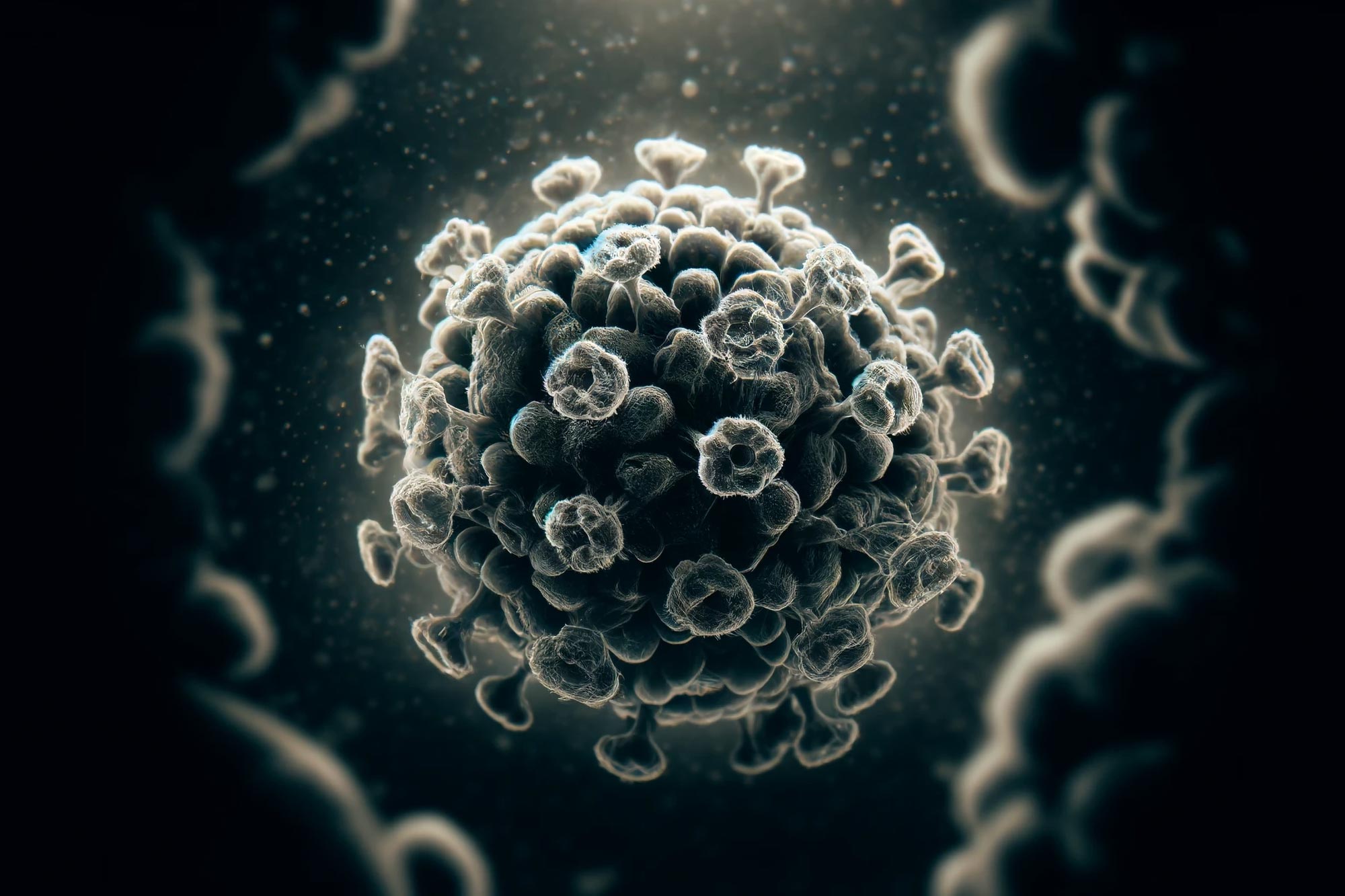
The Epstein-Barr virus (EBV) can cause a spectrum of diseases, including a range of cancers. Emerging data now show that inhibition of a specific metabolic pathway in infected cells can diminish latent infection and therefore the risk of downstream disease. This research was detailed in the journal Science by scientists from the University of Basel and the University Hospital Basel.
Sixty years ago, pathologist Anthony Epstein and virologist Yvonne Barr announced the discovery of a virus that has carried their names ever since. The Epstein-Barr virus made scientific history as the first virus proven to cause cancer in humans. Epstein and Barr isolated the pathogen, which is part of the herpesvirus family, from tumor tissue and demonstrated its cancer-causing potential in subsequent experiments.
Most people are carriers of EBV: 90% of the adult population are infected with the virus, usually experiencing no symptoms and no resulting illness. Around 50% become infected before the age of five, but many people don’t catch it until adolescence. Acute infection with the virus can cause glandular fever — also known as “kissing disease” — and can put infected individuals out of action for several months. In addition to its cancerogenic properties, the pathogen is also suspected to be involved in the development of autoimmune diseases such as multiple sclerosis.
As yet, no drug or approved vaccination can specifically thwart EBV within the body. Now, a research group from the University of Basel and the University Hospital Basel has reported a promising starting point for putting the brakes on EBV. Their results were published today (May 23) in the journal Science.
EBV Hijacks the Metabolism of Infected Cells
Researchers led by Professor Christoph Hess have deciphered how the immune cells infected with EBV —the so-called B cells — are reprogrammed. Known as “transformation,” this process is necessary for the infection to become chronic and cause subsequent diseases such as cancer. Specifically, the team discovered that the virus triggers the infected cell to ramp up the production of an enzyme known as IDO1. This ultimately leads to greater energy production by the power plants of infected cells: the mitochondria. In turn, this additional energy is needed for the increased metabolism and the rapid proliferation of B cells reprogrammed by EBV in this way.
Clinically, the researchers focused on a group of patients who had developed EBV-triggered blood cancer following organ transplantation. To prevent a transplanted organ from being rejected, it is necessary to weaken the immune system using medications. This, in turn, makes it easier for EBV to gain the upper hand and cause blood cancer, referred to as post-transplant lymphoma.
In the paper, which has now been published, the researchers were able to show that EBV upregulates the enzyme IDO1 already months before post-transplant lymphoma is diagnosed. This finding may help to develop biomarkers for the disease.
Second Chance for a Failed Drug
“Previously, IDO1 inhibitors have been developed in the hope that they could help to treat established cancer — which has unfortunately turned out not to be the case. In other words, there are already clinically tested inhibitors against this enzyme,” explains Christoph Hess. Accordingly, this class of drugs might now receive a second chance in applications aimed at dampening EBV infection and thereby tackling EBV-associated diseases. Indeed, in experiments with mice, IDO1 inhibition with these drugs reduced the transformation of B cells and therefore the viral load and the development of lymphoma.
“In transplant patients, it’s standard practice to use drugs against various viruses. Until now, there’s been nothing specific for preventing or treating Epstein-Barr virus associated disease,” says Hess.
Reference: “A metabolic dependency of EBV can be targeted to hinder B cell transformation” by Bojana Müller-Durovic, Jessica Jäger, Christine Engelmann, Patrick Schuhmachers, Sabine Altermatt, Yannick Schlup, Urs Duthaler, Celia Makowiec, Gunhild Unterstab, Sarah Roffeis, Erta Xhafa, Nadine Assmann, Fredrik Trulsson, Rebekah Steiner, Joy Edwards-Hicks, James West, Lorinda Turner, Leyla Develioglu, Robert Ivanek, Tarik Azzi, Philippe Dehio, Christoph Berger, Swiss Transplant Cohort Study#, Dmitry Kuzmin, Sophie Saboz, Josef Mautner, Jordan Löliger, Marco Geigges, Darya Palianina, Nina Khanna, Stefan Dirnhofer, Christian Münz, Glenn R. Bantug, Christoph Hess, Christoph Berger, Christoph Hess, Michael Koller, Simona Rossi, Susanne Stampf and Nicolas J. Müller, 23 May 2024, Science.
DOI: 10.1126/science.adk4898
Never miss a breakthrough: Join the SciTechDaily newsletter.
Follow us on Google and Google News.