
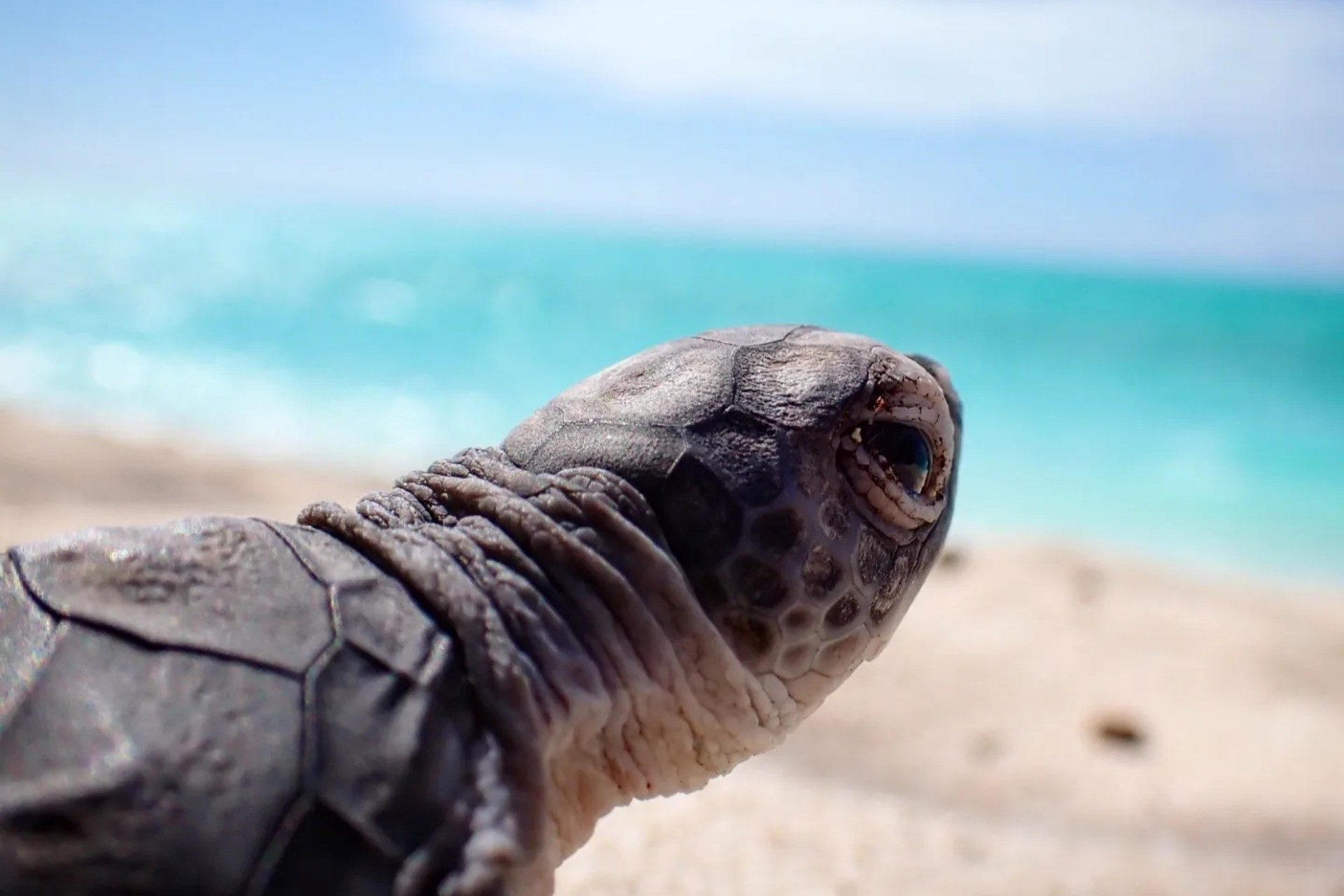
New research reveals that green turtle hatchlings “swim” through the sand to emerge, rather than digging, using a head-up rocking motion.
Recent research indicates that green turtle hatchlings ‘swim’ through the sand to reach the surface after hatching, rather than ‘digging’ their way out. These findings carry significant implications for the conservation of the globally declining turtle population.
Published in Proceedings B, scientists from UNSW’s School of Biological, Earth, and Environmental Sciences, used a small device, known as an accelerometer, to uncover novel findings into the behaviors of hatchlings as they emerge from their nests.
Sea turtle eggs are buried in nests 30 – 80cm deep. Once hatched, the newborn turtles make their way to the surface of the sand over three to seven days. But because this all happens underground, we have very little understanding of the first few days of a hatchling’s life.

The results provided through this novel method revealed that buried hatchlings maintained a head-up orientation and unexpectedly, moved vertically through the sand by rocking forwards and backward rather than tipping side-to-side as expected with digging.
“When I visualize a hatchling that has just come out of its egg, it is completely in the dark in its surroundings. There’s no sign to point which way is up toward the surface – yet, they will orientate themselves and move upwards regardless,” says Mr Davey Dor, who led the study as part of his PhD. “Our initial findings and ‘proof’ of this new methodology opens the door for so many new questions in sea turtle ecology.”
How can you study something underground?
The image of newly hatched baby turtles moving enthusiastically across the sand and into the ocean is somewhat familiar. But what happens before then?
Once they emerge from their eggs, hatchlings move through the sand column and eventually emerge on the surface.
“It was about 64 years ago that the period of turtles hatching from their eggs and coming up to the surface was first observed,” says Mr Dor. “And since then, people have tried different techniques to observe this phase, such as using a glass viewing pane to watch the hatchlings, or using microphones to listen to their movement.”

Each of these previous techniques has come with limitations which means it has remained difficult to study the first few days of life for turtle hatchlings. “You just don’t think about how much work it takes for these tiny hatchlings to swim through the sand in the dark, with almost no oxygen,” says Associate Professor Lisa Schwanz. “It happens right under everyone’s feet, but we haven’t had the technology to really understand what is happening during this time.”
So Mr Dor, A/Prof. Lisa Schwanz and Dr. David Booth, from the University of Queensland, set out to explore new ways to observe and research this obscure, little-known process.
Miniature accelerometer backpacks
Accelerometers, which measure changes in speed or direction, have previously been used to study animal movement, behaviors, and physiology.
“The simple principle of the type of accelerometer we used is that it measures acceleration from three different angles,” says Mr Dor. “So it can measure a change in velocity in a forwards and backward motion, an up and down motion, and a side to side motion.”
But until now, an accelerometer hasn’t been used in this context.
This research took place on Heron Island, a long-term monitoring nesting site for green turtles in the southern Great Barrier Reef, where nesting season typically runs from December to March.
“After locating the nests, we waited for approximately 60 days for the eggs to develop,” says Mr Dor. “Three days before they hatched, we put a device called a hatch detector next to 10 different nests. This unique instrument measures voltage at the nest site and lets us know when the hatchlings had hatched out of their eggs.”
As soon as the team became aware that the eggs had hatched, they carefully dug down into the nest, selected the hatchling closest to the surface, and attached a light-weight, miniature accelerometer onto the baby turtle, before placing it back. “We then gently layered the sand back in the way it was found,” says Mr Dor.
It was then a waiting game to see when the hatchlings emerged. “We checked the nest site every three hours and when they did finally emerge, we retrieved the accelerometer from the hatchling carrying it.”
The accelerometer provided new data on the direction, speed, and time it took for the ten hatchlings to emerge. “We analyzed the data and found that hatchlings show amazingly consistent head-up orientation – despite being in the complete dark, surrounded by sand,” says Mr. Dor. “We found that their movement and resting periods are generally quite short, that they move as if they were swimming rather than digging, and that as they approach the surface of the sand, they restrict their movement to nighttime,” says Mr Dor.
Conservation and nest intervention
Sea turtle populations are in decline in many parts of the world, with several species listed as endangered. The nesting phase is a major vulnerability for turtle populations and as a result, conservation management often focuses on nest intervention, including relocation, shading, and watering.
Nest relocation has been used widely around the world for many years and the practice is expected to continue as the effects of climate change and rising sea levels are affecting turtle nesting. However, factors such as moisture and temperatures in the nest, which can vary when a nest is moved, can impact important performance traits of hatchlings, including their speed and movement.
“Altering nest characteristics, such as substrate moisture and depth, could have consequences for hatchlings that we currently don’t understand,” says Mr Dor. “This means knowledge of hatchling behavior in the sand column – and its links to offspring success – is key to future conservation practices.”
While we know that in the scramble across the sand to the water, hatchlings are at great risk from predators, “it’s also true that some hatchlings don’t even make it to that point,” says A/Prof. Schwanz. “We have so little knowledge of what makes one hatchling successfully emerge while another doesn’t, so it’s really important that we figure out what might contribute to this.”
Opening the door to further research
The latest publication confirms that using accelerometers to monitor hatchlings provides many benefits, including data of movement and behaviors, and crucially, the ability to study turtles when our visibility of them is limited.
These findings have also provided new insights and changed previous assumptions about hatchlings’ earliest days in the sand.
“There are lots of factors that we don’t really understand because we haven’t been able to observe this stage of their lives, but we hope this will change as a result of this new method, particularly in answering questions about best conservation practices,” says Mr Dor.
The following summer, Mr Dor returned to Heron Island to put accelerometers on multiple hatchlings in a single nest. “So using the next year’s data, we’ll get a sense of how coordinated the nests are, because there is a theory about whether the turtles coordinate their movements, or if they have a division of labor,” says A/Prof. Schwanz.
Reference: “Swimming through sand: using accelerometers to observe the cryptic, pre-emergence life-stage of sea turtle hatchlings” by David Dor, David T. Booth and Lisa E. Schwanz, 30 September 2024, Proceedings B.
DOI: 10.1098/rspb.2024.1702
Never miss a breakthrough: Join the SciTechDaily newsletter.
Follow us on Google and Google News.