
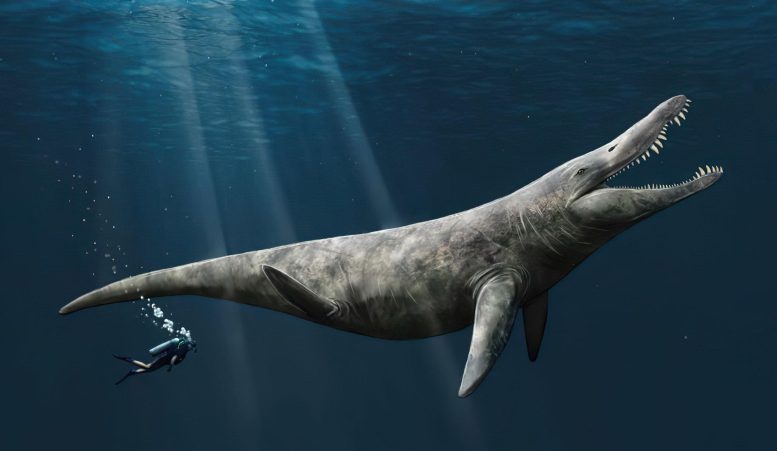
A new fossil discovery suggests a Jurassic pliosaur reached 14.4 meters, confirming the existence of massive marine predators. Found in Oxfordshire, the vertebrae belong to a Pliosaurus species that dominated Jurassic seas.
More than two decades ago, the depiction of a 25-meter-long (82-foot-long) Liopleurodon in the BBC’s documentary series, Walking with Dinosaurs, instigated fervent discussions about the true size of this pliosaur. The portrayal was generally deemed as excessively exaggerated, with the more accepted theory suggesting an adult Liopleurodon would have measured just over six meters (20 feet).
This speculation was expected to continue, however, a serendipitous finding in an Oxfordshire museum has now spurred paleontologists from the University of Portsmouth to publish a research paper suggesting that a similar species could reach a staggering length of 14.4 meters (47.2 feet), twice the size of a killer whale.
Professor David Martill from the University of Portsmouth’s School of the Environment, Geography and Geosciences, said: “I was a consultant for the BBC’s pilot program‘ Cruel Sea’ and I hold my hands up – I got the size of Liopleurodon horrendously wrong. I based my calculations on some fragmentary material that suggested a Liopleurodon could grow to a length of 25 meters, but the evidence was scant and it caused a lot of controversy at the time.
“The size estimate on the BBC back in 1999 was overdone, but now we have some evidence that is much more reliable after a serendipitous discovery of four enormous vertebrates.”
Professor Martill’s co-author, Megan Jacobs, was photographing an ichthyosaur skeleton at Abingdon County Hall Museum, while Dave looked through drawers of fossils. He found a large vertebra and was thrilled to discover the curator had three more of them in storage.
A Massive Marine Predator Unveiled
The vertebrae are clearly identifiable as being closely related to a Pliosaurus species or similar animal. Pliosaurs were like plesiosaurs, but with a bigger elongated head, similar to a crocodile, and a shorter neck. They had four flippers, which acted as powerful paddles to propel them through water, and a relatively short tail.
After conducting topographic scans, Professor Martill and colleagues calculated this Late Jurassic marine reptile could have grown to between 9.8 and 14.4 meters long.
He said: “We know these pliosaurs were very fearsome animals swimming in the seas that covered Oxfordshire 145-152 million years ago. They had a massive skull with huge protruding teeth like daggers – as big, if not bigger than a T. rex, and certainly more powerful.
“They were at the top of the marine food chain and probably preyed on ichthyosaurs, long-necked plesiosaurs, and maybe even smaller marine crocodiles, simply by biting them in half and taking chunks off them. We know they were massacring smaller marine reptiles because you can see bite marks in ichthyosaur bones in examples on display in The Etches Collection in Dorset.”
The vertebrae were originally discovered during temporary excavations at Warren Farm in the River Thames Valley in Oxfordshire and come from the Kimmeridge Clay Formation. This deposit is Late Jurassic in age, around 152 million years old.
Professor Martill added: “It’s wonderful to prove there was indeed a truly gigantic pliosaur species in the Late Jurassic seas. Although not yet on a par with the claims made for Liopleurodon in the iconic BBC TV series Walking With Dinosaurs, it wouldn’t surprise me if one day we find some clear evidence that this monstrous species was even bigger.”
Reference: “A truly gigantic pliosaur (Reptilia, Sauropterygia) from the Kimmeridge Clay Formation (Upper Jurassic, Kimmeridgian) of England” by David M. Martill, Megan L. Jacobs and Roy E. Smith, 10 May 2023, Proceedings of the Geologists’ Association.
DOI: 10.1016/j.pgeola.2023.04.005
Never miss a breakthrough: Join the SciTechDaily newsletter.
Follow us on Google and Google News.