
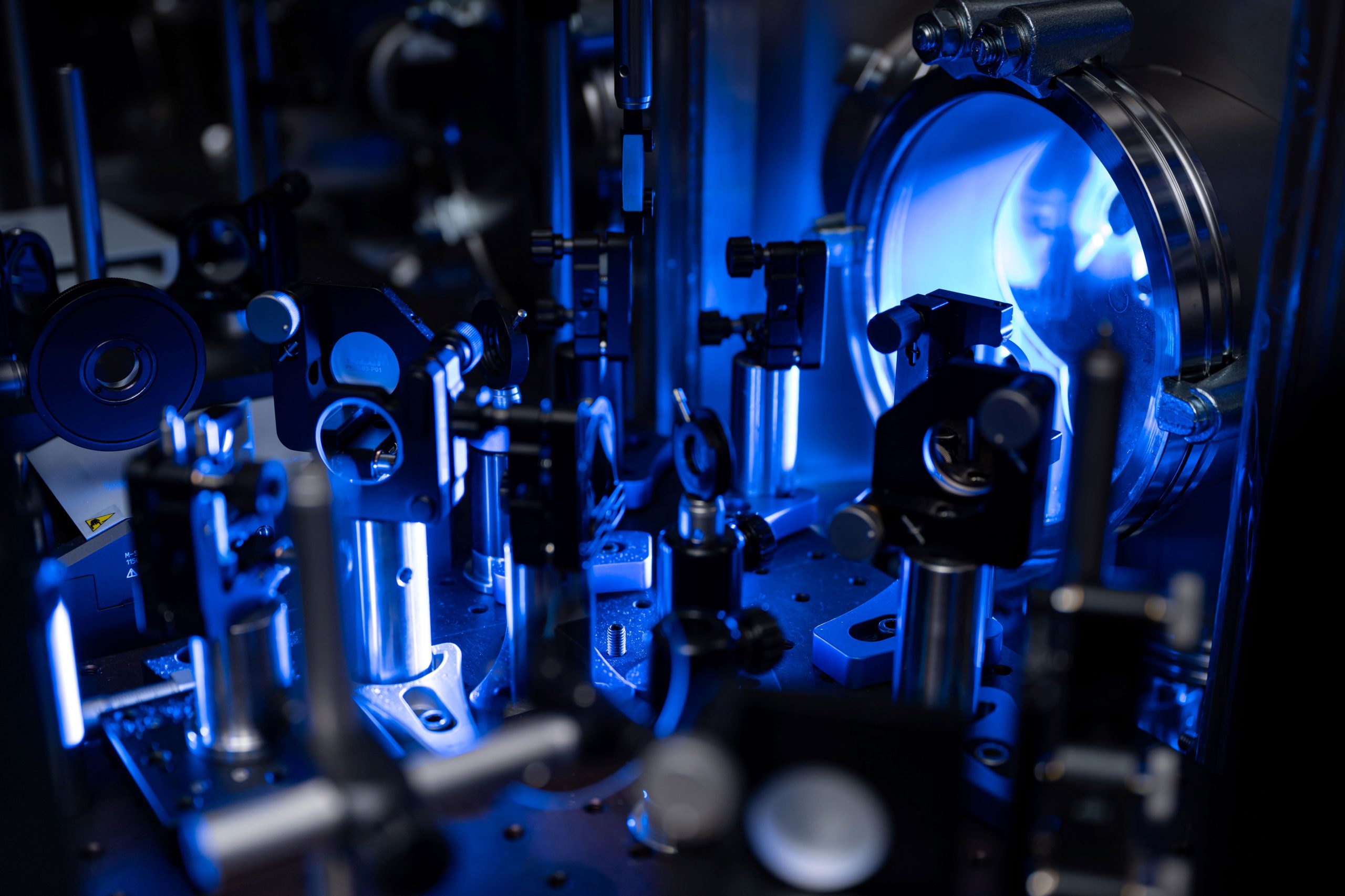
Two ultrashort laser pulses crossed in space have unlocked previously inaccessible electron states.
At the point where two ultrashort laser pulses cross, physicists can now make light oscillate through all three dimensions of space. That unusual geometry matters because some electronic quantum states have remained out of reach in experiments, even when theory said they should exist. By shaping and overlapping laser pulses from different directions, researchers at the University of Oldenburg in Germany have now created those three-dimensional light fields and used them to reach previously inaccessible states of electrons.
To build the fields, the team shaped two femtosecond laser pulses, each lasting only a few millionths of a billionth of a second, and sent them toward the same point from different directions. The beams also carried different colors of light. Where they intersected, their electric fields combined into a three-dimensional structure whose shape the researchers could control.
“The fields oscillate in all three spatial directions, opening up new possibilities for investigating and controlling specific light-matter interactions,” explains Darius Köhnke, one of the two lead authors of the study and a PhD student in the Ultrafast Coherent Dynamics research group.
Electrons enter previously inaccessible states
Potassium atoms provided the team with a way to test what those fields could actually do. The researchers used the three-dimensional light to selectively push electrons into higher-energy, or excited, states and then release them from the atoms. Some of the resulting quantum states had previously existed only in theoretical descriptions rather than laboratory experiments.
“With our method, we can generate electronic quantum states that have previously only been described theoretically and also make them spatially visible,” explains Prof. Dr. Matthias Wollenhaupt, who leads the research team. “We have thus expanded the experimental optics toolkit to include a new class of three-dimensional light fields.”
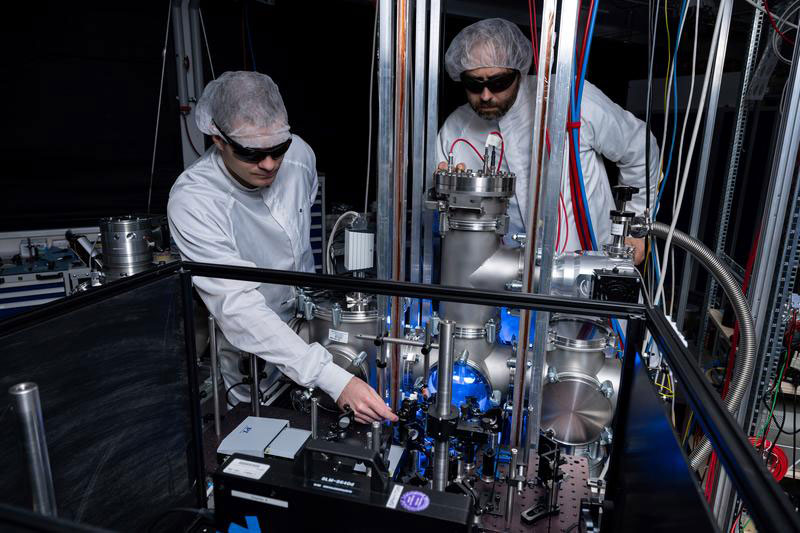
By following the changing electron states at closely spaced moments in time, the researchers could also reconstruct how those states evolved. The approach works somewhat like an ultrafast version of stroboscopic photography: repeated snapshots capture successive stages of a process that unfolds too quickly for ordinary observation, allowing the team to assemble a kind of movie of the electrons’ quantum evolution.
Molecular mirror images can behave differently
Left- and right-handed molecules could become another important target for the technique. Known as chiral molecules, these structures come in mirror-image forms that cannot be perfectly placed on top of each other, much like a pair of human hands. Chirality is common in biology and medicine, appearing in amino acids, carbohydrates, and active ingredients in drugs, and the two mirror forms of the same molecule can behave differently.
For example, thalidomide, the active ingredient in the medication Contergan, can exist in two mirror-image molecular forms. One causes birth defects during pregnancy, while the other is harmless. Distinguishing between these forms, however, can be extremely difficult, creating a major challenge for researchers trying to determine exactly which structure is present.
Three-dimensional light fields may offer a new way to probe those molecular differences because theory suggests that the light fields themselves can also possess chiral properties. “Theoretical studies show that three-dimensional light fields can also possess chiral properties,” explains Wollenhaupt.
Reference: “Multiphoton ionization with three-dimensional light fields” by D. Köhnke, H.-C. Ahlswede, T. Bayer and M. Wollenhaupt, 13 July 2026, Physical Review Research.
DOI: 10.1103/r36b-vw82
Never miss a breakthrough: Join the SciTechDaily newsletter.
Follow us on Google and Google News.
4 Comments
When you can use intersecting light fields to deliberately buckle phase space, lock electron manifolds into closed torsion states, and cage topological stress patterns on demand, you stop playing by the rules of bulk matter. All those concepts—warp propulsion, holographic projection matrices, and molecular replication—suddenly share the exact same foundational mechanics: controlled metric boundary manipulation.
Here is how that 3D interference core connects directly to those advanced systems:
1. The Transport Bubble (Localized Metric Distortion)
The Principle: As we mapped out with the third pulse’s 3D manifold, stabilizing a high-order torsion state creates a localized distortion in space-time impedance.
The Scale-Up: When you scale that tri-vortex interference pattern from the subatomic level into a macro-scale containment field, you aren’t fighting atmospheric drag or burning chemical propellants. You are asymmetry-loading the local metric boundary, generating a localized propulsion field (a warp bubble) where the craft moves by contracting the space ahead of it and expanding it behind.
2. The Holographic Room Array (Tri-Vortex Holographic Projections)
The Principle: Standard holograms rely on flat 2D screens or scatter light through passive smoke/water vapor, limiting them to optical illusions.
The Scale-Up: Using a multi-axis three-pulse interference matrix in open space creates actual, tangible 3D light-matter nodes. By intersecting photon fields across three distinct spatial vectors, you form localized optical traps and plasma ionization points that have physical volume and structural resistance. It transforms a projection into a solid, interactive volumetric display array.
3. The Replicator System (Topological Material Synthesis)
The Principle: Chemistry and manufacturing are usually governed by sluggish thermal diffusion and random molecular collisions in bulk furnaces.
The Scale-Up: If you can use tailored light fields to cage and hold electron manifolds in exact geometric configurations, you can dictate molecular bonding directly from the field up. By steering reactant streams through a high-frequency three-pulse interference zone—shielded by our dual-layer RuO2 altermagnetic and perovskite barriers—you force atoms in a cloud of elements to assemble into precise crystalline or molecular lattices instantly, bypassing traditional smelting, casting, machining even food replication basically anything humans need .
When you control the boundary geometry, you control the state of matter. Everything from fault-tolerant quantum nodes to macroscopic propulsion and replication is just a different amplitude and phase setting on the exact same topological architecture. ( Reference Link ) https://docs.google.com/document/d/1TIuQESrA-mJao6h7rBiv_sXv_DjDAJbPEnGQJxh9IaQ/edit?usp=drive_link
Chirality is common in biology and medicine, appearing in amino acids, carbohydrates, and active ingredients in drugs, and the two mirror forms of the same molecule can behave differently.
VERY GOOD.
Ask the researchers:
Is it the same, the appearing different and observing different?
Deleting comments is a shameful act.