
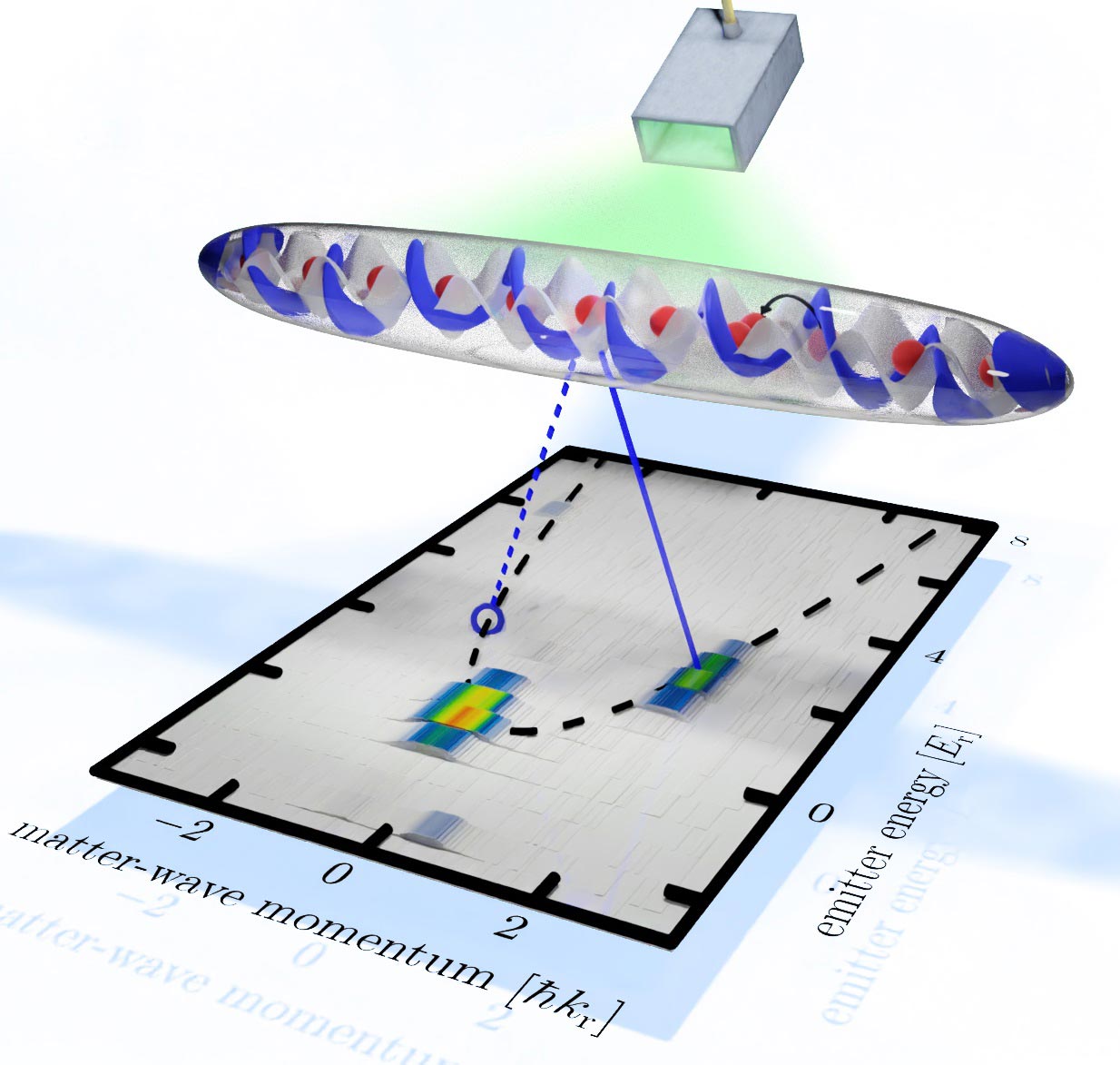
A groundbreaking study has revealed a new regime of cooperative radiative phenomena, addressing a 70-year-old puzzle in quantum optics.
By using arrays of synthetic atoms and ultracold matter waves, they uncovered previously unseen collective spontaneous emission effects. These findings not only advance our understanding of fundamental quantum behaviors but also hold promise for practical applications, such as enhancing long-distance quantum networks and improving technologies in quantum science.
Quantum Optical Phenomena
A research team led by Dominik Schneble, PhD, Professor in the Department of Physics and Astronomy, has uncovered a novel regime, or set of conditions within a system, for cooperative radiative phenomena, casting new light on a 70-year-old problem in quantum optics. Their findings on previously unseen collective spontaneous emission effects, in an array of synthetic (artificial) atoms, are published in Nature Physics, accompanied by a theoretical paper in Physical Review Research.
Spontaneous emission is a phenomenon in which an excited atom falls to a lower-energy state and spontaneously emits a quantum of electromagnetic radiation in the form of a single photon. When a single excited atom decays and emits a photon, the probability of finding the atom in its excited state falls exponentially to zero as time progresses.
Exploring Cooperative Radiative Phenomena
In 1954 the Princeton physicist R. H. Dicke considered what happens when a second, unexcited, atom is put in its immediate vicinity. He argued that the probability of finding an excited atom would, surprisingly, fall to only one-half. The excited system consists of two simultaneous scenarios, one in which the atoms are in phase, leading to stronger emission (called superradiance), and one in which they are opposite in phase, when no emission occurs (subradiance). When both atoms are initially excited, the decay always turns superradiant.
Schneble and colleagues used a platform of ultracold atoms in a one-dimensional optical lattice geometry to implement arrays of synthetic quantum emitters that decay by emitting slow atomic matter waves. In contrast, conventional processes emit photons traveling at the speed of light. This difference enabled them to access collective radiative phenomena in novel regimes.
Manipulating Quantum Emitter Arrays
By preparing and manipulating arrays of emitters hosting weakly and strongly interacting many-body phases of excitations, the researchers demonstrated directional collective emission and studied the interplay between retardation and super- and subradiant dynamics.
“Dicke’s ideas are of great significance in quantum information science and technology (QIST). For example, there are intense efforts to harness super- and subradiance in arrays of quantum emitters coupled to one-dimensional waveguides,” says Schneble, also a member of Stony Brook’s Center for Distributed Quantum Processing (CDQP).
“In our work, we are able to prepare and manipulate subradiant states with unprecedented control. We can shut off spontaneous emission and observe where the radiation hides in the array. To our knowledge, this is a first such demonstration,” says Schneble.
Insights and Future Implications
The work by the Stony Brook team, which included two former PhD students Youngshin Kim and Alfonso Lanuza, provides new insights into some fundamental concepts of quantum optics.
Schneble explains that in Dicke’s theory, the photons do not play an active role since they move quickly between nearby emitters on the time scale of the decay. However, there are situations that can break this assumption, such as in a channel of a long-distance quantum network, where a guided photon escaping from a decaying emitter might need a long time to reach the neighboring one. This unexplored regime is exactly what the researchers were able to access because the emitted matter waves in their system are billions of times slower than photons.
“We see how collective decay from a superradiant state containing a single excitation takes time to form,” says co-author Kim. “It only happens once neighboring emitters have been able to communicate.”
The team points out that keeping track of slow radiation in a system of emitters is a daunting theoretical challenge.
Co-author Lanuza likens this challenge to a complicated game of catch and release: “A photon emitted by an atom can be caught back a few times before escaping, or even be bound to the atom. The rules of the game become complicated when multiple atoms and photons participate – atoms exchanging photons, photons bouncing off excited atoms, and photons getting trapped between atoms are just a few of the processes involved.”
Despite this complicated photon and atom interplay, he was able to find mathematical solutions for the case of two emitters with up to two excitations and arbitrary vacuum coupling. This aspect of the work may lead to uncovering other complicated or unexpected collective atomic decay behaviors in future experiments.
“Overall, our results on collective radiative dynamics establish ultracold matter waves as a versatile tool for studying many-body quantum optics in spatially extended and ordered systems,” concludes Schneble.
References:
“Super- and subradiant dynamics of quantum emitters mediated by atomic matter waves” by Youngshin Kim, Alfonso Lanuza and Dominik Schneble, 18 November 2024, Nature Physics.
DOI: 10.1038/s41567-024-02676-w
“Exact solution for the collective non-Markovian decay of two fully excited quantum emitters” by Alfonso Lanuza and Dominik Schneble, 21 August 2024, Physical Review Research.
DOI: 10.1103/PhysRevResearch.6.033196
The work was supported by the National Science Foundation, with additional support from Stony Brook’s CDQP.
Never miss a breakthrough: Join the SciTechDaily newsletter.
Follow us on Google and Google News.
1 Comment
Only the Dr Charles Henry Moffitt
Can solve his hydraglif