
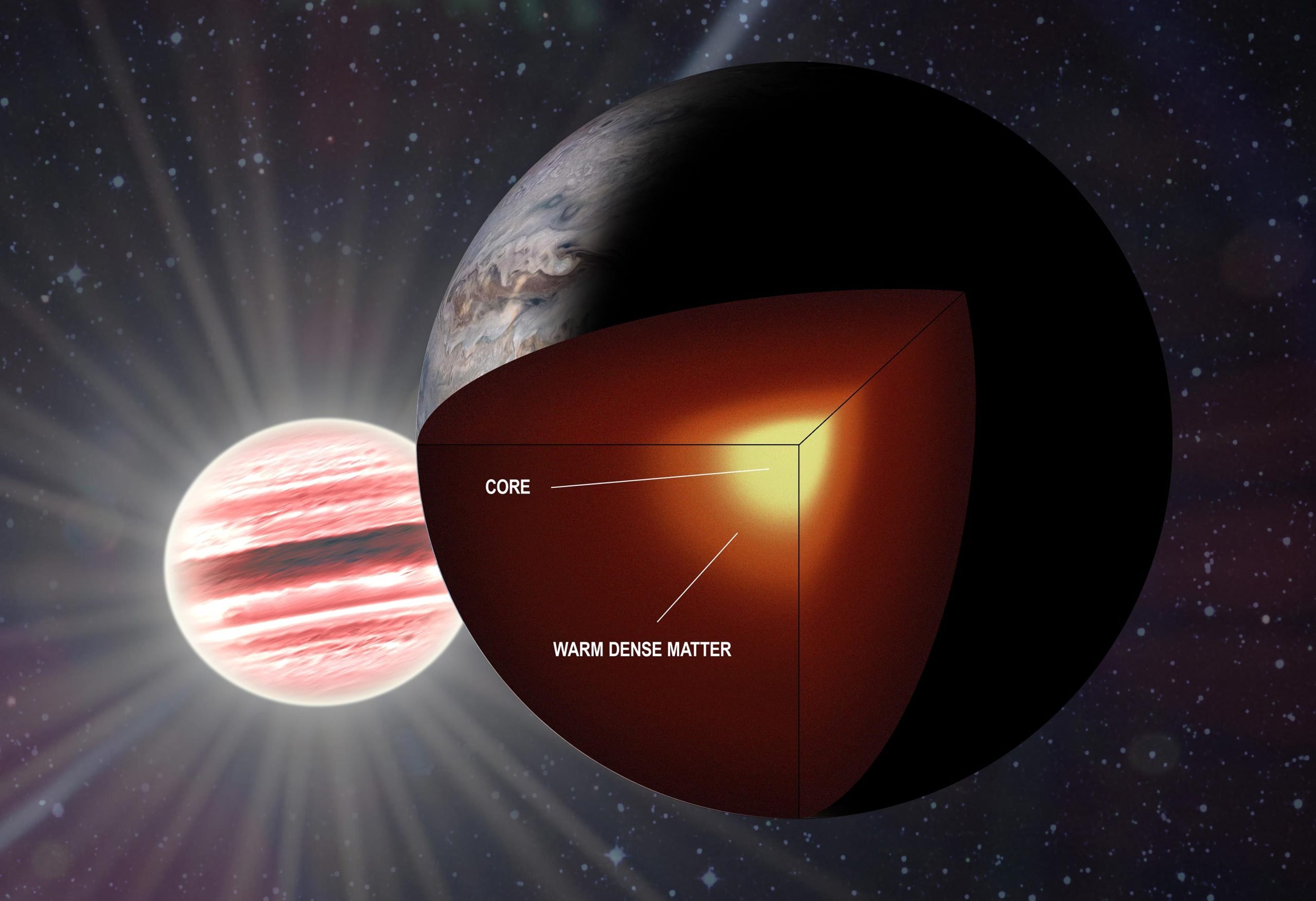
Physicists have made significant strides in understanding warm dense matter using the European XFEL, observing its transformation under intense X-ray pulses.
The properties of warm dense matter have until recently been little known. Now, thanks to the use of X-ray lasers, physicists are gaining more and more information about this important but still mysterious state of matter. The first comprehensive observations of ionization processes in warm dense matter, carried out at the European X-ray Free-Electron Laser (European XFEL), have just been presented in one of the most prestigious physics journals.
The Challenge of Studying Warm Dense Matter
In the interiors of brown dwarfs or gaseous planets, among other places, is a mysterious state of matter with a temperature of a few thousand degrees and a high density, close to that of a solid. Although common in the Universe, it is very difficult to produce and analyze in the laboratory.
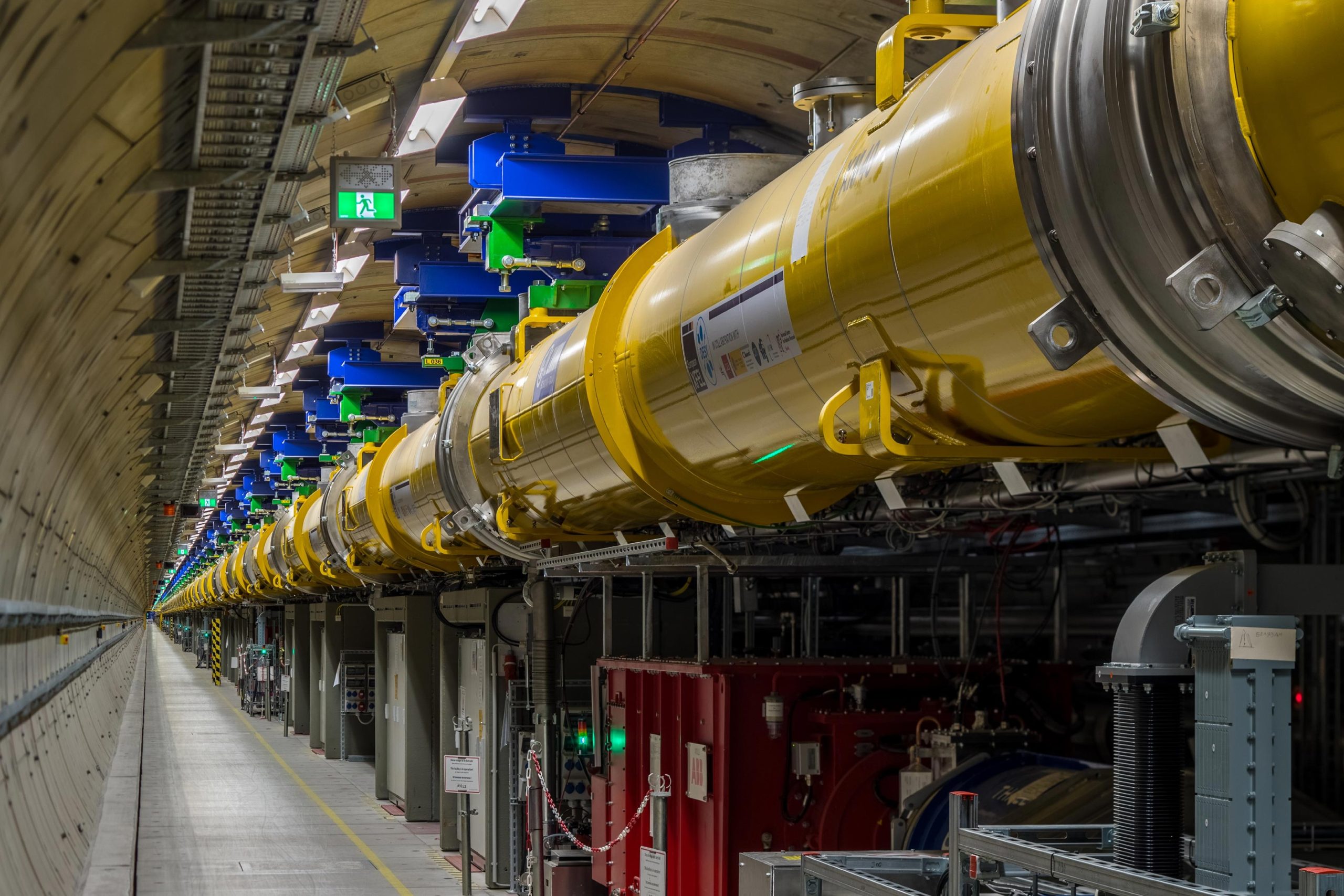
A new era in experimental research of this so-called warm dense matter (WDM) state began just a dozen years ago, when physicists launched the first free-electron X-ray lasers. At the forefront of this type of device is the 3.4 km (2.1 mile) long European XFEL laser.
A series of experiments recently carried out there made it possible to observe for the first time how quickly a metal transforms into the exotic state of ionized WDM to become transparent (non-absorbing) to X-rays at the end of the process. The achievement of the international team of scientists – including those from the Institute of Nuclear Physics of the Polish Academy of Sciences (IFJ PAN) in Cracow – is discussed in a paper published in the journal Nature Physics.
Detailed Insights From European XFEL Experiments
X-Ray Free-Electron Lasers (XFELs) are used to generate high-intensity X-ray pulses lasting single femtoseconds, i.e. millionths of a billionth of a second. These can be used to study the structure of matter at atomic length scales and to track phenomena on extremely short time scales. One of only a dozen such devices in the world is the European XFEL in Hamburg, built in cooperation with the DESY research center.
“In our experiment at the European XFEL, we illuminated copper samples with X-ray pulses lasting 15 femtoseconds, using different, gradually increasing intensities,” Prof. Beata Ziaja-Motyka (IFJ PAN, DESY) introduces the experiment.
The first author of the paper in question, Dr. Laurent Mercadier from the European XFEL, adds some physical details: “When a single X-ray laser pulse reached the material, it caused strong ionization. The electrons released in the process were characterized by high temperatures. Under these extreme conditions, the copper was transformed into a state of warm dense matter. We meticulously recorded how much radiation passed through the matter and from this inferred the ionization changes in the observed system.”
Simulations and Experimental Breakthroughs
Simulations carried out using the BOLTZMANN SOLVER software, developed since 2004 at DESY by Prof. Ziaja-Motyka, were particularly helpful in interpreting the measurement results. This tool was used to simulate changes in the electronic occupancy of individual energy levels in WDM depending on the intensity of the incident laser radiation.
By confronting experimental data with simulations, it was established that when the X-ray intensity becomes sufficiently high, atoms of WDM become strongly ionized. As a result of this phenomenon, new energy levels appear which can be occupied by excited electrons – making WDM opaque for photons resonant with transitions to these new energy levels. These states had already been observed previously with optical lasers, however, the lasers’ energy limitations did not allow them to be studied in more detail.
Now, thanks to the European X-ray laser XFEL, it is possible to characterize them accurately also in response to various intensities of X-ray pulses. In accordance with theoretical predictions for X-ray absorption spectra, prepared by Dr. Joshua Kas (University of Washington, USA) and Dr. Andrei Benediktovitch (DESY, Hamburg), it was further observed that with increasing the laser intensity the warm dense matter becomes first opaque and then – at highest intensities – transparent to the laser pulse.
“The appearance of ‘transparency’ – i.e. lack of absorption – in WDM is a consequence of the high ionization of WDM atoms occurring at sufficiently high X-ray pulse intensities. The energy of the Xray photons available in the experiment then becomes too small to excite further electrons. As a result, these photons cannot be absorbed by the warm dense matter at all,” explains Prof. Ziaja- Motyka.
Future Directions and Practical Applications
Knowledge of the properties of warm dense matter and the processes taking place within it is not only of astrophysical, but also of practical, engineering importance. Matter in this state plays an important role in certain types of controlled nuclear fusion (ICF – Inertial Confinement Fusion), and also appears during the ablation of metallic heat shields of spacecraft returning from orbit to Earth.
The team of physicists at the European X-ray XFEL laser, led by Prof. Nina Rohringer (DESY, Universität Hamburg), intends to continue research into the electron and ionization processes occurring in WDM and their dynamics. On the Polish side, the work is co-financed by the Institute of Nuclear Physics of the Polish Academy of Sciences.
Reference: “Transient absorption of warm dense matter created by an X-ray free-electron laser” by Laurent Mercadier, Andrei Benediktovitch, Špela Krušič, Joshua J. Kas, Justine Schlappa, Marcus Agåker, Robert Carley, Giuseppe Fazio, Natalia Gerasimova, Young Yong Kim, Loïc Le Guyader, Giuseppe Mercurio, Sergii Parchenko, John J. Rehr, Jan-Erik Rubensson, Svitozar Serkez, Michal Stransky, Martin Teichmann, Zhong Yin, Matjaž Žitnik, Andreas Scherz, Beata Ziaja and Nina Rohringer, 29 July 2024, Nature Physics.
DOI: 10.1038/s41567-024-02587-w
Never miss a breakthrough: Join the SciTechDaily newsletter.
Follow us on Google and Google News.
5 Comments
By confronting experimental data with simulations, it was established that when the X-ray intensity becomes sufficiently high, atoms of WDM become strongly ionized. As a result of this phenomenon, new energy levels appear which can be occupied by excited electrons – making WDM opaque for photons resonant with transitions to these new energy levels. WHY?
Scientific research guided by correct theories can help humanity avoid detours, failures, and pomposity. Please witness the exemplary collaboration between theoretical physicists and experimentalists (https://scitechdaily.com/microscope-spacecrafts-most-precise-test-of-key-component-of-the-theory-of-general-relativity/#comment-854286). Some people in contemporary physics has always lived in a self righteous children’s story world. Whose values have been overturned by such a comical and ridiculous reality?
The branch of mathematics known as topology has become a cornerstone of modern physics. The perpetually swirling topological vortices defy traditional physics’ expectations, potentially breaking through the bottleneck of physical theory and unveiling new particles and forces.
The universe does not algebra, formulas, or fractions. The universe is a superposition, deflection, and entanglement of geometric shapes, is the interaction and balance of countless topological vortex fractal structures. In their interaction and balance, the past is difficult to change. For the future, some predictable, some unpredictable. But, the present moment is real, certain, and actionable. Physics should not ignore that low dimensional topological fractal structures are the material basis of high-dimensional spacetime.
When physics no longer believes in geometric shapes, it can only believe in God, angels, and even a strange cat (quantum mechanics). Contemporary physics should not always live in a world of fairy tales.
Space has physical properties of zero viscosity and absolute incompressibility. Zero viscosity and absolute incompressibility are physical characteristics of ideal fluids. The space with ideal fluid physical characteristics forms vortices via topological phase transitions, which is not difficult to understand mathematically. Once the topological vortex is formed, it occupies space and maintains its presence in time. This is the transition from chaos to order via two bidirectional coupled continuous chaotic systems.
Symmetry of topological vortex can be used to explore particle behavior under spatial, temporal, and quantum number reversals, involving quantum gravity, discrete and continuous changes. It underpins the consistency of natural laws and experiment reproducibility. The perpetually swirling topological vortices defy traditional physics’ expectations, heavily influencing modern physics theories and potentially unveiling new particles and forces.
Spin generates energy, spin generates cycles, spin generates gravitation, and spin generates evolution. From cosmic accretion disks to microscopic particle spins, topological vortex fractal structures create everything and the world via the synchronous effects of spin and self-organization.
From cosmic accretion disks to microscopic particle spins, topological vortex fractal structures are ubiquitous. Exploring and understanding new particles and forces is not impossible via their interaction and balance.
Thank you … interesting article. 🙂
… and noticed an error in the caption of the photo of the accelerator section of the XFEL, stating:
“The accelerator section of the XFEL with its yellow superconducting accelerator modules is two kilometers long. Credit: DESY / Dirk Nölle”
,,, according to the website of the European XFEL ( https://www.xfel.eu/index_eng.html ), it states the length of the instrument is 3.4km.