
Close Menu
    Facebook X (Twitter) Instagram
    SciTechDaily
    • Biology
    • Chemistry
    • Earth
    • Health
    • Physics
    • Science
    • Space
    • Technology
    Facebook X (Twitter) Pinterest YouTube RSS
    SciTechDaily
    Home»Technology»U.S. Navy Researchers Create Electronic Diodes Beyond 5G Performance
    Technology

    U.S. Navy Researchers Create Electronic Diodes Beyond 5G Performance

    By U.S. Naval Research LaboratoryMay 19, 2020No Comments3 Mins Read
    Facebook Twitter Pinterest Telegram LinkedIn WhatsApp Email Reddit
    Share
    Facebook Twitter LinkedIn Pinterest Telegram Email Reddit
    David Storm and Tyler Growden
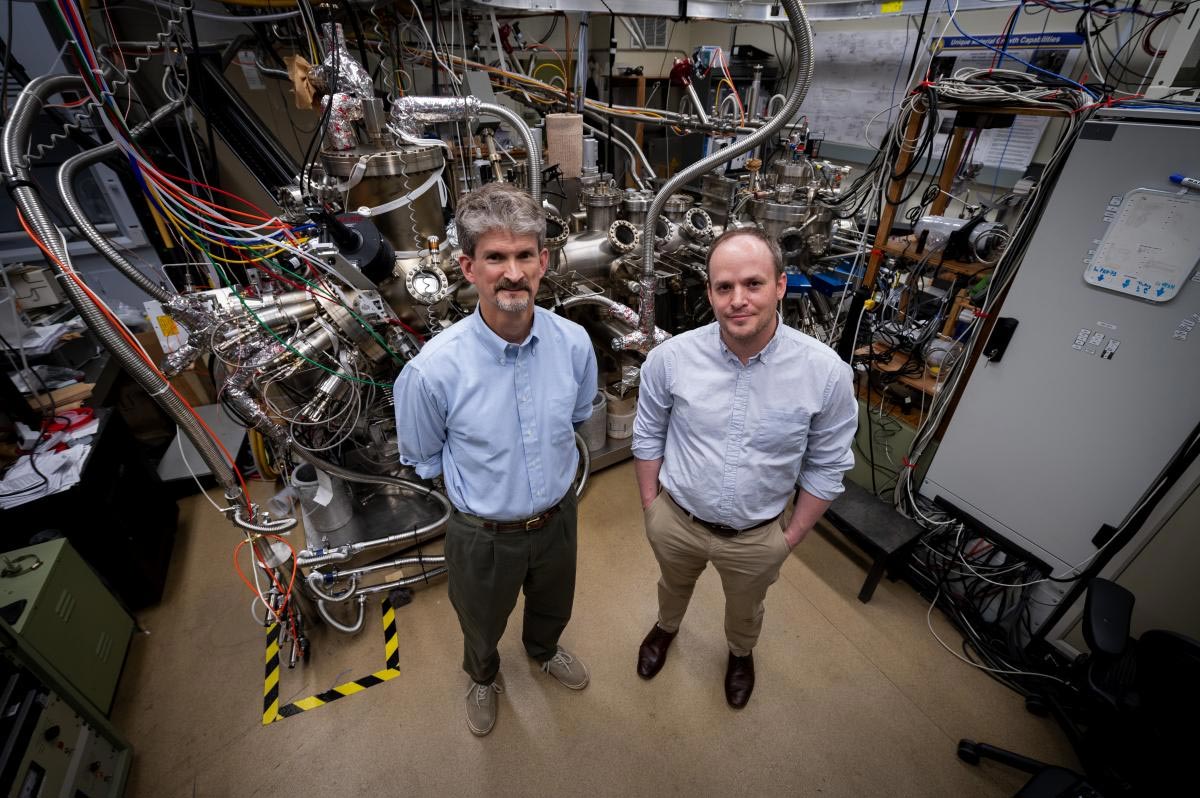
    David Storm, a research physicist, and Tyler Growden, a National Research Council postdoctoral researcher, at the U.S. Naval Research Laboratory with their molecular beam epitaxy system that develops gallium nitride-based (GaN) semiconductors in Washington, D.C., March 10, 2020. Storm and Growden published their research on GaN semiconductor materials, which showed high yield and performance well suited for high frequency and high power electronic devices in Applied Physics Letters. U.S. Credit: Navy photo by Jonathan Steffen

    David Storm, a research physicist, and Tyler Growden, an electrical engineer, both with the U.S. Naval Research Laboratory, developed a new gallium nitride-based electrical component called a resonant tunneling diode (RTD) with performance beyond the anticipated speed of 5G.

    The fifth-generation network technology is now just starting to roll out across the United States.

    Storm and Growden’s electronic component diode research findings were published on March 19, 2020, in the academic journal Applied Physics Letters.

    “Our work showed that gallium nitride-based RTDs are not inherently slow, as others suggested,” Growden said. “They compare well in both frequency and output power to RTDs of different materials.”
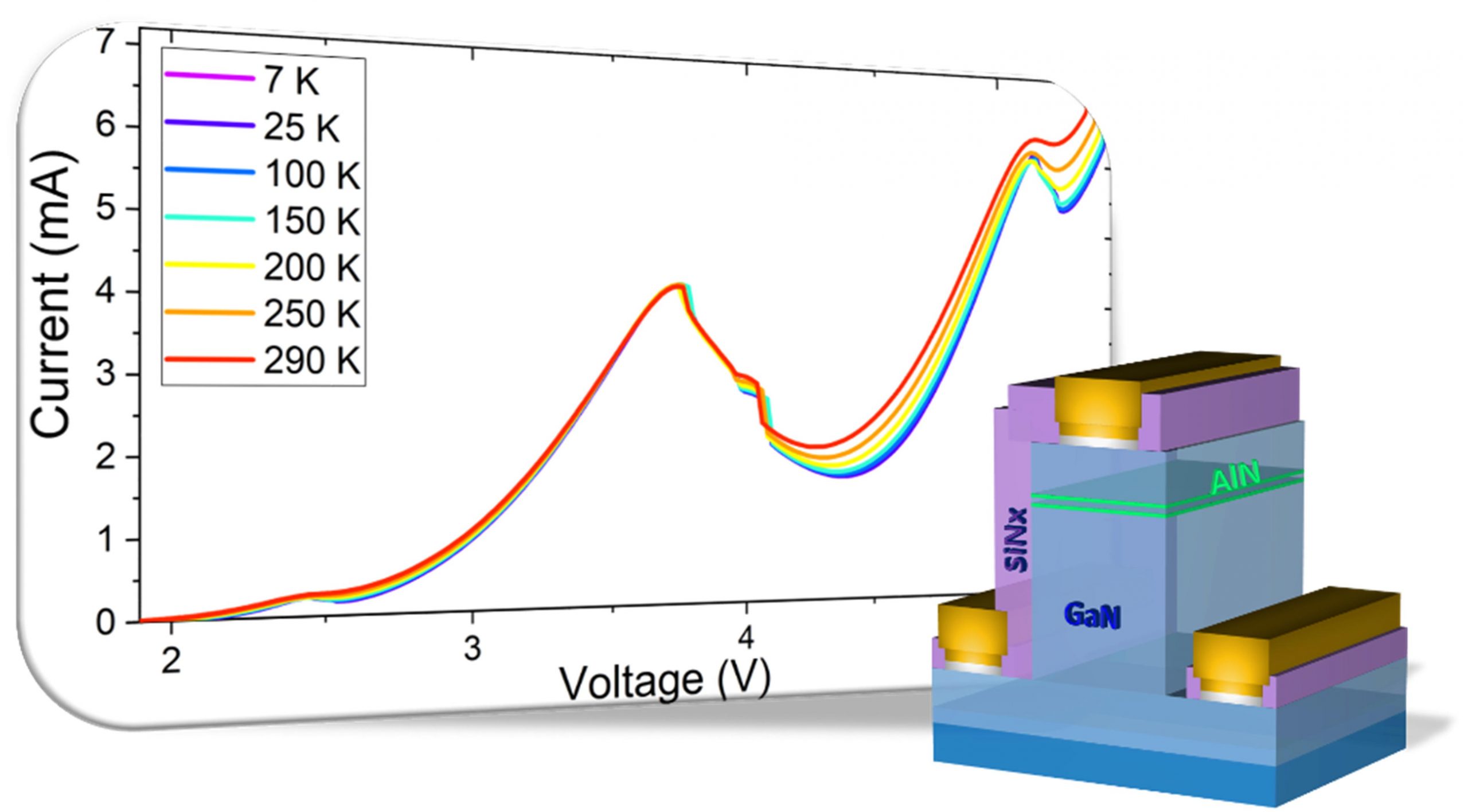
    Gallium Nitride Based Resonant Tunneling Diode
    A simplified view of the gallium nitride-based resonant tunneling diode developed at the U.S. Naval Research Laboratory’s Electronic Science and Technology Division and its performance characteristics. NRL researchers anticipate this RTD will enable technologies beyond 5G and created a process to deliver manufacturing yield of approximately 90%. Credit: NRL graphic by Tyler Growden.

    The diodes enable extremely fast transport of electrons to take advantage of a phenomenon called quantum tunneling. In this tunneling, electrons create current by moving through physical barriers, taking advantage of their ability to behave as both particles and waves.

    Storm and Growden’s design for gallium nitride-based diodes displayed record current outputs and switching speeds, enabling applications requiring electromagnetics in the millimeter-wave region and frequencies in terahertz. Such applications could include communications, networking, and sensing.

    The team developed a repeatable process to increase the diodes yield to approximately 90%; previous typical yields range around 20%.

    Storm said accomplishing a high yield of operational tunneling devices can be difficult because they require sharp interfaces at the atomic level and are very sensitive to many sources of scattering and leakage.

    Sample preparation, uniform growth, and a controlled fabrication process at every step were the key elements to the diodes satisfactory results on a chip.
    “Until now, gallium nitride was difficult to work with from a manufacturing perspective,” Storm said. “I hate to say it, but our high yield was as simple as falling off a log, and a lot of it was due to our design.”

    Storm and Growden said they are committed to continue refining their RTD design to improve the current output without losing power potential. They performed their work along with colleagues at Ohio State University, Wright State University, as well as industry partners.

    Reference: “Superior growth, yield, repeatability, and switching performance in GaN-based resonant tunneling diodes” by Tyler A. Growden, David F. Storm, Evan M. Cornuelle, Elliott R. Brown, Weidong Zhang, Brian P. Downey, Jason A Roussos, Nicholas Cronk, Laura B. Ruppalt, James G. Champlain, Paul R. Berger and David J. Meyer, 19 March 2020, Applied Physics Letters.
    DOI: 10.1063/1.5139219

    Never miss a breakthrough: Join the SciTechDaily newsletter.
    Follow us on Google and Google News.

    Electrical Engineering Nanotechnology Telecommunications U.S. Naval Research Laboratory
    Share. Facebook Twitter Pinterest LinkedIn Email Reddit

    Related Articles

    Innovative Technology for Building Ultralow-Loss Integrated Photonic Circuits

    Ditching the Fiber in Fiber Optics: Capturing Free-Space Optical Light for High-Speed WiFi

    Breaking the Power and Speed Limit of Lasers: New Fast, Powerful Compact Laser Invented

    Photorealistic Painting With Light: Nanopillars Precisely Control the Color and Intensity of Transmitted Light

    Breaking the Size and Speed Limit of Modulators for Next Generation Internet and Communication Networks

    Nano-Thin Flexible Touchscreens Could Be Printed at Home – 100x Thinner Than Current Technology

    New Nanotech Device Provides Cat-Like ‘Hearing’

    Physicists Improve Optical Efficiency in Hexagonal Boron Nitride

    Researchers Develop Spaser Made of Graphene and Carbon Nanotubes

    Leave A Reply Cancel Reply

    • Facebook
    • Twitter
    • Pinterest
    • YouTube

    Don't Miss a Discovery

    Subscribe for the Latest in Science & Tech!

    Trending News

    Popular Sugar-Free Sweetener Linked to Liver Disease, Study Warns

    What Is Hantavirus? The Deadly Disease Raising Alarm Worldwide

    Scientists Just Discovered How the Universe Builds Monster Black Holes

    Scientists Unveil New Treatment Strategy That Could Outsmart Cancer

    A Simple Vitamin May Hold the Key to Treating Rare Genetic Diseases

    Scientists Think the Real Fountain of Youth May Be Hiding in Your Gut

    Ravens Don’t Follow Wolves, They Predict Them

    This Common Knee Surgery May Be Doing More Harm Than Good

    Follow SciTechDaily
    • Facebook
    • Twitter
    • YouTube
    • Pinterest
    • Newsletter
    • RSS
    SciTech News
    • Biology News
    • Chemistry News
    • Earth News
    • Health News
    • Physics News
    • Science News
    • Space News
    • Technology News
    Recent Posts
    • Why Are So Many New Fathers Dying? Scientists Say the U.S. Has a Dangerous Blind Spot
    • Scientists Identify Simple Supplement That Greatly Reduces Alzheimer’s Damage
    • You May Have a Dangerous Type of Cholesterol Even if Your Tests Look Normal
    • Study Reveals Dangerous Flaw in AI Symptom Checkers
    • New MRI Breakthrough Captures Stunningly Clear Images of the Eye and Brain
    Copyright © 1998 - 2026 SciTechDaily. All Rights Reserved.
    • Science News
    • About
    • Contact
    • Editorial Board
    • Privacy Policy
    • Terms of Use

    Type above and press Enter to search. Press Esc to cancel.