
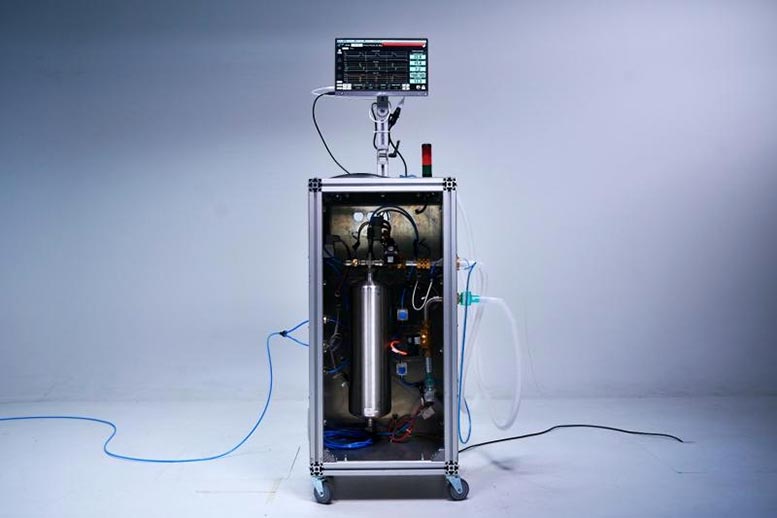
UK scientists have been awarded funding to develop a robust, low-cost ventilator to help patients in low and middle-income countries suffering from severe respiratory problems due to COVID-19.
Mechanical ventilation is a small but important part of the management of pandemic virus infections that affect the lungs, including SARS-CoV-1, SARS-CoV-2 (COVID-19), and influenza.
Ventilators are typically expensive to purchase and maintain, and need considerable training to use. Most also rely on the provision of high-flow oxygen and medically pure compressed air, which are not readily available in many countries around the world.
Affordable, reliable and easy to use
A team of researchers, co-ordinated by the Science and Technology Facilities Council’s (STFC) Daresbury Laboratory, aim to produce and test plans for the creation of an affordable, reliable, and easy-to-operate ventilator that does not rely so heavily on compressed gases and mains electricity supply.
It is anticipated that these plans will be used by a wide variety of manufacturing groups across the world, thereby reducing the need for expensive transportation and maintenance.
The Head of the Technology Department at STFC’s Daresbury Laboratory, Ian Lazarus, is the project lead. He said: “I am proud to be leading this team, in which we have brought together experts from medicine, science, engineering, and knowledge transfer with a shared goal to make resilient high-quality ventilators available in areas of the world which currently don’t have enough of them.
“We look forward to redeploying skills that normally underpin science research into this different and very necessary field, working with medical experts in both UK and Brazil. Together we hope to make a positive impact in the current fight against COVID-19 and afterwards in the treatment of other respiratory conditions in countries where ventilators are not as readily available as they are here in the UK.”
International expertise
As well as leadership from Daresbury Lab, teams across STFC will be working on this project, from the Technology Department, the Hartree Centre, ISIS Neutron and Muon Source, and the Business and Innovation Department (BID).
STFC will also be working with international partners from the Federal University of Rio de Janeiro (Brazil) and CERN, as well as the University of Birmingham, the University of Liverpool and the Medical Devices Testing and Evaluation Centre (MDTEC).
The £760,000 funding for the prototypes has been awarded by UK Research and Innovation (UKRI) through the Global Challenges Research Fund (GCRF), which looks to support scientists to develop solutions to mitigate the short and long-term social, economic and health impacts of the pandemic.
Real-world applications
This project, known as HPLV (High Performance Low Cost Ventilator), builds on the original designs for the HEV (High Energy physics Ventilator).
The HEV was developed at CERN by a group of institutes from the LHCb collaboration, with guidance from local hospitals, an international team of medical experts, and organizations such as the World Health Organisation. Professor Themis Bowcock, of the University of Liverpool instigated the train of events leading to HEV and HPLV. He is part of the LHCb experiment team at CERN and the original HEV team, as well as a member of the ‘CERN against Covid’ committee and the WHO Expert Respiratory Panel.
He said, “It is of enormous importance to us that the technology and software techniques we developed for fundamental physics at the Large Hadron Collider will be used to support the international community in the COVID-19 era. This shows that the expertise of researchers across the whole UKRI portfolio plays a part in tackling urgent and acute challenges faced by humanity.”
A common goal
The HEV prototype design, which was developed using research techniques routinely used at CERN, will now be re-engineered to make it ready for regulatory approval and for manufacture.
HEV team leader Paula Collins, part of the LHCb experiment at CERN and a CERN physicist, said: “HEV was born at CERN during the first lockdown thanks to a dedicated team of physicists and engineers who adapted their expertise to fight the pandemic.
“We are grateful to our international team of medical advisers who helped us to orient the HEV design towards the needs of low and middle-income countries, and to build a ventilator focused on quality and patient comfort.
“We warmly welcome the HPLV initiative, which will build upon the success of HEV and we look forward to working together with the outstanding HPLV team for our common humanitarian goal.”
A team effort
During the HPLV project, partners based in Brazil will identify difficulties encountered when ventilating patients and pass that information to the design team, while regulatory experts in the UK will also provide valuable guidance on this re-engineering activity.
The STFC BID team will work closely with their counterparts in CERN’s Knowledge Transfer group to identify industrial partners who will manufacture and supply the HPLV ventilators.
The project will run for 6 months from October 2020 to April 2021 with a small amount of funding in the following 12 months to support the transfer of the HPLV technology to industrial partners.
Never miss a breakthrough: Join the SciTechDaily newsletter.
Follow us on Google and Google News.