
Close Menu
    Facebook X (Twitter) Instagram
    SciTechDaily
    • Biology
    • Chemistry
    • Earth
    • Health
    • Physics
    • Science
    • Space
    • Technology
    Facebook X (Twitter) Pinterest YouTube RSS
    SciTechDaily
    Home»Science»Uncovering How Our Gaze Is “Anchored” in the Brain – How Our Eyes Stay Focused on What We Reach For
    Science

    Uncovering How Our Gaze Is “Anchored” in the Brain – How Our Eyes Stay Focused on What We Reach For

    By New York University,April 20, 2022No Comments4 Mins Read
    Facebook Twitter Pinterest Telegram LinkedIn WhatsApp Email Reddit
    Share
    Facebook Twitter LinkedIn Pinterest Telegram Email Reddit
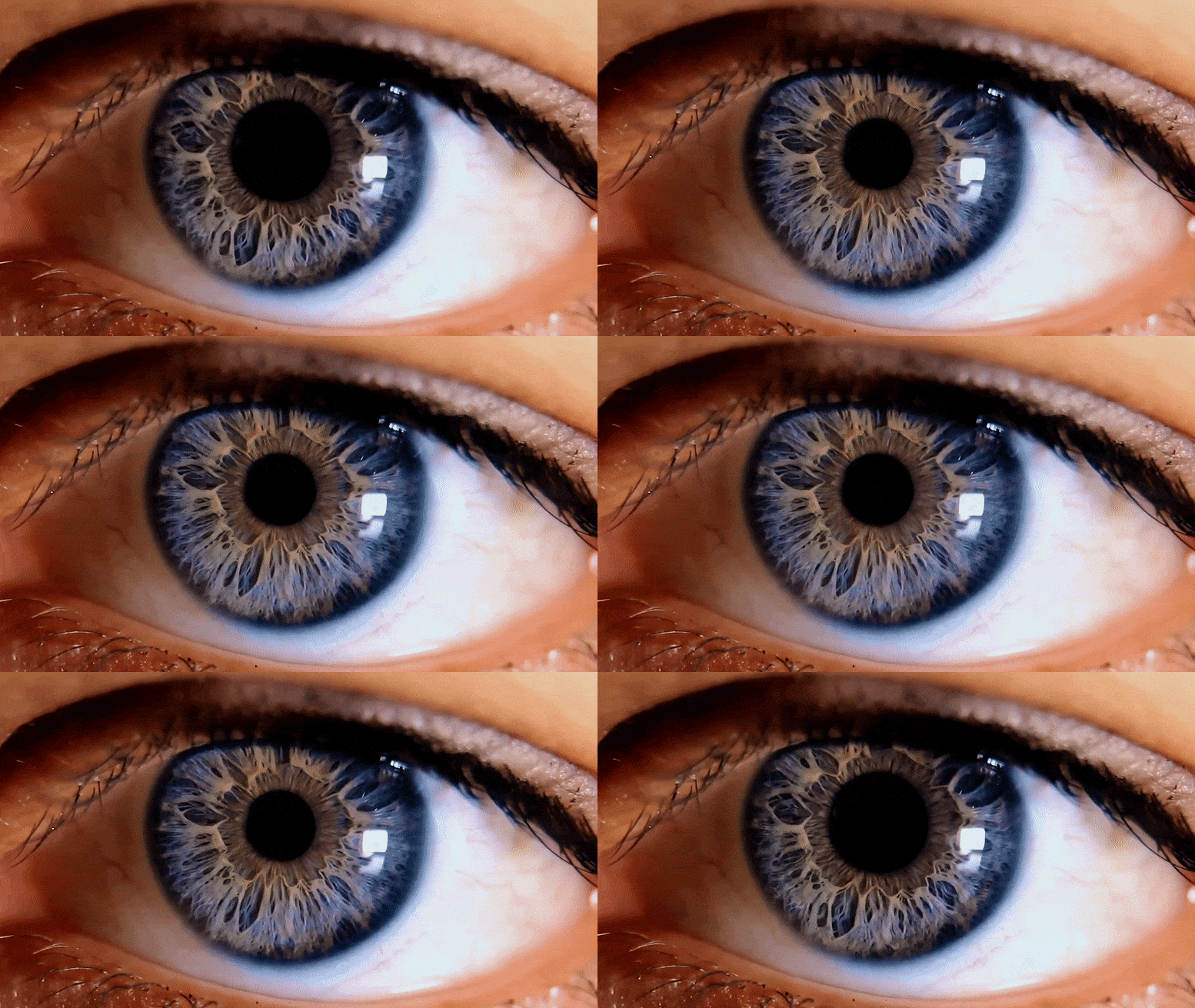
    Human Eye Iris Focus Concept
    A study undertaken by neuroscientists investigated the well-studied but poorly understood process of gaze anchoring—specifically, how different regions of the brain communicate with one another.

    Research Findings Offer New Insights Into How Our Movements Are Coordinated

    Keeping our eyes focused on what we reach for, whether it’s a supermarket item or a ground ball on the baseball field, may appear to be effortless, but it’s actually the result of a complex brain process involving delicate timing and coordination. A team of academics sheds more insight on the mechanisms that ensure we don’t glance away from where we’re going in a new study published today (April 20, 2022) in the journal Nature.

    The work centers on a form of coordinated looking and reach called “gaze anchoring”—the temporary stoppage of eye movements in order to coordinate reaches.

    “Our results show that we anchor our gaze to the target of the reach movement, thereby looking at that target for longer periods,” explains Bijan Pesaran, a professor at NYU’s Center for Neural Science and one of the paper’s authors. “This is what makes our reaches much more accurate. The big question has been: How does the brain orchestrate this kind of natural behavior?”

    NYU Shortstop Reaching for Baseball
    Keeping our eyes focused on what we reach for, such as fielding a ground ball on the baseball field, may appear seamless. But, in fact, it is due to a complex neurological process involving intricate timing and coordination. In a newly published study, a team of researchers sheds additional light on the machinations that ensure we don’t look away from where we are reaching. Pictured is NYU shortstop Zane Baker (’22). Credit: NYU Athletic Communications

    The study, conducted with Maureen Hagan, a neuroscientist at Australia’s Monash University, explores the frequently studied but not well understood process of gaze anchoring—in particular, how different regions of the brain communicate with each other.

    To examine this phenomenon, the scientists studied brain activity in the arm and eye movement regions of the brain at the same time as non-human primates performed a sequence of eye and arm movements. The first movement was a coordinated look-and-reach to a target. Then, as little as 10 milliseconds later, a second target was presented that subjects needed to look at as quickly as possible. This second eye movement revealed the gaze anchoring effect. These movements are similar to those made when changing the radio while driving and attending to a traffic light—if you quickly look away from the radio to the traffic light, you might not select the right channel.

    Insights into Beta Waves and Brain Coordination

    Their results showed that, during gaze anchoring, neurons in the part of the brain—the parietal reach region—used for reaching work to inhibit neuron activity in the part of the brain—the parietal saccade region—used for eye movements. This suppression of neuron firing serves to inhibit eye movement, keeping our eyes centered on the target of our reach, which then enhances the accuracy of what we’re grasping for. Importantly, the scientists note, the effects were tied to patterns of brain waves at 15-25 Hz, called beta waves, that organize neural firing across the different regions of the brain.

    “Beta waves have been previously linked to attention and cognition, and this study reveals how beta activity may control inhibitory brain mechanisms to coordinate our natural behavior,” explains Pesaran.

    By further illuminating the neurological processes of coordinated looking and reaching, tying them to inhibitory beta waves, this study offers the potential to better understand afflictions of attention and executive control that orchestrate natural behaviors like coordinated looking and reaching.

    Reference: “Modulation of inhibitory communication coordinates looking and reaching” by Maureen A. Hagan and Bijan Pesaran, 20 April 2022, Nature.
    DOI: 10.1038/s41586-022-04631-2

    The research was supported by the National Institutes of Health (T32 EY007136), Australian Research Council (DE180100344), the National Science Foundation (BCS-0955701), the National Eye Institute (R01-EY024067), the Army Research Office, the Simons Foundation, a McKnight Scholar Award, and a Sloan Research Fellowship.

    Never miss a breakthrough: Join the SciTechDaily newsletter.
    Follow us on Google and Google News.

    Brain Neuroscience New York University Vision
    Share. Facebook Twitter Pinterest LinkedIn Email Reddit

    Related Articles

    Unveiling the Mystery of “Unseeing” – New Research Sheds Light on Visual Masking Phenomenon

    New Study: Everyday Pleasures Can Boost Cognitive Performance

    Cognitive Scientists Unravel the Secret – Can We Learn To Think Further Ahead?

    Neuroscientists Discover New Factors Behind Better Vision

    Scientists Unveil How Our Memories Are Stored: The Format of Working Memory

    Study of Mice Watching Movies Reveals Brain Circuit That Ensures Vision Remains Reliable

    MIT Neuroscientists Research Brain Activity Related to Face Recognition

    Neuroscientists Predict Which Parts of the Fusiform Gyrus are Face-Selective

    Be Like Neo and Learn New Skills Matrix-Style

    Leave A Reply Cancel Reply

    • Facebook
    • Twitter
    • Pinterest
    • YouTube

    Don't Miss a Discovery

    Subscribe for the Latest in Science & Tech!

    Trending News

    Largest-Ever Study Finds Medicinal Cannabis Ineffective for Anxiety, Depression, PTSD

    250-Million-Year-Old Egg Solves One of Evolution’s Biggest Mysteries

    Living With Roommates Might Be Changing Your Gut Microbiome Without You Knowing

    Century-Old Cleaning Chemical Linked to 500% Increased Risk of Parkinson’s Disease

    What if Your Memories Never Happened? Physicists Take a New Look at the Boltzmann Brain Paradox

    One of the Universe’s Largest Stars May Be Getting Ready To Explode

    Scientists Discover Enzyme That Could Supercharge Ozempic-Like Weight Loss Drugs

    Popular Sweetener Linked to DNA Damage – “It’s Something You Should Not Be Eating”

    Follow SciTechDaily
    • Facebook
    • Twitter
    • YouTube
    • Pinterest
    • Newsletter
    • RSS
    SciTech News
    • Biology News
    • Chemistry News
    • Earth News
    • Health News
    • Physics News
    • Science News
    • Space News
    • Technology News
    Recent Posts
    • What Did Prehistoric Europeans Eat? Scientists Uncover Surprising Answers
    • Scientists Say This Overlooked Organ Could Hold the Key to Longer Life
    • Want Less Stress? Landmark Study Points to a Simple Habit
    • Scientists Reveal Eating Fruits and Vegetables May Increase Your Risk of Lung Cancer
    • AI Reveals Explosive Growth of Floating Algae Across the World’s Oceans
    Copyright © 1998 - 2026 SciTechDaily. All Rights Reserved.
    • Science News
    • About
    • Contact
    • Editorial Board
    • Privacy Policy
    • Terms of Use

    Type above and press Enter to search. Press Esc to cancel.