
The result may open doors to several lines of research in particle physics and beyond.
A hybrid matter–antimatter helium atom containing an antiproton, the proton’s antimatter equivalent, in place of an electron has an unexpected response to laser light when immersed in superfluid helium, reports the ASACUSA collaboration at CERN. The result, described in a paper published on March 16, 2022, in the journal Nature, may open doors to several lines of research.
“Our study suggests that hybrid matter-antimatter helium atoms could be used beyond particle physics, in particular in condensed-matter physics and perhaps even in astrophysics experiments,” says ASACUSA co-spokesperson Masaki Hori. “We have arguably made the first step in using antiprotons to study condensed matter.”
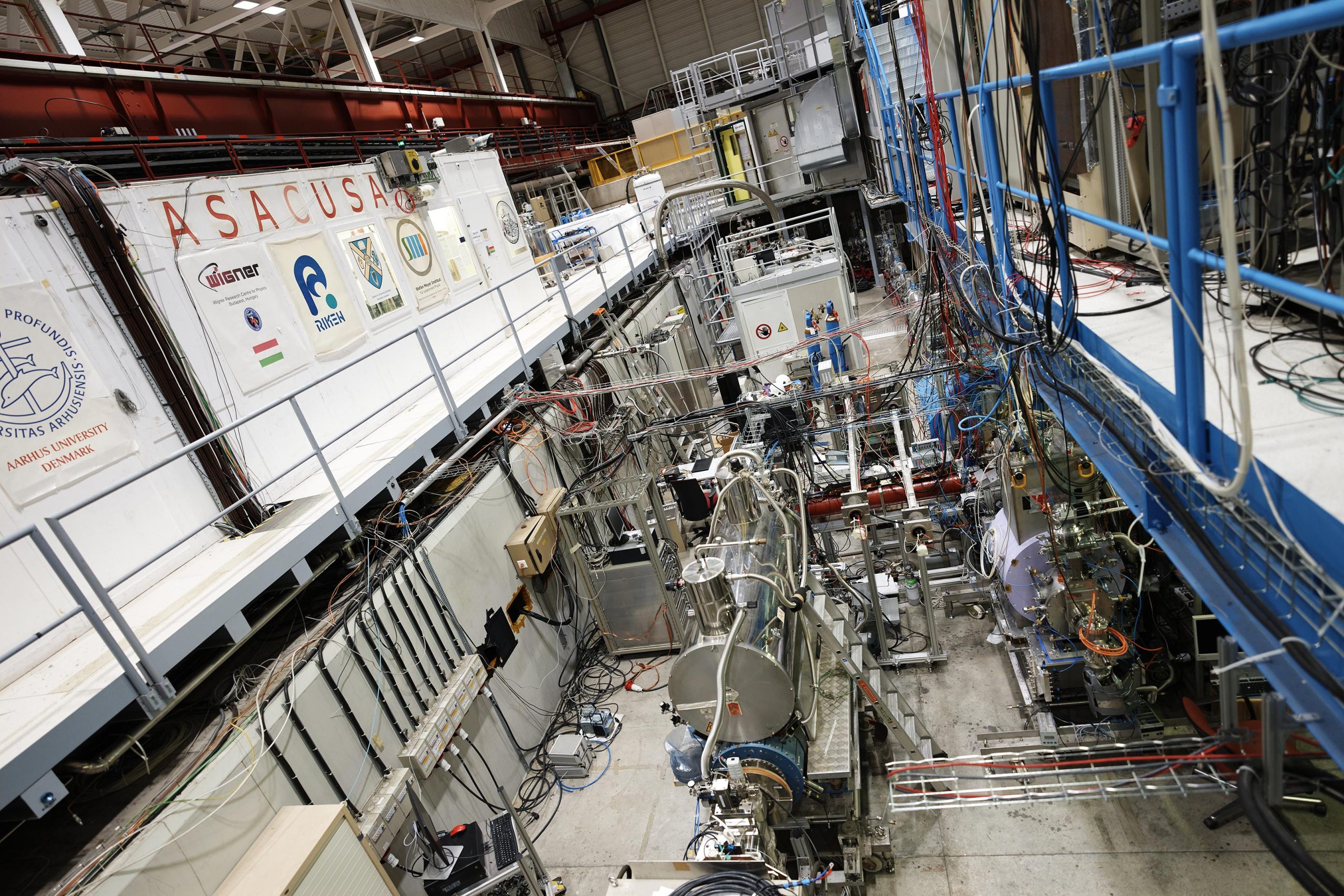
The ASACUSA collaboration is well used to making hybrid matter-antimatter helium atoms to determine the antiproton’s mass and compare it with that of the proton. These hybrid atoms contain an antiproton and an electron around the helium nucleus (instead of two electrons around a helium nucleus) and are made by mixing antiprotons produced at CERN’s antimatter factory with a helium gas that has a low atomic density and is kept at low temperature.
Low gas densities and temperatures have played a key role in these antimatter studies, which involve measuring the response of the hybrid atoms to laser light in order to determine their light spectrum. High gas densities and temperatures result in spectral lines, caused by transitions of the antiproton or electron between energy levels, that are too broad, or even obscured, to allow the mass of the antiproton relative to that of the electron to be determined.
This is why it came as surprise to the ASACUSA researchers that, when they used liquid helium, which has a much higher density than gaseous helium, in their new study, they saw a decrease in the width of the antiproton spectral lines.
Moreover, when they decreased the temperature of the liquid helium to values below the temperature at which the liquid becomes a superfluid, i.e. flows without any resistance, they found an abrupt further narrowing of the spectral lines.
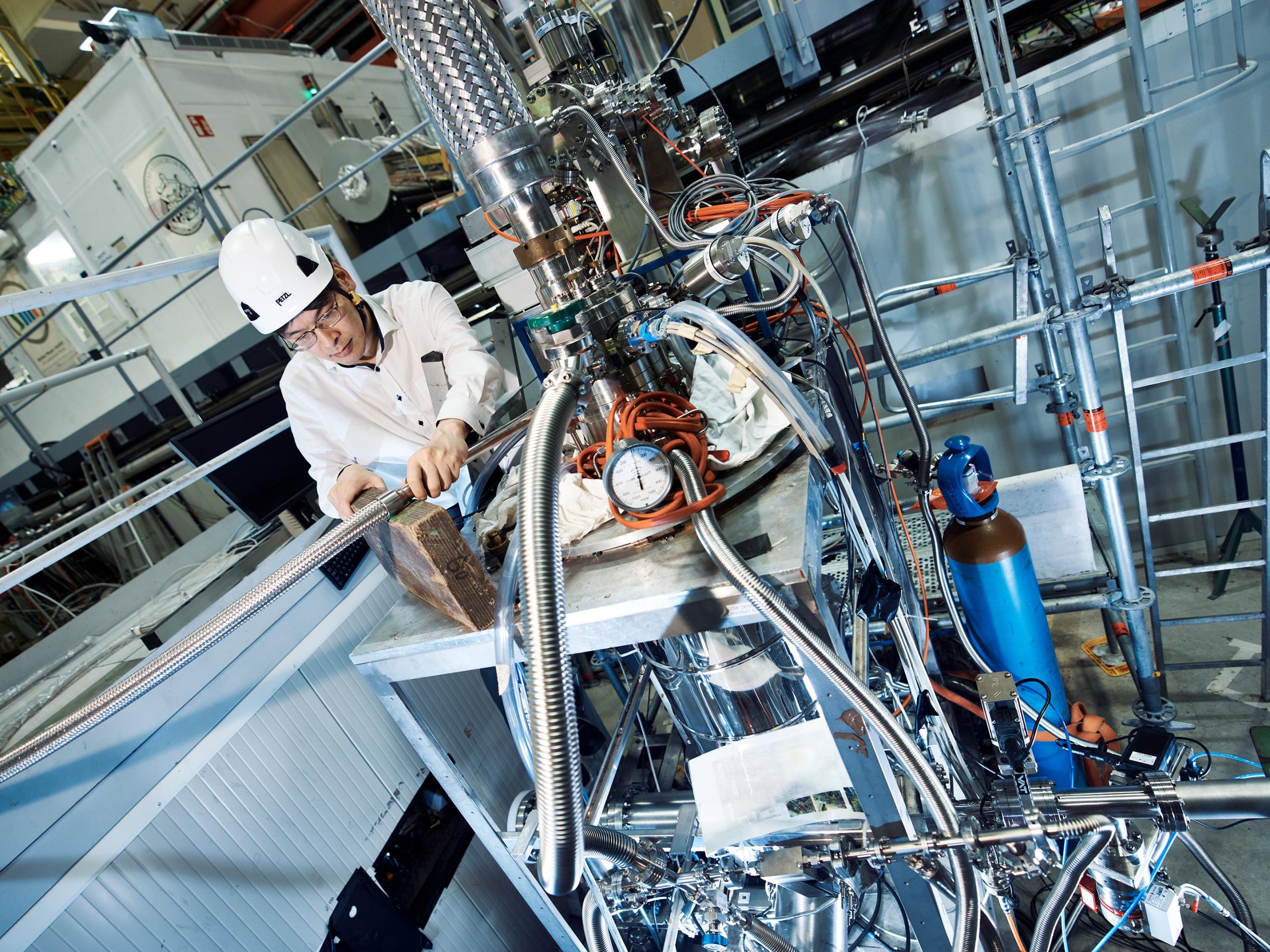
“This behavior was unexpected,” says Anna Sótér, who was the principal PhD student working on the experiment and is now an assistant professor at ETHZ. “The optical response of the hybrid helium atom in superfluid helium is starkly different to that of the same hybrid atom in high-density gaseous helium, as well as that of many normal atoms in liquids or superfluids.”
The researchers think that the surprising behavior observed is linked to the radius of the electronic orbital, i.e. the distance at which the hybrid helium atom’s electron is located. In contrast to that of many normal atoms, the radius of the hybrid atom’s electronic orbital changes very little when laser light is shone on the atom and thus does not affect the spectral lines even when the atom is immersed in superfluid helium. However, further studies are needed to confirm this hypothesis.
The result has several ramifications. Firstly, researchers may create other hybrid helium atoms, such as pionic helium atoms, in superfluid helium using different antimatter and exotic particles, to study their response to laser light in detail and measure the particle masses. Secondly, the substantial narrowing of the lines in superfluid helium suggests that hybrid helium atoms could be used to study this form of matter and potentially other condensed-matter phases. Finally, the narrow spectral lines could in principle be used to search for cosmic antiprotons or antideuterons (a nucleus made of an antiproton and an antineutron) of particularly low velocity that hit the liquid or superfluid helium that is used to cool experiments in space or in high-altitude balloons. However, numerous technical challenges must be overcome before the method becomes complementary to existing techniques for searching for these forms of antimatter.
Reference: “High-resolution laser resonances of antiprotonic helium in superfluid 4He” by Anna Sótér, Hossein Aghai-Khozani, Dániel Barna, Andreas Dax, Luca Venturelli and Masaki Hori, 16 March 2022, Nature.
DOI: 10.1038/s41586-022-04440-7
Never miss a breakthrough: Join the SciTechDaily newsletter.
Follow us on Google and Google News.
1 Comment
… what else now?