
Close Menu
    Facebook X (Twitter) Instagram
    SciTechDaily
    • Biology
    • Chemistry
    • Earth
    • Health
    • Physics
    • Science
    • Space
    • Technology
    Facebook X (Twitter) Pinterest YouTube RSS
    SciTechDaily
    Home»Space»Unexpected Interactions: How Solar Winds Are Stripping Mars of Its Atmosphere
    Space

    Unexpected Interactions: How Solar Winds Are Stripping Mars of Its Atmosphere

    By Umea UniversityOctober 4, 2024No Comments2 Mins Read
    Facebook Twitter Pinterest Telegram LinkedIn WhatsApp Email Reddit
    Share
    Facebook Twitter LinkedIn Pinterest Telegram Email Reddit
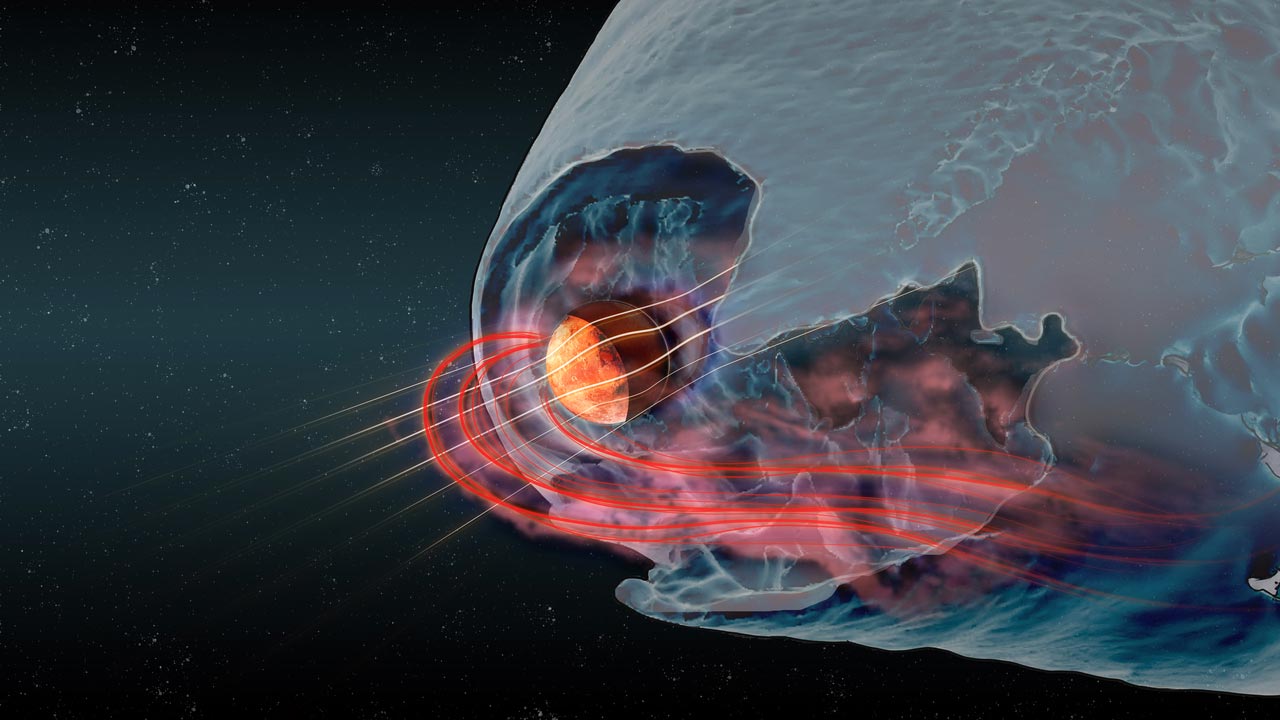
    How Mars Interacts With the Solar Wind
    A study published in Nature describes how Mars interacts with the solar wind. The solar wind flows along the white lines and atmospheric particles are lost to space along the red lines. Credit: Swedish Institute of Space Physics/IRF

    Researchers exploring Mars have uncovered how the planet’s lack of an internal magnetic field results in an induced magnetosphere, which directly interacts with the solar wind.

    Using instruments like ASPERA-3 on the Mars Express and MAVEN spacecraft, scientists have documented changes in this magnetosphere when aligned with solar wind magnetic fields, impacting atmospheric loss to space.

    Understanding Induced Magnetospheres

    When a planet does not possess an internal magnetic field, it can develop an induced magnetosphere through direct interactions between its atmosphere and the solar wind. The solar wind is a stream of charged particles from the Sun with an embedded magnetic field.

    The scientists have been using computer models and observations from scientific instruments, as IRF’s Analyzer of Space Plasmas and Energetic Atoms (ASPERA-3), onboard the ESA spacecraft Mars Express and NASA’s spacecraft MAVEN, both of which orbit around Mars.

    Qi Zhang
    Qi Zhang, PhD student at IRF and Umeå University. Credit: Swedish Institute of Space Physics/IRF

    Impact of Solar Wind Alignment

    “When the solar wind protons flow align with the magnetic field of the solar wind, the induced magnetosphere of Mars will degenerate. Such a degenerate magnetosphere will affect how much atmosphere is lost from Mars to space,” says the lead author Qi Zhang, PhD student at IRF and Umeå University.

    The results were published in the journal Nature on September 18, 2024.

    Long-Term Observations and Findings

    The ASPERA-3 instrument measures the fluxes of ions, electrons, and neutral atoms in space around Mars. During more than 20 years in orbit around the planet, ASPERA-3 has made a number of interesting observations at Mars, including continuous measurements of the ion outflow from the planet.

    Reference: “Mars’s induced magnetosphere can degenerate” by Qi Zhang, Stas Barabash, Mats Holmstrom, Xiao-dong Wang, Yoshifumi Futaana, Christopher M. Fowler, Robin Ramstad and Hans Nilsson, 18 September 2024, Nature.
    DOI: 10.1038/s41586-024-07959-z

    Never miss a breakthrough: Join the SciTechDaily newsletter.
    Follow us on Google and Google News.

    Atmospheric Science Magnetosphere Mars Solar Wind Umea University
    Share. Facebook Twitter Pinterest LinkedIn Email Reddit

    Related Articles

    Earth May Have Seeded the Moon With Life-Supporting Elements

    NASA Scientists Develop Instrument for Analyzing Mars’s Boundary Layer – “We Have Great Capabilities in Lidar, Space Lasers, and Detectors”

    NASA’s MAVEN Spacecraft Observes Weird Glowing and Pulsing in Mars’ Night Sky

    How Venus and Mars Can Teach Us About the Past and Future of Earth

    Mysteriously Long, Thin Cloud Returns on Mars – Not Linked to Volcanic Activity

    “Puzzling and Surprising” New Gas Signatures Discovered by ExoMars Orbiter in the Martian Atmosphere

    “Mind Boggling” Mars Mystery As Oxygen Doesn’t Behave by Known Chemistry

    New Research Explains Loss of Carbon in Martian Atmosphere

    Curiosity Rover Reveals Evidence of Ancient Top-of-Atmosphere Loss

    Leave A Reply Cancel Reply

    • Facebook
    • Twitter
    • Pinterest
    • YouTube

    Don't Miss a Discovery

    Subscribe for the Latest in Science & Tech!

    Trending News

    Sitting Up Straight Could Actually Help You Make Better Decisions

    Never-Before-Seen Vortices Are Swirling Across the Sun

    This Common Amino Acid May Help the Body Fight Cancer and Viruses

    Low-Protein “Longevity Diet” Linked to Fat Loss, Muscle Preservation, and Healthy Aging

    How Prehistoric Poop Changed Earth’s Ecosystems Forever

    This Fossil Upends a Decades-Old Debate About Snake Evolution

    A Blood Test Years Before Cancer May Reveal a Hidden Warning Sign

    Starlink Satellites Reveal a Hidden Atmosphere 300 Miles Above Earth

    Follow SciTechDaily
    • Facebook
    • Twitter
    • YouTube
    • Pinterest
    • Newsletter
    • RSS
    SciTech News
    • Biology News
    • Chemistry News
    • Earth News
    • Health News
    • Physics News
    • Science News
    • Space News
    • Technology News
    Recent Posts
    • A Simple Feeding Change Makes Zoo Lions Behave More Like They Do in the Wild
    • Scientists Discover a Hidden World of Fungi 1,640 Feet Beneath Michigan
    • Where Were All the Tiny Dinosaurs? Scientists May Finally Have an Answer
    • Astronomers Caught a Star Exploding Almost the Instant It Began
    • Empty Space May Not Be Empty After All: Magnetar Reveals a Bizarre Quantum Effect
    Copyright © 1998 - 2026 SciTechDaily. All Rights Reserved.
    • Science News
    • About
    • Contact
    • Editorial Board
    • Privacy Policy
    • Terms of Use

    Type above and press Enter to search. Press Esc to cancel.