
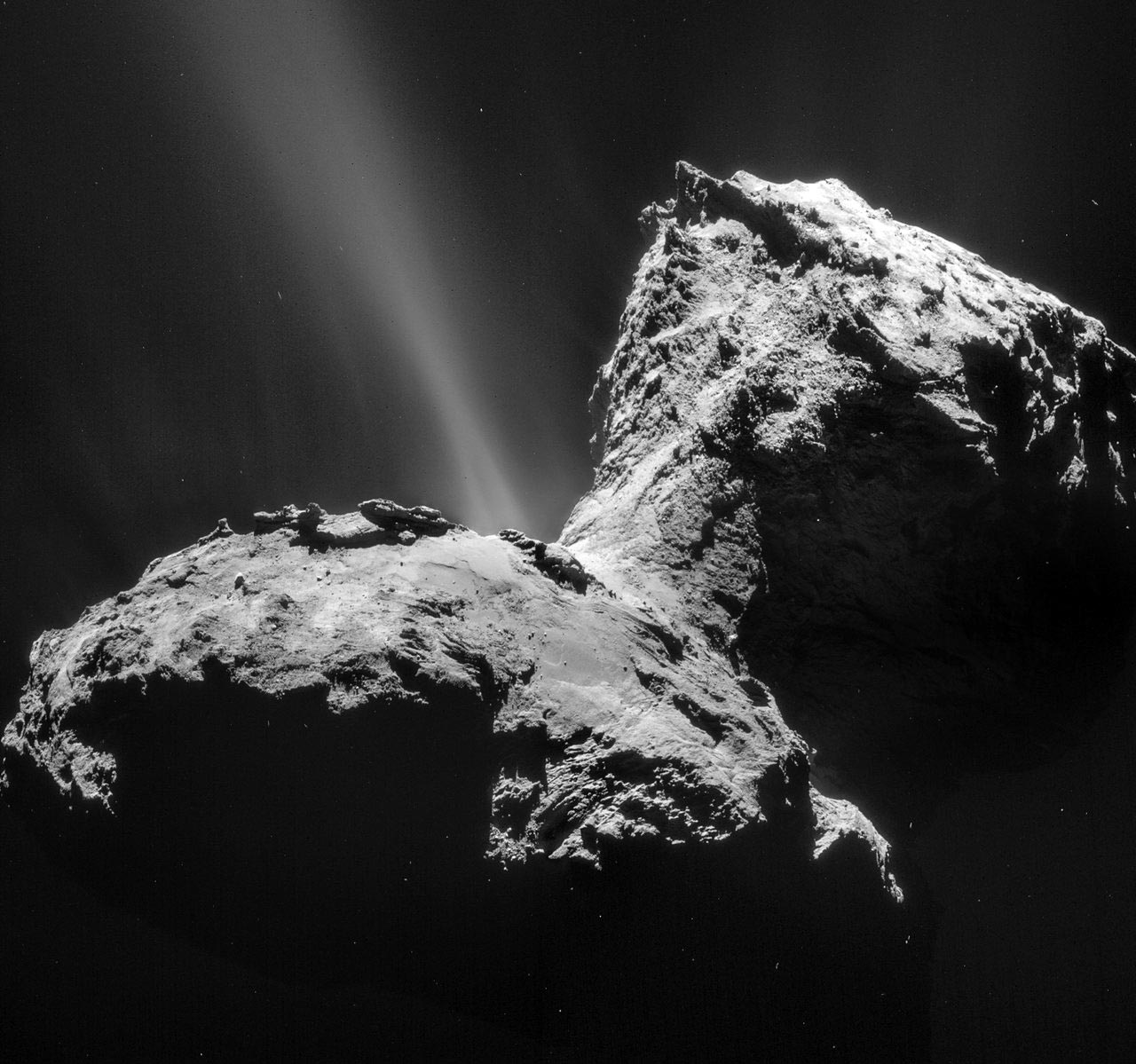
ESA’s Rosetta mission discovers unique aurora at Comet 67P/Churyumov-Gerasimenko.
Data from Southwest Research Institute-led instruments aboard ESA’s Rosetta spacecraft have helped reveal auroral emissions in the far ultraviolet around a comet for the first time.
At Earth, auroras are formed when charged particles from the Sun follow our planet’s magnetic field lines to the north and south poles. There, solar particles strike atoms and molecules in Earth’s atmosphere, creating shimmering curtains of colorful light in high-latitude skies. Similar phenomena have been seen at various planets and moons in our solar system and even around a distant star. SwRI’s instruments, the Alice far-ultraviolet (FUV) spectrograph and the Ion and Electron Sensor (IES), aided in detecting these novel phenomena at comet 67P/Churyumov-Gerasimenko (67P/C-G).
“Charged particles from the Sun streaming towards the comet in the solar wind interact with the gas surrounding the comet’s icy, dusty nucleus and create the auroras,” said SwRI Vice President Dr. Jim Burch who leads IES. “The IES instrument detected the electrons that caused the aurora.”
The envelope of gas around 67P/C-G, called the “coma,” becomes excited by the solar particles and glows in ultraviolet light, an interaction detected by the Alice FUV instrument.
“Initially, we thought the ultraviolet emissions at comet 67P were phenomena known as ‘dayglow,’ a process caused by solar photons interacting with cometary gas,” said SwRI’s Dr. Joel Parker who leads the Alice spectrograph. “We were amazed to discover that the UV emissions are aurora, driven not by photons, but by electrons in the solar wind that break apart water and other molecules in the coma and have been accelerated in the comet’s nearby environment. The resulting excited atoms make this distinctive light.”
Dr. Marina Galand of Imperial College London led a team that used a physics-based model to integrate measurements made by various instruments aboard Rosetta.
“By doing this, we didn’t have to rely upon just a single dataset from one instrument,” said Galand, who is the lead author of a Nature Astronomy paper outlining this discovery. “Instead, we could draw together a large, multi-instrument dataset to get a better picture of what was going on. This enabled us to unambiguously identify how 67P/C-G’s ultraviolet atomic emissions form, and to reveal their auroral nature.”
“I’ve been studying the Earth’s auroras for five decades,” Burch said. “Finding auroras around 67P, which lacks a magnetic field, is surprising and fascinating.”
Following its rendezvous with 67P/C-G in 2014 through 2016, Rosetta has provided a wealth of data revealing how the Sun and solar wind interact with comets. In addition to discovering these cometary auroras, the spacecraft was the first to orbit a comet’s nucleus, the first to fly alongside a comet as it traveled into the inner Solar System, and the first to send a lander to a comet’s surface.
For more on this research:
- Ultraviolet Aurora Phenomenon Discovered on Comet Chury
- Astronomers Discover “One of a Kind” Glow Surrounding Comet
Reference: “Far-ultraviolet aurora identified at comet 67P/Churyumov-Gerasimenko” by M. Galand, P. D. Feldman, D. Bockelée-Morvan, N. Biver, Y.-C. Cheng, G. Rinaldi, M. Rubin, K. Altwegg, J. Deca, A. Beth, P. Stephenson, K. L. Heritier, P. Henri, J. Wm. Parker, C. Carr, A. I. Eriksson and J. Burch, 21 September 2020, Nature Astronomy.
DOI: 10.1038/s41550-020-1171-7
Additional instruments contributing to this research were Rosetta’s Langmuir Probe (LAP), the Rosetta Orbiter Spectrometer for Ion and Neutral Analysis (ROSINA), the Microwave Instrument for the Rosetta Orbiter (MIRO) and the Visible and InfraRed Thermal Imaging Spectrometer (VIRTIS).
Rosetta is an ESA mission with contributions from its member states and NASA. Rosetta’s Philae lander is provided by a consortium led by DLR, MPS, CNES and ASI. Airbus Defense and Space built the Rosetta spacecraft. NASA’s Jet Propulsion Laboratory (JPL) manages the U.S. contribution of the Rosetta mission for NASA’s Science Mission Directorate in Washington, under a contract with the California Institute of Technology (Caltech). JPL also built the Microwave Instrument for the Rosetta Orbiter and hosts its principal investigator, Dr. Mark Hofstadter. SwRI (San Antonio and Boulder, Colorado) developed the Rosetta orbiter’s Ion and Electron Sensor and Alice instrument and hosts their principal investigators.
Never miss a breakthrough: Join the SciTechDaily newsletter.
Follow us on Google and Google News.