
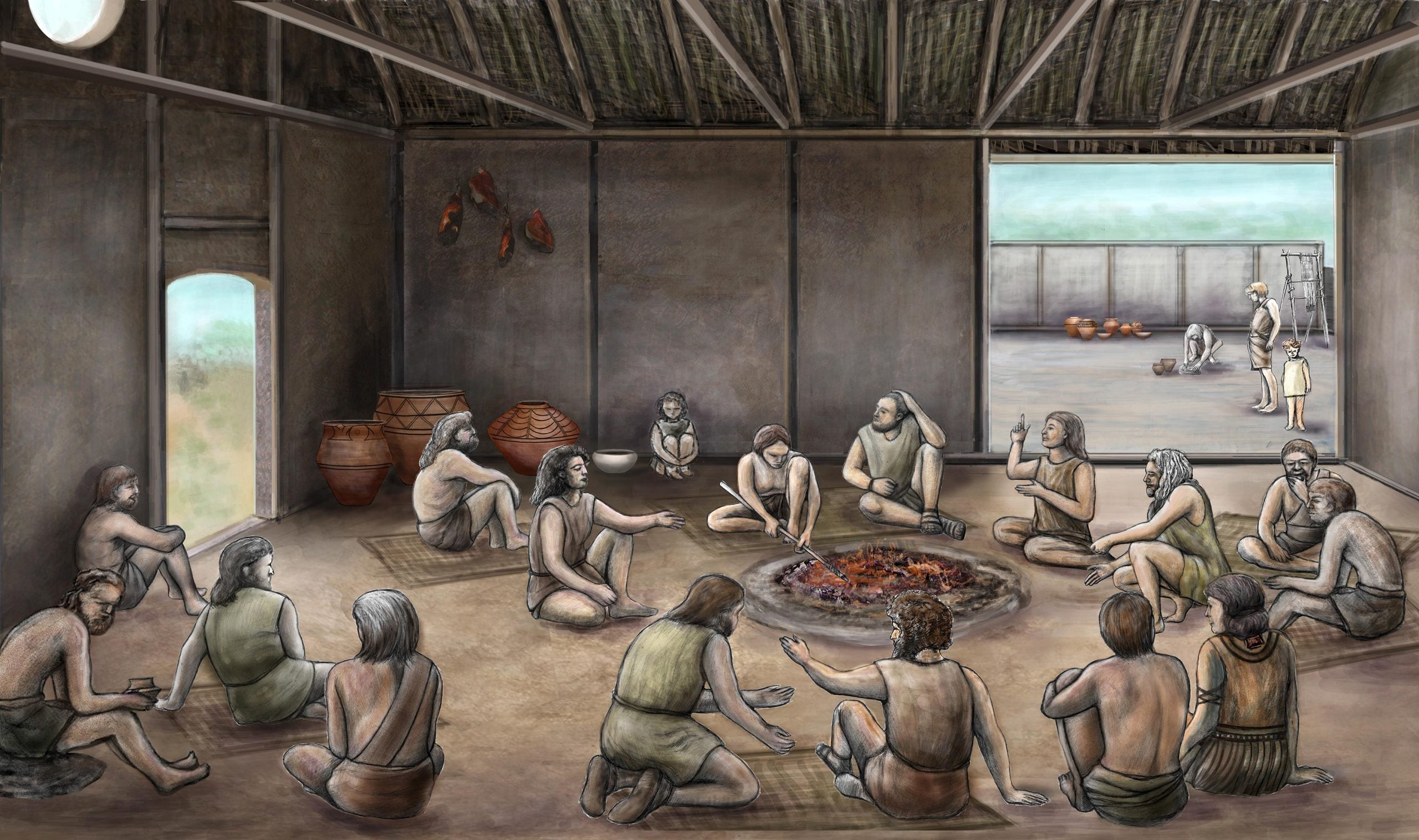
Researchers have developed a new method using the ‘capability approach’ to interpret archaeological data, revealing insights into ancient social structures and individual well-being.
By relating archaeological categories to the United Nations Human Development Index, the approach has allowed scholars to link ancient mega settlements in Europe with modern concepts of human development, offering fresh perspectives on historical societal dynamics and suggesting that opportunities for personal realization may have influenced demographic and technological changes.
Archaeological Philosophy
Archaeological excavations often uncover fragments of pottery, traces of ancient buildings, and scattered bones — remnants of material culture that hint at the lives of people in the past. Interpreting these finds requires a variety of analytical tools, including philosophical frameworks. However, such frameworks have typically been applied to broad theoretical debates rather than the direct analysis of specific discoveries.
In a recent study published in Open Archaeology, a team comprising two archaeologists and a philosopher from the ROOTS Cluster of Excellence at Kiel University proposes a novel approach. They apply the “capability approach” to explore questions of identity and social organization through archaeological evidence. Using Europe’s first mega settlements—spanning roughly 7,000 to 5,000 years ago—as a case study, the researchers make groundbreaking connections between ancient archaeological data and the United Nations Human Development Index.
“For the first time, we were ultimately able to relate archaeological categories to those of the United Nations Human Development Index. Thus, the presented approach also enables links to be made between the distant past and the present,” explains Dr. Vesa Arponen, one of the authors.
Incorporating the Capability Approach
The ‘capability approach’ is a philosophical concept that goes back to the work of the Indian philosopher and economist Amartya Sen in the 1970s and 1980s. “The approach assumes that human well-being is not only measured by material possessions but also by other means that enable and facilitate action, as well as by the capabilities for groups and individuals to lead an active life,” explains Dr. Arponen.
Today, this concept of human well-being serves as the theoretical basis for the United Nations Human Development Index (HDI). However, applying it to human communities in the distant past poses a major challenge. “How can we use the static remains of material culture to reconstruct dimensions of the dynamic activity behind it?” says co-author Dr. René Ohlrau, summing up this challenge.
Exploring Ancient Mega Settlements
In order to master these challenges, the authors first related the dimensions and levels of analysis of the Human Development Index to archaeological indicators. “One of these categories, for example, is the standard of living, which is also reflected at a societal level in the capacity for innovation. Technical innovations can indeed be traced in archaeological finds, for example, when a certain shape of plow or new looms appear in the archaeological record,” explains co-author Prof. Dr. Tim Kerig.
In a second step, the authors applied the newly developed scheme to the Cucuteni-Trypillia communities (ca. 5050-2950 BCE) that were located in what is now present-day Romania, the Republic of Moldova and Ukraine. The communities are known for large, ring-shaped settlements that extended up to ca. 320 hectares in size and were the home of up to 17,000 people.
Reinterpreting Historical Societal Dynamics
“The application of our analysis tool confirms previous studies. They maintain that these settlements were characterized by great social equality in their blossoming phase and that people had extensive opportunities to be active themselves,” says Dr. Arponen. “However, our results point to different explanations for this than before.”
Until now, climate change and population growth have often been seen as triggers to which people reacted with innovations in politics and technology. “Our analytical approach opens up the possibility of interpreting the developments in the Cucuteni-Trypillia societies the other way around. It could have been the expanded opportunities for people and their chance of realization that attracted more people, which then led to population growth and innovation,” summarizes Dr. Arponen.
Future Prospects in Archaeological Research
In future research, the approach will also be applied to other societies of the past and in other archaeological contexts. “In any case, it offers the opportunity to question traditional patterns of explanation in archaeology and to stimulate new discussions on the interpretation of finds,” Dr. Arponen is convinced.
Reference: “The Capability Approach and Archaeological Interpretation of Transformations: On the Role of Philosophy for Archaeology” by V. P. J. Arponen, René Ohlrau and Tim Kerig, 30 October 2024, Open Archaeology.
DOI: 10.1515/opar-2024-0013
Never miss a breakthrough: Join the SciTechDaily newsletter.
Follow us on Google and Google News.