

Close Menu
    Facebook X (Twitter) Instagram
    SciTechDaily
    • Biology
    • Chemistry
    • Earth
    • Health
    • Physics
    • Science
    • Space
    • Technology
    Facebook X (Twitter) Pinterest YouTube RSS
    SciTechDaily
    Home»Health»Unlocking Down Syndrome’s Secrets: Protein Interaction Unveils New Molecular Mechanisms
    Health

    Unlocking Down Syndrome’s Secrets: Protein Interaction Unveils New Molecular Mechanisms

    By Kyoto UniversityJanuary 4, 20241 Comment3 Mins Read
    Facebook Twitter Pinterest Telegram LinkedIn WhatsApp Email Reddit
    Share
    Facebook Twitter LinkedIn Pinterest Telegram Email Reddit
    Smiling Girl Downs Syndrome
    Researchers at Kyoto University have made significant strides in understanding Down syndrome, focusing on the protein kinase DYRK1A. Their discoveries offer new insights into the molecular mechanisms of Down syndrome and autism spectrum disorder, as well as potential clinical applications for managing these conditions.

    A recent study uncovers the role of FAM53C in regulating DYRK1A, offering new insights into the cellular mechanisms of Down syndrome and potential clinical implications.

    Down syndrome, a congenital disorder stemming from abnormal cell division and differentiation, is most common in newborns fated to neurodevelopmental delays and other health complications.

    The genetic defect causes the dysfunction of the protein kinase DYRK1A, which is encoded on chromosome 21 and is deeply associated with both Down syndrome and autism spectrum disorder. DYRK1A has attracted attention as a target molecule for treating various diseases, but specific cellular mechanisms regulating the enzyme DYRK1A have yet to be made clear.

    Now, researchers at Kyoto University have identified the FAM53C protein and its DYRK1A-inhibiting effect that keeps the protein kinase inactive inside the cytoplasm.
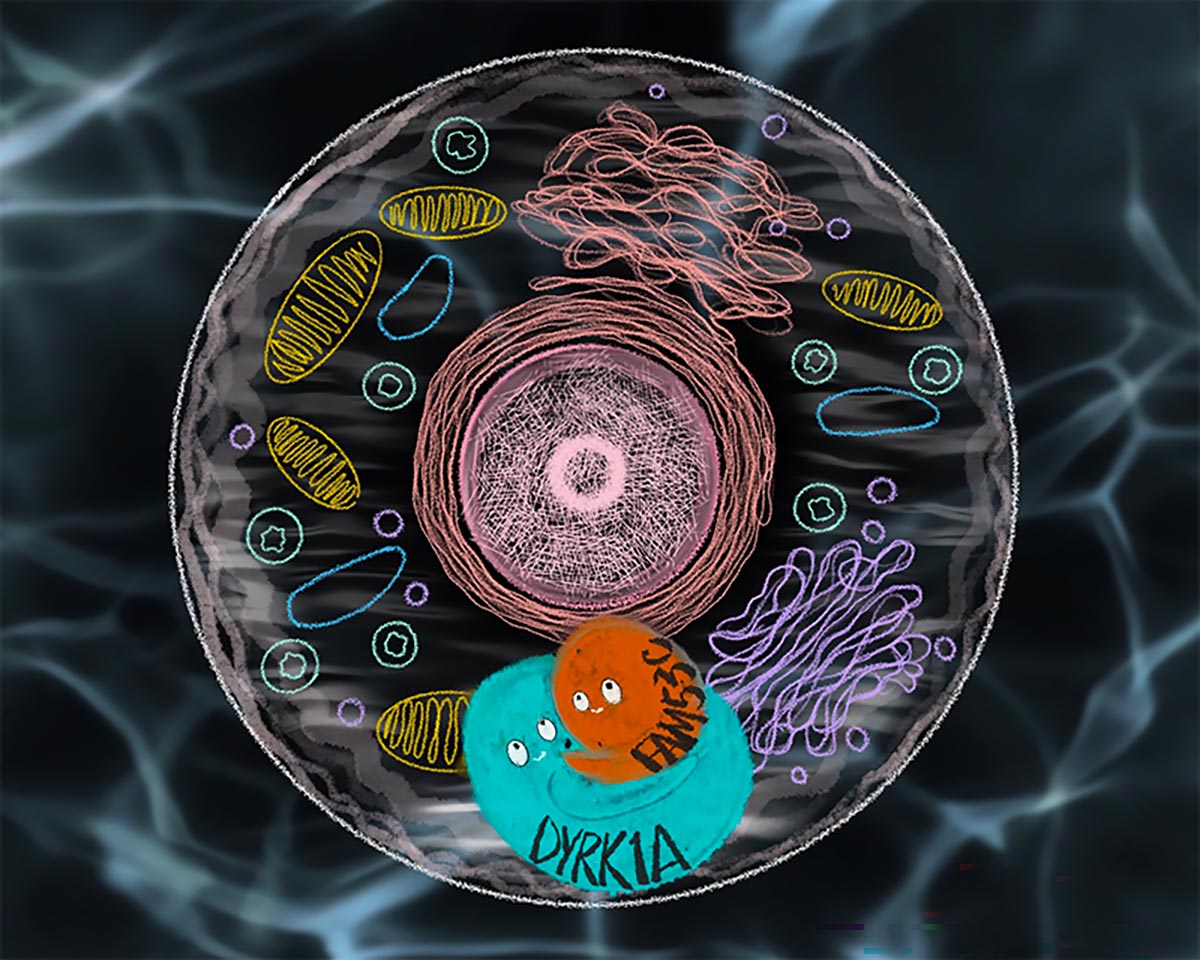
    DYRK1A Bound to FAM53C
    DYRK1A bound to FAM53C in the cytoplasm is less active. DYRK1A not bound to FAM53C in the nucleus is highly active. Functional abnormalities cause various neuropsychiatric developmental and functional disorders. Credit: KyotoU/Gakuji Tobiyama/Yoshihiko Miyata

    “Our findings demonstrate the important role of the intracellular regulatory mechanism of DYRK1A in the normal development and function of the neuropsychiatric system,” says first author Yoshihiko Miyata at KyotoU’s Graduate School of Biostudies.

    “The molecular regulation of the highly complex development and activity of the human brain fascinates me,” adds Miyata. In addition to neuropsychiatric symptoms, Down syndrome may also cause early onset of Alzheimer’s disease, type 2 diabetes, and facial maldevelopment.

    “Given DYRK1A’s significance, we have explored potential molecules serving as its interacting counterpart,” says Miyata.

    DYRK1A controls many biological functions, including the development and function of the nervous system. At the cellular level, this critical protein phosphorylates various other proteins in the cytoplasm and nucleus to regulate the cell cycle, cell differentiation, cytoskeletal formation, and DNA damage response.

    After identifying DCAF7/WDR68 as a major binding protein for DYRK1A in a previous study, Miyata’s team used mass spectrometry to uncover other interacting proteins that modulate DYRK1A’s function and cellular location. Notably, the structurally flexible FAM53C protein binds directly to a region of DYRK1A responsible for protein phosphorylation. This interaction reduces DYRK1A’s kinase activity, securely anchoring DYRK1A within the cytoplasm but outside the cell nucleus, as in normal brain tissue.

    “The FAM53C-mediated regulation of the protein kinase activity may significantly impact gene expression regulation caused by normal and aberrant levels of DYRK1A, giving us many potential clinical insights,” suggests Miyata.

    Reference: “Identification of FAM53C as a cytosolic-anchoring inhibitory binding protein of the kinase DYRK1A” by Yoshihiko Miyata and Eisuke Nishida, 6 October 2023, Life Science Alliance.
    DOI: 10.26508/lsa.202302129

    Never miss a breakthrough: Join the SciTechDaily newsletter.
    Follow us on Google and Google News.

    Developmental Biology Genetics Kyoto University Neuroscience
    Share. Facebook Twitter Pinterest LinkedIn Email Reddit

    Related Articles

    Genetic Mutation Reveals Surprising Role of Bioelectricity in Early Brain Formation

    Suffering in Silence: Two-Thirds of Seniors Say They Won’t Treat Their Depression

    Plant Compound Apigenin Reduces Cognitive Deficits in Mouse Model of Down Syndrome

    Neural Vulnerability in Huntington’s Disease Tied to Immune Response to Genetic Material

    New Genetic Mutations Linked to Autism Spectrum Disorder Uncovered by Scientists

    New Rare Disease Uncovered With Own Facial Features, Cardiac Defects and Developmental Delay

    Neuroscientists May Have Just Discovered Why Some People Are More Prone to Anxiety

    New Insight on CLOCK Gene May Hold Answers to Human Brain Evolution

    Scientists Report a Major Breakthrough in Alzheimer’s Disease

    1 Comment

    1. Paul Dodd on January 5, 2024 1:42 pm

      “Down syndrome, a congenital disorder stemming from abnormal cell division and differentiation, is most common in newborns fated to neurodevelopmental delays and other health complications.”
      Confusing cause and effect?

      Reply
    Leave A Reply Cancel Reply

    • Facebook
    • Twitter
    • Pinterest
    • YouTube

    Don't Miss a Discovery

    Subscribe for the Latest in Science & Tech!

    Trending News

    Bone-Strengthening Discovery Could Reverse Osteoporosis

    Scientists Uncover Hidden Trigger Behind Stem Cell Aging

    Scientists Find Way to Reverse Fatty Liver Disease Without Changing Diet

    Could Humans Regrow Limbs? New Study Reveals Promising Genetic Pathway

    Scientists Reveal Eating Fruits and Vegetables May Increase Your Risk of Lung Cancer

    Scientists Reverse Brain Aging With Simple Nasal Spray

    Scientists Uncover Potential Brain Risks of Popular Fish Oil Supplements

    Scientists Discover a Surprising Way To Make Bread Healthier and More Nutritious

    Follow SciTechDaily
    • Facebook
    • Twitter
    • YouTube
    • Pinterest
    • Newsletter
    • RSS
    SciTech News
    • Biology News
    • Chemistry News
    • Earth News
    • Health News
    • Physics News
    • Science News
    • Space News
    • Technology News
    Recent Posts
    • This Student Recreated the Universe in a Bottle. What She Discovered Could Help Reveal How Life Started on Earth
    • Alzheimer’s Symptoms May Start Outside the Brain, Study Finds
    • Cancer’s Secret Weapon? Scientists Reveal How Tumors “Learn” To Survive Treatment
    • Millions Take This Popular Supplement – Scientists Discover a Concerning Link to Heart Failure
    • What Makes Rubber So Strong? Scientists Finally Solve 100-Year-Old Mystery
    Copyright © 1998 - 2026 SciTechDaily. All Rights Reserved.
    • Science News
    • About
    • Contact
    • Editorial Board
    • Privacy Policy
    • Terms of Use

    Type above and press Enter to search. Press Esc to cancel.