

Close Menu
    Facebook X (Twitter) Instagram
    SciTechDaily
    • Biology
    • Chemistry
    • Earth
    • Health
    • Physics
    • Science
    • Space
    • Technology
    Facebook X (Twitter) Pinterest YouTube RSS
    SciTechDaily
    Home»Biology»Unlocking Evolution: Breakthroughs in Fruit Fly Genomic Sequencing
    Biology

    Unlocking Evolution: Breakthroughs in Fruit Fly Genomic Sequencing

    By PLOSJuly 18, 2024No Comments3 Mins Read
    Facebook Twitter Pinterest Telegram LinkedIn WhatsApp Email Reddit
    Share
    Facebook Twitter LinkedIn Pinterest Telegram Email Reddit
    Genetics Genome Sequence DNA Map
    Researchers have made significant strides in genomic sequencing for the fruit fly family, Drosophilidae, by sequencing 179 species, including wild, museum-preserved, and lab-reared flies. Using a hybrid sequencing approach, they produced high-quality, low-cost genomes.

    Researchers used a hybrid approach to sequence DNA from individual wild flies and museum specimens.

    New research has significantly advanced fruit fly genomics by sequencing 179 species and improving the phylogenetic tree for 360 species, showing that comprehensive genome sequencing is achievable on a small budget.

    Expanding Genomic Horizons in Fruit Fly Research

    A multitude of new genomic sequence data fills major gaps in the fruit fly tree of life, Bernard Kim from Stanford University and colleagues report today (July 18) in the open-access journal PLOS Biology.

    Fruit flies are classic model organisms in biological research and were among the first species to have their whole genome sequenced. With over 4,400 species, the diversity of the fruit fly family could offer insights into evolutionary patterns and processes. However, only a fraction of these species have their genome sequenced, and most published fruit fly genome sequences are from a very limited set of species with representative inbred laboratory strains.
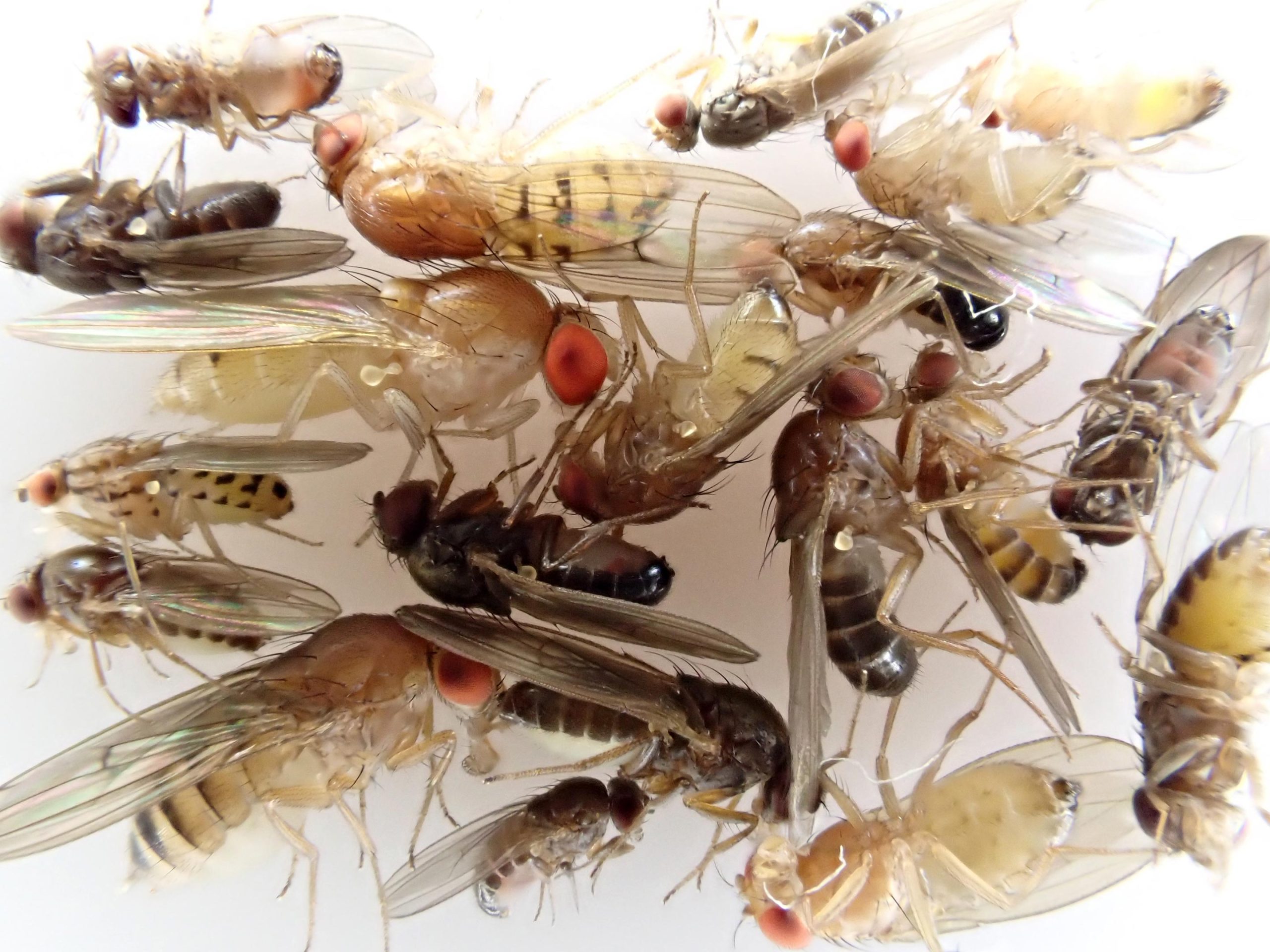
    Different Fly Species Collected in the United Kingdom
    A mix of 15 different fly species collected in the United Kingdom in 2023. Credit: Darren J. Obbard (CC-BY 4.0)

    Advancements in Fruit Fly Genome Sequencing

    To address this, researchers sequenced the genomes of 179 fly species in the Drosophilidae family, including wild-caught flies, preserved museum specimens, and laboratory-reared strains. Using a hybrid sequencing approach that combines the newest short- and long-read sequencing technologies, they were able to produce low-cost, high-quality genome sequences from limited material. They used the new genome sequences and previously published data to produce a phylogenetic tree for 360 species in the Drosophilidae family, refining our understanding of the evolutionary relationships of these species. They also aligned nearly 300 fruit fly genomes as an open-source tool for future comparative genomics research, such as a whole-genome alignment.

    James Hemker Conducts Sweep Net Sampling in Redwoods State and National Park
    Co-author James Hemker conducts sweep net sampling in Redwoods State and National Park, California, USA. Credit: Bernard Y. Kim (CC-BY 4.0)

    While large-scale sequencing efforts for larger organisms such as mammals are well underway, this study demonstrates that genome sequencing for small organisms such as individual flies — even those preserved in museums for up to two decades — is now possible.

    The authors add, “It is now entirely feasible to think about assembling genomes for hundreds or thousands of species, even on the research budget of a single lab. This kind of large-scale, clade-level sampling will provide us with an unprecedented level of resolution for studying the genome sequences of diverse groups like fruit flies and beyond, which is sure to improve our understanding of the evolutionary process.”

    Reference: “Single-fly genome assemblies fill major phylogenomic gaps across the Drosophilidae Tree of Life” by Bernard Y. Kim, Hannah R. Gellert, Samuel H. Church, Anton Suvorov, Sean S. Anderson, Olga Barmina, Sofia G. Beskid, Aaron A. Comeault, K. Nicole Crown, Sarah E. Diamond, Steve Dorus, Takako Fujichika, James A. Hemker, Jan Hrcek, Maaria Kankare, Toru Katoh, Karl N. Magnacca, Ryan A. Martin, Teruyuki Matsunaga, Matthew J. Medeiros, Danny E. Miller, Scott Pitnick, Michele Schiffer, Sara Simoni, Tessa E. Steenwinkel, Zeeshan A. Syed, Aya Takahashi, Kevin H-C. Wei, Tsuya Yokoyama, Michael B. Eisen, Artyom Kopp, Daniel Matute, Darren J. Obbard, Patrick M. O’Grady, Donald K. Price, Masanori J. Toda, Thomas Werner and Dmitri A. Petrov, 18 July 2024, PLOS Biology.
    DOI: 10.1371/journal.pbio.3002697

    Never miss a breakthrough: Join the SciTechDaily newsletter.
    Follow us on Google and Google News.

    Drosophila Evolution Fruit Flies Genomics PLOS
    Share. Facebook Twitter Pinterest LinkedIn Email Reddit

    Related Articles

    Predicting the Next Pandemic Virus Is Harder Than We Think – Here’s Why

    Human Screams Communicate at Least Six Emotions – Surprisingly Acoustically Diverse

    New Research Finds SARS-CoV-2 (the Virus That Causes COVID-19) Jumped From Bats to Humans Without Much Change

    Evolution of One of the Fastest Jaws in the Natural World: Function Before Form in Trap-Jaw Ants

    How an Infectious Tumor in Endangered Tasmanian Devils Evolved As It Spread

    Wild Animals Lose Fear of Predators Quickly After They Start Encountering Humans

    Shocking Research Finds DNA From an Ancient, Unidentified Ancestor Was Passed Down to Humans Living Today

    DNA Study Reveals Clues about Primate Evolution

    Prolific Changes in the Human Genome in the Past 5,000 Years

    Leave A Reply Cancel Reply

    • Facebook
    • Twitter
    • Pinterest
    • YouTube

    Don't Miss a Discovery

    Subscribe for the Latest in Science & Tech!

    Trending News

    One of the Universe’s Largest Stars May Be Getting Ready To Explode

    Scientists Discover Enzyme That Could Supercharge Ozempic-Like Weight Loss Drugs

    Popular Sweetener Linked to DNA Damage – “It’s Something You Should Not Be Eating”

    Ancient “Rock” Microbes May Reveal How Complex Life Began

    Researchers Capture Quantum Interference in One of Nature’s Rarest Atoms

    “A Plague Is Upon Us”: The Mass Death That Changed an Ancient City Forever

    Scientists Discover Game-Changing New Way To Treat High Cholesterol

    This Small Change to Your Exercise Routine Could Be the Secret to Living Longer

    Follow SciTechDaily
    • Facebook
    • Twitter
    • YouTube
    • Pinterest
    • Newsletter
    • RSS
    SciTech News
    • Biology News
    • Chemistry News
    • Earth News
    • Health News
    • Physics News
    • Science News
    • Space News
    • Technology News
    Recent Posts
    • Scientists Rethink Extreme Warming After Surprising Ocean Discovery
    • The Surprising Role of Asteroids in the Origin of Life
    • Scientists Raise Concerns Over Newly Recognized Pollutant Found Everywhere in the Air
    • New Study Challenges 40-Year Puzzle About Childhood Body Fat
    • 20-Year Study Finds Daily Multivitamins Don’t Extend Lifespan
    Copyright © 1998 - 2026 SciTechDaily. All Rights Reserved.
    • Science News
    • About
    • Contact
    • Editorial Board
    • Privacy Policy
    • Terms of Use

    Type above and press Enter to search. Press Esc to cancel.