

Scientists have decoded the mystery of Earth’s hottest period 400,000 years ago by studying cave formations and ocean data.
Their findings explain how weak solar radiation and moderate greenhouse gases led to significant ice melt and high sea levels, offering important lessons for current global warming scenarios.
Earth’s Climatic Shifts
Over millions of years, Earth has experienced cycles of ice ages and warm periods. Today, we find ourselves in a warm period heavily influenced by human activities. As greenhouse gas levels in the atmosphere rise, global warming intensifies, causing ice sheets to melt rapidly, sea levels to rise, and posing severe threats to global ecosystems and human societies. Understanding the mechanisms behind these warming periods by studying past extreme warm periods is a crucial task for modern scientists.
Unraveling the MIS 11c Paradox
The hottest warm period in the past million years is believed to have occurred around 400,000 years ago. During this time, the Northern Hemisphere had less ice than today, and sea levels were about 10 meters higher. Surprisingly, solar radiation, a key driver of warm periods, was weak during this time, and greenhouse gas levels were lower than today. This puzzling period, known as the “MIS 11c Paradox,”[1] has long baffled scientists.
Dr. Hsun-Ming Hu, a postdoctoral researcher from the Department of Geosciences at National Taiwan University (NTU), along with an international team led by NTU’s Distinguished Professor Shen Chuan-Chou, has uncovered the key to this mystery. Using speleothem data from Mediterranean caves and North Atlantic ocean records, their groundbreaking research reveals the causes of the anomalous warmth 400,000 years ago. Their findings were published in the prestigious journal Nature Communications on July 15, 2024.[2]

Key Insights From Speleothem Studies
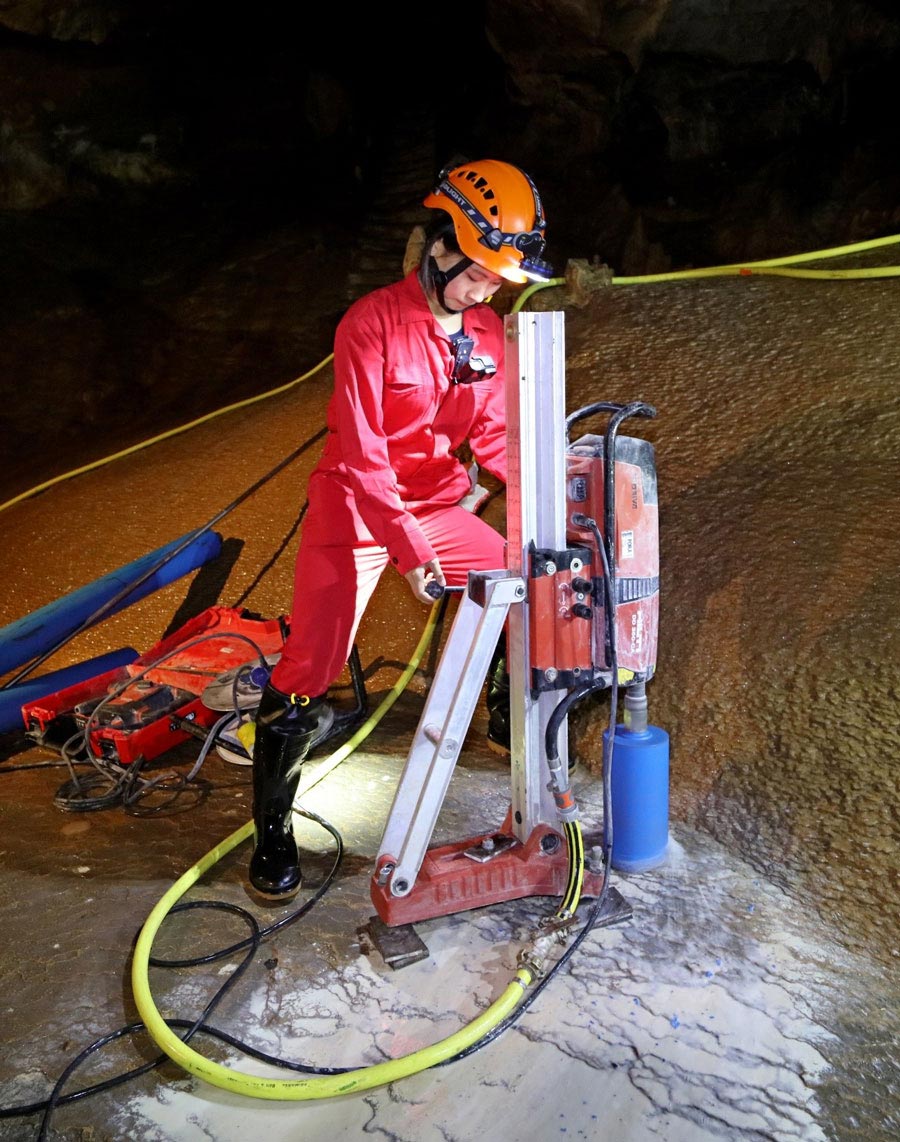
Dr. Hu explains that the key to solving the “MIS 11c Paradox” lies in understanding the sequence of reactions of Earth’s ice sheets, oceans, and atmosphere to solar radiation. Due to the lack of precise dating in most ocean and land records, this issue has puzzled scientists for years. In 2014, the NTU team and their European partners collected a two-meter-long speleothem core sample from Bàsura cave in northern Italy (Figures 1-3).
Using high-precision uranium-thorium dating technology from NTU HISPEC laboratory (Figures 4,5), they provided accurate age control for geological records, reconstructing the environmental history of southern Europe from 480,000 to 360,000 years ago. By comparing solar radiation, global sea level changes, and various climate records, the team finally unraveled the “MIS 11c Paradox.”

Climate Implications From Historical Data
Dr. Shen highlights that over the past few years, the team discovered that the carbonate records from Bàsura cave are closely linked to climate changes in the Atlantic and Mediterranean regions (Hu et al. 2022a, Nature Communications, 13, 4898; Hu et al., 2022b, Nature Communications, 13, 7866). The chronology of paleoclimate records from the North Atlantic could, therefore, be controlled accurately using the precisely dated stalagmites from the cave.
Consequences of Oceanic Warming on Ice Shelves
Their research shows that the extreme warm period of MIS 11c was due to a combination of factors. Around 426,000 years ago, increased summer solar radiation in the Northern Hemisphere first caused extreme warming in the mid-to-low latitude Atlantic. Coincidentally, as ocean warming occurred, Earth’s tilt gradually increased to make hot summers, allowing this warm water to persist for thousands of years. The prolonged transfer of heat to high latitudes through ocean currents caused an unusual, long-lasting melting of ice shelves, leading to the hottest period in Earth’s history over the past million years.
Implications for Current Climate Understanding
MIS 11c serves as an important example for understanding global warming. Like today, this period did not have particularly strong solar radiation, but it shows that prolonged ocean warming alone can cause significant ice shelf collapse and sea level rise without requiring extremely high atmospheric temperatures or greenhouse gas concentrations. This study highlights the crucial role of oceans in driving global warming and ice shelf collapse and is of utmost importance for the future of our planet.
This research was supported by the Ministry of Science and Technology’s Project, the Center of Future Earth Science Research. The international project, led by NTU’s Department of Geosciences, involved researchers from 20 institutes in Europe, USA, and Asia. In addition to Dr. Hu and Professor Shen, NTU participants included alumni Hsien-Chen Tsai, Wei-Yi Chien, Wen-Hui Sung, and Chia-Hao Hsu.
References:

- “MIS” stands for Marine Isotope Stage, which categorizes the alternating warm and cold periods in Earth’s geological history. Odd numbers denote warm periods; while, even numbers represent ice ages. Presently, Earth is experiencing MIS 1, a warm period. MIS 11c specifically denotes the initial stage ‘c’ of the MIS 11 warm period, occurring around 428,000 years ago.
- “Sustained North Atlantic warming drove anomalously intense MIS 11c interglacial” by Hsun-Ming Hu, Gianluca Marino, Carlos Pérez-Mejías, Christoph Spötl, Yusuke Yokoyama, Jimin Yu, Eelco Rohling, Akihiro Kano, Patrick Ludwig, Joaquim G. Pinto, Véronique Michel, Patricia Valensi, Xin Zhang, Xiuyang Jiang, Horng-Sheng Mii, Wei-Yi Chien, Hsien-Chen Tsai, Wen-Hui Sung, Chia-Hao Hsu, Elisabetta Starnini, Marta Zunino and Chuan-Chou Shen, 15 July 2024, Nature Communications.
DOI: 10.1038/s41467-024-50207-1
Never miss a breakthrough: Join the SciTechDaily newsletter.
Follow us on Google and Google News.
8 Comments
What drove the increased earth tilt?
https://en.wikipedia.org/wiki/Milankovitch_cycles
“As greenhouse gas levels in the atmosphere rise, global warming intensifies, causing ice sheets to melt rapidly, sea levels to rise, and posing severe threats to global ecosystems and human societies.”
The above is the commonly accepted interpretation of the dynamic system of climate. However, the Law Dome (Antarctica) ice cores indicate that warming occurred well before CO2 increased, for several events. That is understandable because as water warms it can hold less CO2 in solution (Henry’s Law). Thus, less CO2 is dissolved in the oceans at high latitudes, and dissolved CO2 out-gases at lower latitudes. At the same time, as the temperatures increase, vegetation, fungi, and bacteria grow more rapidly and expand to areas formerly covered with ice. The increasing vegetative cover provides more annual organic detritus for the bacteria to decompose and add to the atmosphere, as is notably happening today in the Arctic. Warmer Winters also allow dormant trees to respire more CO2 from their roots, also adding to more CO2 in the atmosphere. Thus, warming in general is good for vegetation because the warming increases metabolic rates, provides more soil and CO2, and increased evaporation should provide more rainfall for plants. Because photosynthesis requires sunlight and temperatures above freezing, the annual Northern Hemisphere seasonal ramp-up phase, driven by bacteria, is currently longer than the seasonal Summer draw-down phase. However, in the future, with first killing frosts happening later and last killing frosts happening earlier, the asymmetry should end and the photosynthetic draw-down should balance the ramp-up. This is basically an argument that the current paradigm has cause and effect backwards.
The early geologist James Hutton famously promoted the idea that “The present is the key to the past” to counter the prevailing idea of catastrophism. Conversely, the past is the key to the present. Therefore, one has to come up with good reasons to invalidate Occam’s Razor, which states that the simplest explanation is probably correct. It has been both warmer and colder in the geologic past without destabilizing effects of humans, who hadn’t evolved yet! Therefore, there is no compelling reason to assign the current warming entirely to humans. I find it more likely that the current warming is natural with only negligible impact from humans tapping sequestered carbon for energy.
What are your degrees in climatology that you know so much more than experts?
Are you aware that the (in)famous ‘climatologist’ Michael Mann does not have a degree in climatology? His degrees are in mathematics and geophysics. Not too different from my degrees.
Ignoring the substance of an argument, and insisting on ‘credentials’ that you may or may not approve of, is a not so subtle ad hominem attack. That is, you are appealing to authority, while ignoring what was written. Perhaps you can’t follow the line of reasoning and your only recourse is to try to nullify what I have written by claiming that I don’t meet your standards. Do you remember the story of the ‘king’s new clothes?’ It didn’t take another ‘king’ to point out the obvious.
Can you post your mathematical model so it can be evaluated by your peer climatologists?
Apparently you didn’t understand what I wrote. There is no formal mathematical model. It is a monologue of connected facts that were intended to raise the question of whether the accepted paradigm about global warming being based on anthropogenic CO2 can be supported when the inconvenient facts are examined along with the ‘cherry picked’ facts. It is essentially an alternative working hypothesis to be considered, and perhaps rejected if warranted. I would suggest that you do an online search for T. C. Chamberlain’s “Method of Multiple Working Hypotheses.” It is recommended reading, especially for laymen who want to play at being a scientist and criticize real scientists. In any event, you might learn something from someone whom you would find it difficult to legitimately criticize.
I respect science. I am no “Scientist” though have received under grad 100-400 level classes
in Physics, Biology, Chemistry, and am aware of Occam’s Razor. I also am aware of the Scientific Method. This system of observation has been in use since at least the 17th Century. Rigorous skepticism is perfectly preferred because cognitive assumptions can distort interpretation of and measurement of observation. The presuppositions held by scientists are often not disclosed. Their use of underlying unproven theory points the finger at the approval of skepticism and suggests that scientists also attempt to explore the theories of catastrophism, creation, and young earth answers in full context rather than rejecting them outright.