

LAMOST observations show the Initial Mass Function (IMF) varies with metallicity, impacting galaxy models and revealing fewer low-mass stars in older populations.
The fate of galaxies is determined by the initial mass distribution at the birth of a new population of stars in the diverse and vast Universe. This relationship is referred to as the Initial Mass Function (IMF). For over 50 years, astronomers have believed that the IMF is a universal relationship, meaning that it is consistent throughout the Universe.
However, recent findings imply that in certain galaxies where star formation is especially vigorous, the IMF may not take the same form as commonly assumed in the Milky Way. To confirm these findings, astronomers need to gather more direct observational evidence within the Milky Way.
Observational Advances with LAMOST
Now, based on the Large Sky Area Multi-Object Fiber Spectroscopic Telescope (LAMOST, also known as the Guo Shou Jing telescope), a research team led by Prof. Liu Chao from the National Astronomical Observatories of the Chinese Academy of Sciences (NAOC) has found a crucial piece of direct evidence on how the IMF varies with different environments.
The study was recently published in the journal Nature.
“The IMF varies with levels of metal elements, and populations of stars born earlier in the Universe’s history contain fewer low-mass stars than younger populations,” said Li Jiadong, a Ph.D. student at NAOC and first author of the study.
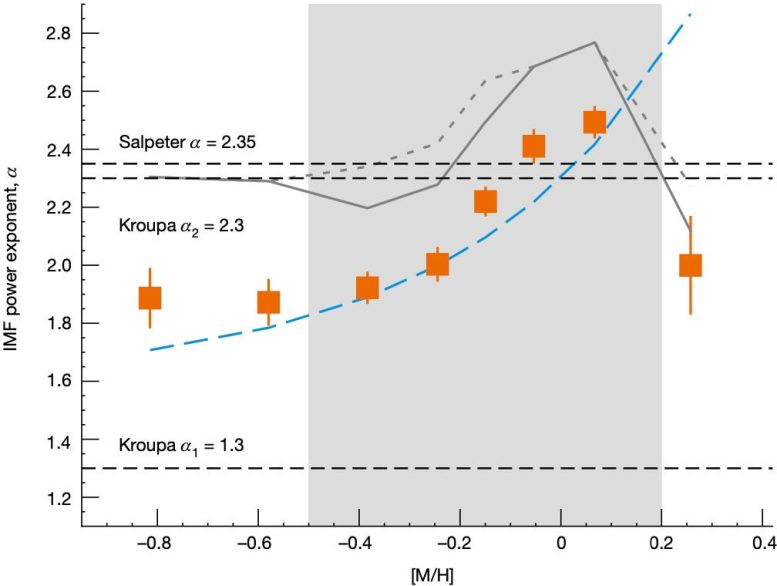
Counting stars in a given volume is a direct and classical way to measure the IMF of low-mass (red dwarf) stars, whose mass distribution does not evolve with time; this approach is essentially independent of models or assumptions.
“Although many previous studies applied star counting to derive the IMF, two problems have not been solved. One is that only a small number of stars were counted in previous work. The second is that previous studies did not measure the metallicity of stars,” said Prof. Zhang Zhiyu, co-author of the study.
LAMOST has provided spectra that contain information about the chemical composition, temperature, and luminosity of millions of stars, enabling the researchers to measure the metallicity of nearby red dwarf stars.
Variability of Low-Mass Stars in the Milky Way
By selecting about 93,000 red dwarf stars in catalogs from both LAMOST and the Gaia survey, the researchers were able to group stars according to their metallicity and calculate the distribution of stellar mass in each group.
The study has revealed the variable abundance of low-mass stars in our galaxy, the Milky Way, and established a powerful benchmark for models of star formation. The findings may also affect the results of models of chemical enrichment of distant galaxies, as well as estimates of galaxy mass and the efficiency of planet formation.
“For instance, the total stellar mass of galaxies is often estimated by assuming that the IMF is invariant, but if the IMF is variable, this could change the total mass estimates of galaxies and potentially alter the field of Galactic astronomy,” said Prof. Liu.
Prof. Pavel Kroupa, an authority on the IMF at the University of Bonn, Germany, commented on the results: “On the basis of a large ensemble of well-observed stars, the authors report that the IMF of late-type stars in the local Galactic disk is metallicity- and age-dependent. These results are highly important for addressing how universal the stellar IMF is and enable an in-depth understanding of the possible shifts in stellar populations that formed at different times and under different conditions in the Galaxy.”
Reference: “Stellar initial mass function varies with metallicity and time” by Jiadong Li, Chao Liu, Zhi-Yu Zhang, Hao Tian, Xiaoting Fu, Jiao Li and Zhi-Qiang Yan, 18 January 2023, Nature.
DOI: 10.1038/s41586-022-05488-1
Never miss a breakthrough: Join the SciTechDaily newsletter.
Follow us on Google and Google News.