
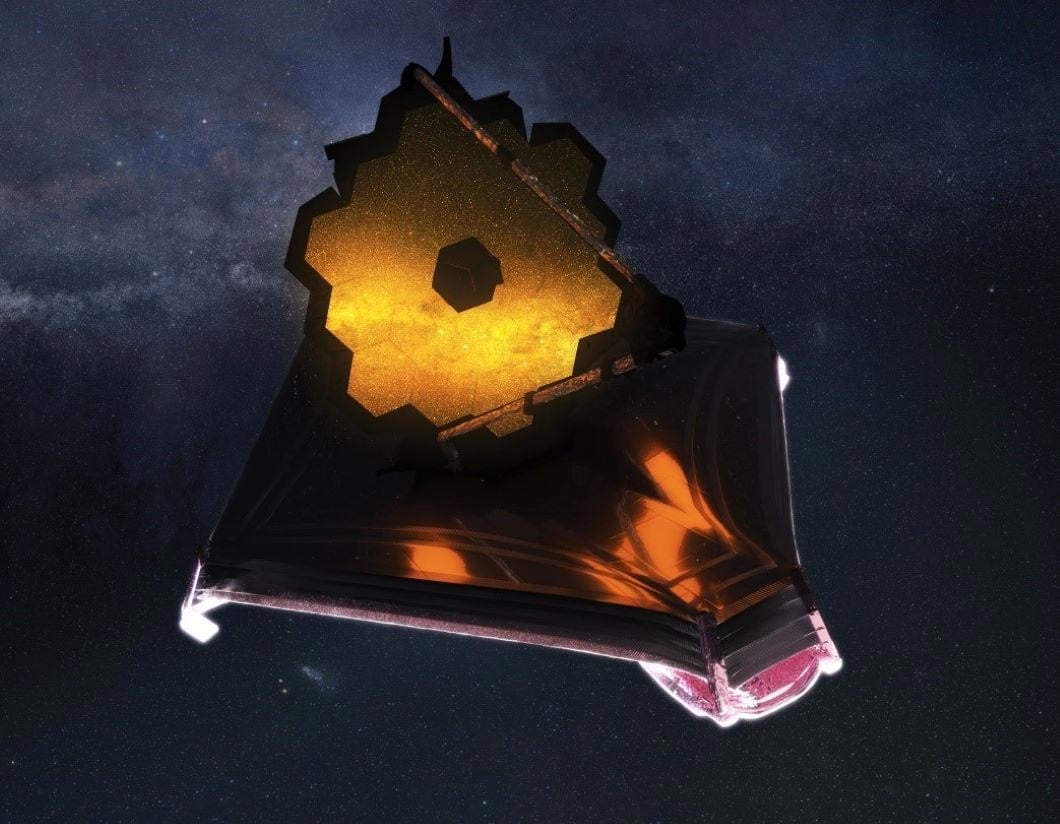
Webb’s Advanced Tools for Exoplanet Detection
The examination of exoplanets is a central aspect of the James Webb Space Telescope’s scientific objectives. NASA invited Christopher Stark, the Deputy Observatory Project Scientist from NASA’s Goddard Space Flight Center, to share insights on one of the methods Webb employs to investigate these distant worlds.
NASA’s James Webb Space Telescope has many different observing modes to study planets orbiting other stars, known as exoplanets. One way, in particular, is that Webb can directly detect some of these planets. Directly detecting planets around other stars is no easy feat. Even the nearest stars are still so far away that their planets appear to be separated by a fraction of the width of a human hair held at arm’s length. At these tiny angular scales, the planet’s faint light is lost in the glare of its host star when trying to observe it.
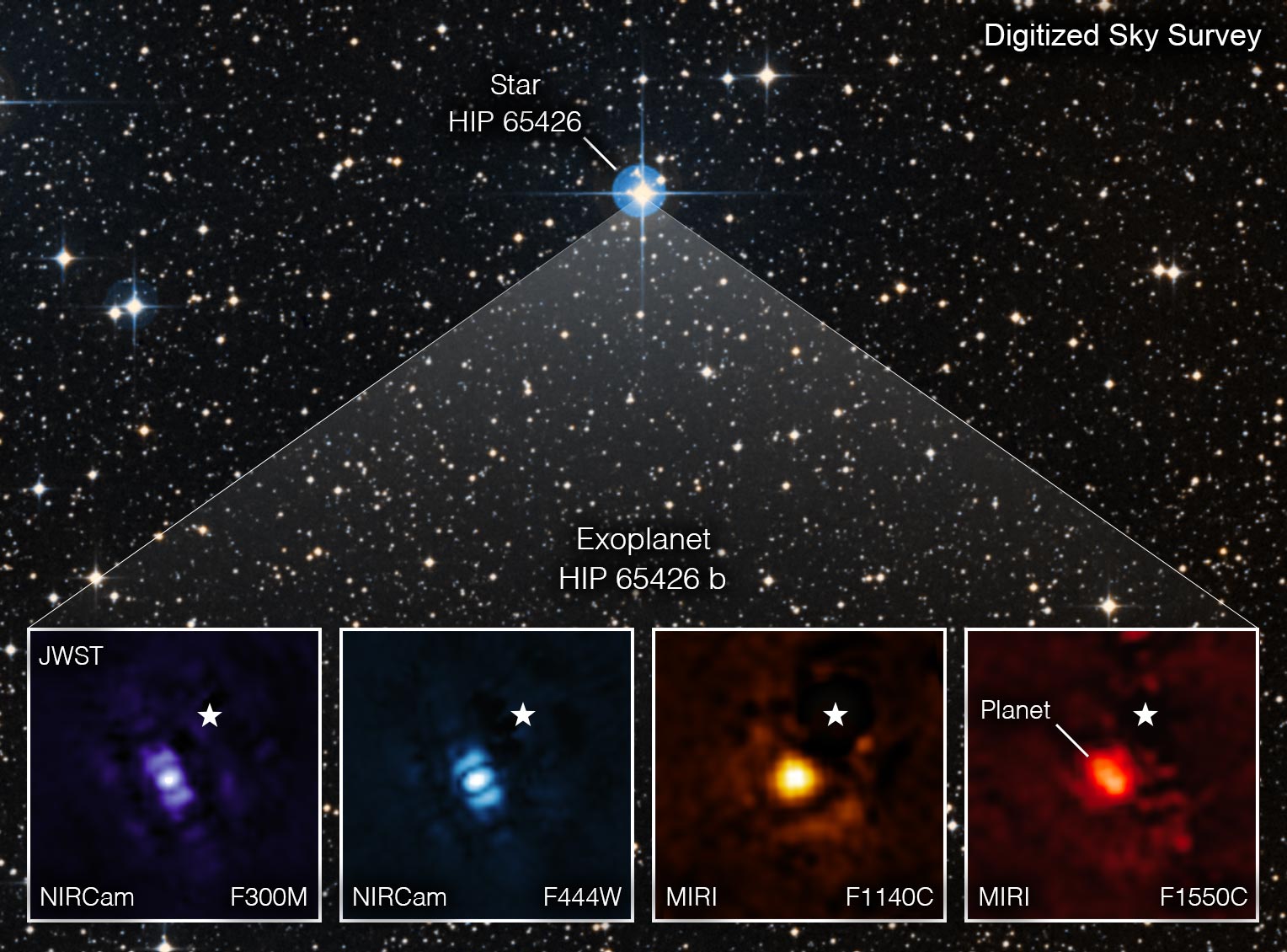
Fortunately, Webb has the right tools for the job: the Near-Infrared Camera (NIRCam) and Mid-Infrared Instrument (MIRI) coronagraphic modes. Webb’s coronagraphs block the light from a distant star, while allowing the faint planet light through to reach its sensors. This is not unlike how we use our car’s visor during sunset or sunrise to see the cars in front of us, albeit Webb uses a much fancier “visor.”
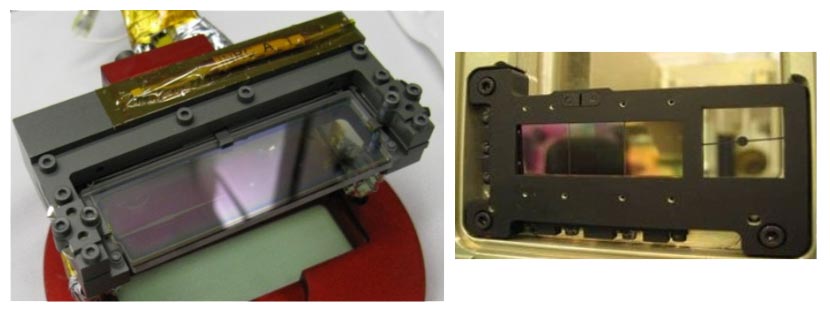
Along the path light takes through Webb’s optics, there are several important locations called “planes.” The “image plane” is where the distant sky is in focus, including all astrophysical objects. The “pupil plane” allows the surface of the primary mirror to be in focus, which was used to make Webb’s “selfie.” All of Webb’s coronagraphs physically mask out unwanted starlight in both the image and pupil planes to optimize performance. Most of Webb’s image plane masks, resembling opaque spots or bars, remove starlight simply by blocking it in the image. The exception to this are MIRI’s “four-quadrant phase masks,” which shift the wave-tops of one part of the wave of light, so it cancels out with another part through a process called “destructive interference.”
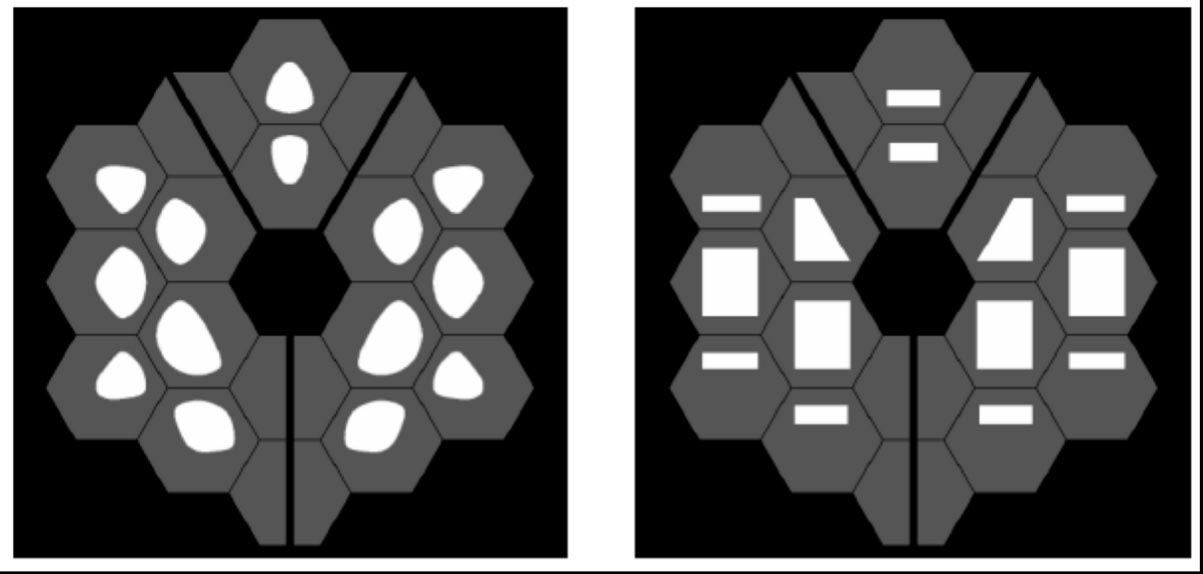
However, due to the wave nature of light, the image plane masks can’t completely block the star. So Webb uses additional pupil plane masks, also called Lyot stops, to remove much of the remaining starlight. These pupil plane masks look very different from the hexagonal primary mirror (the telescope “pupil”). As a result, objects imaged with the coronagraphs do not exhibit Webb’s hallmark six-spiked diffraction pattern, as shown in the observations above.
Webb’s NIRCam instrument has five coronagraphic masks, each of which can each be configured to observe at different wavelengths ranging from 1.7 to 5 microns. Webb’s MIRI instrument has four coronagraphic masks that operate at fixed wavelengths between 10 and 23 microns. The coronagraphs can observe objects as close as 0.13 arcseconds from the star, and as distant as about 30 arcseconds from the star, which roughly translates to circumstellar distances ranging from a few Astronomical Units (au) to hundreds of au around nearby stars. One AU is equivalent to the distance between the Earth and the Sun.
Despite the masks, Webb’s coronagraphs don’t perfectly remove a star’s light. To remove the last remnants of light, Webb’s astronomers will carefully use a variety of “point spread function (PSF) subtraction methods.” Simply put, this means measuring the pattern of the residual starlight, and then subtracting it from the science image. In the end, what remains is a noisy-looking pattern, which ultimately limits the faintest detectable exoplanet. This limit is expressed in terms of “contrast,” the ratio in brightness between the faintest detectable planet and the star. During commissioning, Webb’s NIRCam and MIRI coronagraphs demonstrated contrasts better than 10-5 and 10-4 at 1 arcsecond separation, respectively.
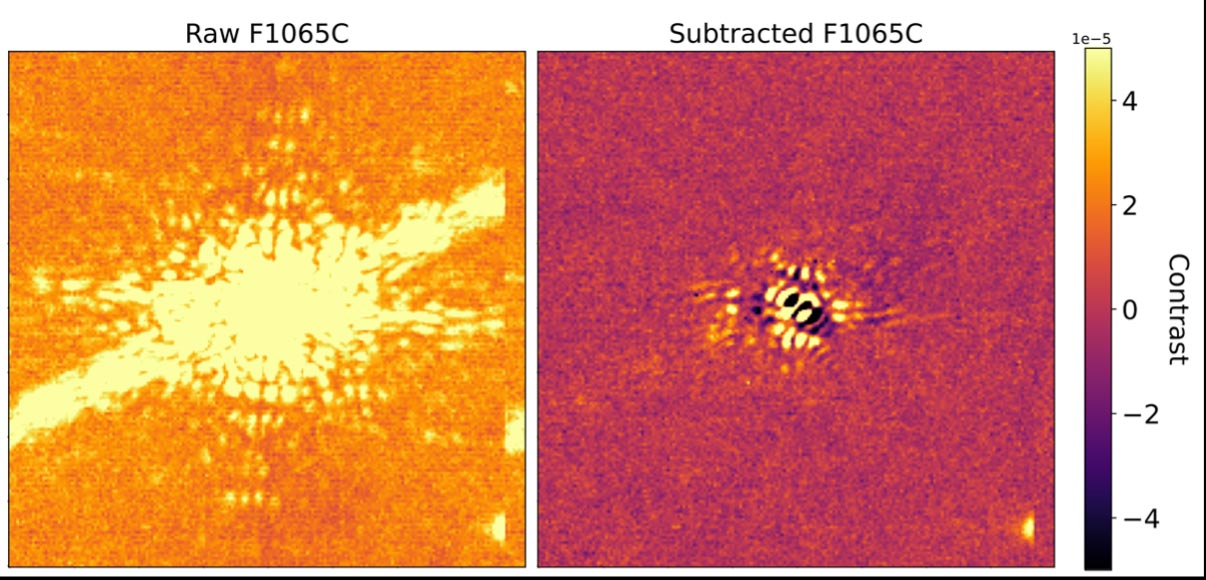
Webb’s large primary mirror and infrared capabilities mean that its coronagraphs are uniquely suited to study faint objects in the infrared and will complement other instruments currently observing at other wavelengths, including Hubble’s STIS coronagraph and multiple instruments on ground-based observatories. Exoplanet astronomers will mainly use Webb’s coronagraphs to detect giant extrasolar planets that are still warm from being formed, like those shown above, which are the first images of an exoplanet at wavelengths longer than 5 microns. Webb will also excel at imaging dense circumstellar disks of debris generated by the asteroids and comets in these exoplanetary systems, as well as protoplanetary disks in which planets are still forming. Webb’s coronagraphs can even be used for extragalactic astronomy, to study host galaxies that contain bright active galactic nuclei.
Webb’s coronagraphs won’t be able to reveal all the secrets of a planetary system. To image planets like our own around nearby Sun-like stars, we’ll need to observe even closer to the star and be able to detect planets just one ten billionth the brightness of the star. This will require a future mission fully optimized around next-generation coronagraphs. Fortunately, NASA is already looking into it. The agency’s upcoming Nancy Grace Roman Space Telescope will carry a technology demonstration instrument to test next-generation coronagraph technology. And, following the recommendations of the 2020 Astrophysics Decadal Survey, NASA is laying the groundwork for further technology development for a Habitable Worlds Observatory mission concept, a telescope that would be as large as Webb, operating in the same wavelengths as Hubble, but designed to find truly Earth-like exoplanets around other stars and search them for signs of life.
Written by Christopher Stark, Webb deputy observatory project scientist, NASA Goddard.
Never miss a breakthrough: Join the SciTechDaily newsletter.
Follow us on Google and Google News.