
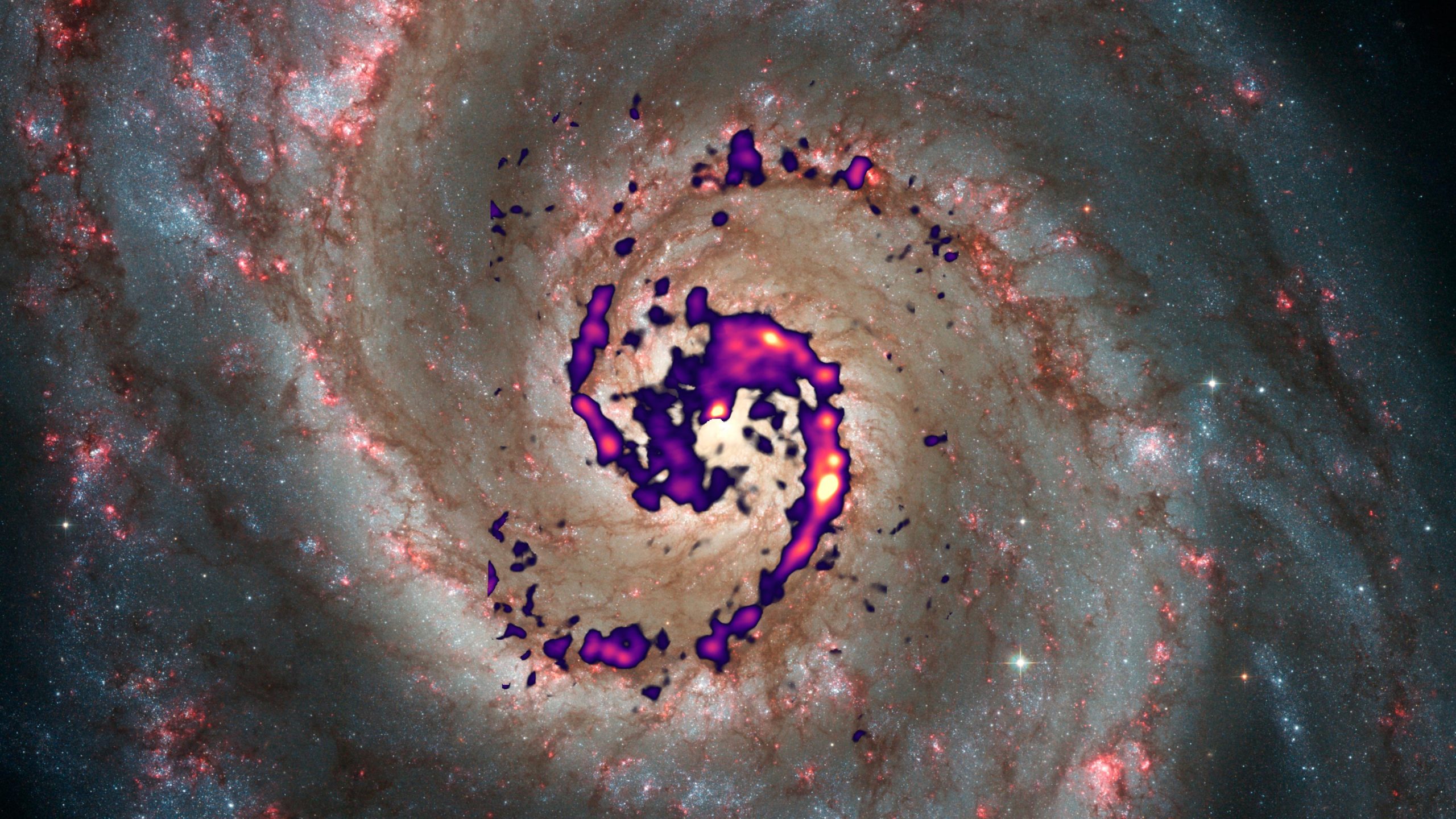
For the first time, signatures of individual cold and dense star-forming clouds in a galaxy outside the Milky Way have been mapped over a wide area.
An international research team led by astronomers from the Max Planck Institute for Astronomy (MPIA) has meticulously mapped expansive cold and dense gas regions, the future stellar nurseries, in a galaxy outside the Milky Way with unprecedented detail. Utilizing the NOEMA interferometer, these observations cover a vast expanse within the galaxy, providing insight into varying conditions conducive to star formation. The data marks a ground-breaking achievement in this type of measurement, allowing researchers, for the first time, to scrutinize the early phases of star formation beyond the Milky Way on scales as minute as individual gas clouds birthing stars.
The Birthplaces of Stars in the Whirlpool Galaxy
Paradoxically, the evolution of hot stars initiates in some of the coldest realms of the universe —dense clouds of gas and dust that traverse entire galaxies. “To investigate the early phases of star formation, where gas gradually condenses to eventually produce stars, we must first identify these regions,” says Sophia Stuber, a PhD student at the Max Planck Institute for Astronomy (MPIA) in Heidelberg. She is the lead author of the research article slated for publication in Astronomy & Astrophysics. “For this purpose, we typically measure the radiation emitted by specific molecules that are particularly abundant in these extremely cold and dense zones.”
Molecules As Chemical Probes
Astronomers typically employ molecules such as HCN (hydrogen cyanide) and N2H+ (diazenylium) as chemical probes in exploring star formation within the Milky Way. “But only now have we been able to measure these signatures in great detail over an extensive range within a galaxy outside the Milky Way, covering various zones with diverse conditions,” explains Eva Schinnerer, research group leader at MPIA. “Even at first glance, it’s evident that while the two molecules effectively reveal dense gas, they also disclose interesting differences.”
Through collisions with the abundant hydrogen molecules, which are themselves challenging to detect, other molecules are set into rotation. Following a reduction in rotational speed, they emit radiation with characteristic wavelengths, approximately three millimeters for the abovementioned molecules.
These measurements are part of a comprehensive observational program named SWAN (Surveying the Whirlpool at Arcsecond with NOEMA), co-led by Schinnerer and Frank Bigiel from the University of Bonn. Utilizing the Northern Extended Millimetre Array (NOEMA), a radio interferometer in the French Alps, the team aims to study the distribution of various molecules within the inner 20,000 light-years of the Whirlpool Galaxy (Messier 51), including hydrogen cyanide and diazenylium. In addition to the 214 hours of observation from this program, about 70 hours from other observation campaigns with the 30-meter single-dish telescope in southern Spain complement the dataset.
“As data from radio interferometers are much more complex than telescope images, processing and refining the data took approximately another year,” notes Jérôme Pety from the Institute de Radioastronomie Millimétrique (IRAM), the institution operating the telescopes. Interferometric telescopes like NOEMA consist of multiple individual antennas, collectively achieving detail resolution comparable to a telescope with a primary mirror diameter equivalent to the spacing between the individual telescopes.
Gas Properties Depend on the Environment
As we observe this galaxy from a distance of approximately 28 million light-years, we can distinguish signatures of individual gas clouds in diverse areas, such as the centre and the spiral arms. “We leveraged this circumstance to determine how well the two gases trace the dense clouds in this galaxy for us and whether they are equally suited,” Stuber explains.
While the radiation intensity of hydrogen cyanide and diazenylium consistently increases and decreases across the spiral arms, providing equally reliable results for determining gas density, the astronomers find a notable deviation in the galactic centre. Compared to diazenylium, the brightness of hydrogen cyanide emission increases more significantly in this region. There appears to be a mechanism there that stimulates hydrogen cyanide to emit additional light, which is not observed in diazenylium.
“We suspect that the active galactic nucleus in the Whirlpool Galaxy is responsible for this,” Schinnerer says. This region surrounds the central massive black hole. Before the gas drops into the black hole, it forms a rotating disk, accelerates to high speeds, and is heated to thousands of degrees through friction, emitting intense radiation. This radiation could indeed contribute partially to the additional emission of hydrogen cyanide molecules. “However, we still need to explore in detail what makes the two gases behave differently,” Schinnerer adds.
A Worthwhile Challenge
Hence, at least in the central region of the Whirlpool Galaxy, diazenylium appears to be the more reliable density probe compared to hydrogen cyanide. Unfortunately, it shines five times fainter on average for the same gas density, significantly increasing the measurement effort. The required additional sensitivity is achieved through a considerably longer observation period.
The prospect of exploring the early phases in detail within galaxies outside the Milky Way brings hope to scientists. Such a clear view of the Whirlpool Galaxy is unavailable for the Milky Way. While molecular clouds and star-forming regions are closer in the Milky Way, determining the exact structure and location of spiral arms and clouds is considerably more challenging.
“Although we can learn a lot from the detailed observation program with the Whirlpool Galaxy, it is, in a sense, a pilot project,” Stuber points out. “We would love to explore more galaxies in this way in the future.” However, this possibility currently faces limitations due to technical capabilities. The Whirlpool Galaxy shines exceptionally brightly in the light of those chemical probes. For other galaxies, telescopes and instruments need to be far more sensitive.
“The next-generation Very Large Array (ngVLA), currently in planning, is likely to be sufficiently powerful,” Schinnerer hopes. If all goes well, it will only be available in approximately ten years from now. Until then, the Whirlpool Galaxy serves as a rich laboratory to explore star formation on a galactic scale.
Reference: “Surveying the Whirlpool at Arcseconds with NOEMA (SWAN) – I. Mapping the HCN and N2H+ 3mm lines” by Sophia K. Stuber, Jerome Pety, Eva Schinnerer, Frank Bigiel, Antonio Usero, Ivana Bešlić, Miguel Querejeta, María J. Jiménez-Donaire, Adam Leroy, Jakob den Brok, Lukas Neumann, Cosima Eibensteiner, Yu-Hsuan Teng, Ashley Barnes, Mélanie Chevance, Dario Colombo, Daniel A. Dale, Simon C. O. Glover, Daizhong Liu and Hsi-An Pan, 20 December 2023, Astronomy & Astrophysics.
DOI: 10.1051/0004-6361/202348205
The MPIA researchers involved in this study are Sophia Stuber and Eva Schinnerer.
Other contributors are Jérôme Pety (IRAM and Observatoire de Paris/PSL, France [PSL]), Frank Bigiel (University of Bonn, Germany [UB]), Antonio Usero (Observatorio Astronómica Nacional/IGN, Madrid, Spain [OAN]), Ivana Bešlić (PSL), Miguel Querejeta (OAN), J. María Jiménez-Donaire (OAN and Observatorio de Yebes/IGN, Guadalajara, Spain), Adam Leroy (Ohio State University, Columbus, USA), Jakob den Brok (Center for Astrophysics, Harvard & Smithsonian, Cambridge, USA), Lukas Neumann (UB), Cosima Eibensteiner (UB), Yu-Hsuan Teng (University of California San Diego, La Jolla, USA), Ashley Barnes (European Southern Observatory, Garching, Germany [ESO]), Mélanie Chevance (Centre for Astronomy, Heidelberg University, Germany [ZAH] and Cosmic Origins of Life Research DAO), Dario Colombo (UB), Daniel A. Dale (University of Wyoming, Laramie, USA), Simon C.O. Glover (ZAH), Daizhong Liu (Max Planck Institute for Extraterrestrial Physics, Garching, Germany), and Hsi-An Pan (Tamkang University, Taiwan).
Never miss a breakthrough: Join the SciTechDaily newsletter.
Follow us on Google and Google News.