
Close Menu
    Facebook X (Twitter) Instagram
    SciTechDaily
    • Biology
    • Chemistry
    • Earth
    • Health
    • Physics
    • Science
    • Space
    • Technology
    Facebook X (Twitter) Pinterest YouTube RSS
    SciTechDaily
    Home»Space»NASA’s Galileo Mission Discovers Clay-Like Minerals on Europa
    Space

    NASA’s Galileo Mission Discovers Clay-Like Minerals on Europa

    By Jia-Rui C. Cook, Jet Propulsion Laboratory; NASADecember 12, 20131 Comment4 Mins Read
    Facebook Twitter Pinterest Telegram LinkedIn WhatsApp Email Reddit
    Share
    Facebook Twitter LinkedIn Pinterest Telegram Email Reddit
    Clay-Like Minerals Found on Europa
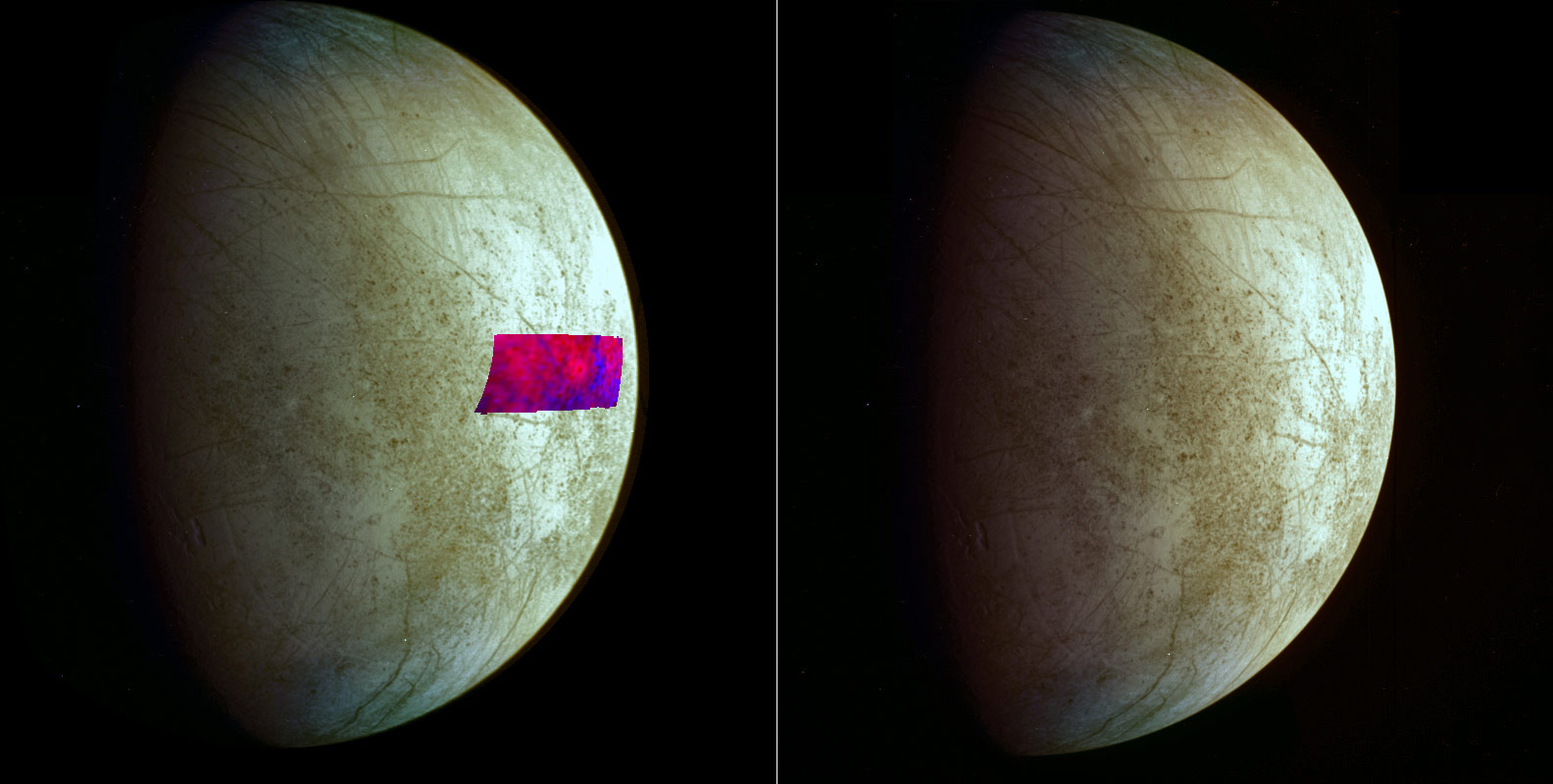
    This image, using data from NASA’s Galileo mission, shows the first detection of clay-like minerals on the surface of Jupiter’s moon Europa. The clay-like minerals appear in blue in the false-color patch of data from Galileo’s Near-Infrared Mapping Spectrometer. Credit: NASA/JPL-Caltech/SETI

    Using data from NASA’s Galileo mission, researchers have discovered clay-type minerals on the surface of Europa for the first time.

    A new analysis of data from NASA’s Galileo mission has identified clay-type minerals at the surface of Jupiter’s icy moon Europa that appear to have been delivered by a spectacular collision with an asteroid or comet. This is the first time such minerals have been detected on Europa’s surface. The types of space rocks that deliver such minerals typically also often carry organic materials.

    “Organic materials, which are important building blocks for life, are often found in comets and primitive asteroids,” said Jim Shirley, a research scientist at NASA’s Jet Propulsion Laboratory, Pasadena, California. Shirley is giving a talk on this topic at the American Geophysical Union meeting in San Francisco on Friday, December 13. 2013. “Finding the rocky residues of this comet crash on Europa’s surface may open up a new chapter in the story of the search for life on Europa,” he said.

    Many scientists believe Europa is the best location in our solar system to find existing life. It has a subsurface ocean in contact with rock, an icy surface that mixes with the ocean below, salts on the surface that create an energy gradient, and a source of heat (the flexing that occurs as it gets stretched and squeezed by Jupiter’s gravity). Those conditions were likely in place shortly after Europa first coalesced in our solar system.

    Scientists have also long thought there must be organic materials at Europa, too, though they have yet to detect them directly. One theory is that organic material could have arrived by comet or asteroid impacts, and this new finding supports that idea.
    Galileo Mission Reveals Clay Like Minerals on Europa
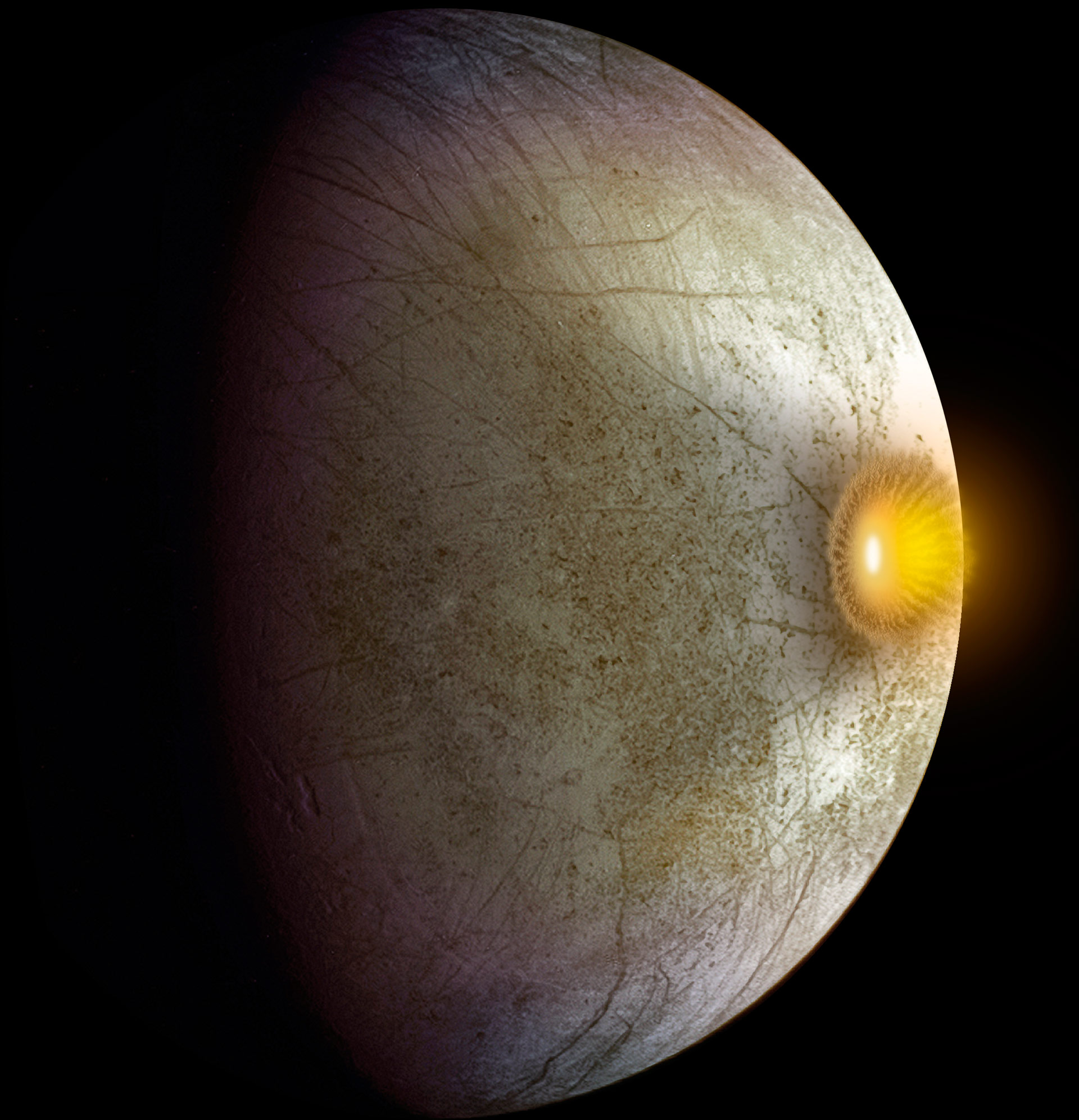
    This artist’s concept shows a possible explosion resulting from a high-speed collision between a space rock and Jupiter’s moon Europa. Clay-type minerals have been found on Europa’s surface in a new analysis of data from NASA’s Galileo mission. Credit: NASA/JPL-Caltech

    Shirley and colleagues, funded by a NASA Outer Planets Research grant, were able to see the clay-type minerals called phyllosilicates in near-infrared images from Galileo taken in 1998. Those images are low resolution by today’s standards, and Shirley’s group is applying a new technique for pulling a stronger signal for these materials out of the noisy picture. The phyllosilicates appear in a broken ring about 25 miles (40 kilometers) wide, which is about 75 miles (120 kilometers) away from the center of a 20-mile-diameter (30 kilometers) central crater site.

    The leading explanation for this pattern is the splashback of material ejected when a comet or asteroid hits the surface at an angle of 45 degrees or more from the vertical direction. A shallow angle would allow some of the space rock’s original material to fall back to the surface. A more head-on collision would likely have vaporized it or driven that space rock’s materials below the surface. It is hard to see how phyllosilicates from Europa’s interior could make it to the surface, due to Europa’s icy crust, which scientists think may be up to 60 miles (100 kilometers) thick in some areas.

    Therefore, the best explanation is that the materials came from an asteroid or comet. If the body was an asteroid, it was likely about 3,600 feet (1,100 meters) in diameter. If the body was a comet, it was likely about 5,600 feet (1,700 meters) in diameter. It would have been nearly the same size as the comet ISON before it passed around the sun a few weeks ago.

    “Understanding Europa’s composition is key to deciphering its history and its potential habitability,” said Bob Pappalardo of JPL, the pre-project scientist for a proposed mission to Europa. “It will take a future spacecraft mission to Europa to pin down the specifics of its chemistry and the implications for this moon hosting life.”

    JPL is a division of the California Institute of Technology in Pasadena.

    Never miss a breakthrough: Join the SciTechDaily newsletter.
    Follow us on Google and Google News.

    Astronomy Europa JPL NASA NASA Galileo Mission Planetary Science
    Share. Facebook Twitter Pinterest LinkedIn Email Reddit

    Related Articles

    Hubble Detects Water Vapor Over Jupiter’s Moon Europa

    Researchers Assess the Surface of Europa for Materials Representing Ocean Composition

    NASA Data Suggests “Dry Ice” Snowfall on Mars

    “Habitable Zone” Might Help Extreme Life Forms Survive on Exoplanets

    NASA’s Curiosity Prepares for Use of Its Arm and Tools

    Curiosity Sends Back Radioed Words and New Telephoto View of Mars

    NASA’s Curiosity Readies for First Drive on Mars

    Color HiRISE Image of Curiosity Rover on Mars

    First 360-Degree Color Panorama From NASA’s Curiosity Mars Rover

    1 Comment

    1. James ( JIM) Oss on December 12, 2013 7:30 am

      Time to get going on an under-the-ice probe to Europa.

      Reply
    Leave A Reply Cancel Reply

    • Facebook
    • Twitter
    • Pinterest
    • YouTube

    Don't Miss a Discovery

    Subscribe for the Latest in Science & Tech!

    Trending News

    Even Occasional Binge Drinking May Triple Liver Damage Risk

    Liftoff! NASA’s Artemis II Launch Sends Astronauts Around the Moon for First Time in 50 Years

    Scientists Discover New Way To Eliminate “Zombie Cells” Driving Aging

    This New Quantum Theory Could Change Everything We Know About the Big Bang

    This One Vitamin May Help Protect Your Brain From Dementia Years Later

    Stopping Weight-Loss Drugs Like Ozempic Can Quickly Erase Heart Benefits

    A 500-Million-Year-Old Surprise Is Forcing Scientists to Rethink Spider Evolution

    Coffee and Blood Pressure: What You Need To Know Before Your Next Cup

    Follow SciTechDaily
    • Facebook
    • Twitter
    • YouTube
    • Pinterest
    • Newsletter
    • RSS
    SciTech News
    • Biology News
    • Chemistry News
    • Earth News
    • Health News
    • Physics News
    • Science News
    • Space News
    • Technology News
    Recent Posts
    • New Water Filter Removes up to 98% of Hard-To-Catch “Forever Chemicals”
    • This Nearby Earth-Sized Planet Could Answer Big Questions About Alien Worlds
    • A Fiery Finale: How NASA’s Artemis II Moon Mission Returns to Earth
    • NASA Artemis II Skips Burn As Astronaut Captures Stunning View of Earth
    • NASA’s Artemis II: Humans Just Left Earth Orbit for the First Time Since 1972
    Copyright © 1998 - 2026 SciTechDaily. All Rights Reserved.
    • Science News
    • About
    • Contact
    • Editorial Board
    • Privacy Policy
    • Terms of Use

    Type above and press Enter to search. Press Esc to cancel.