
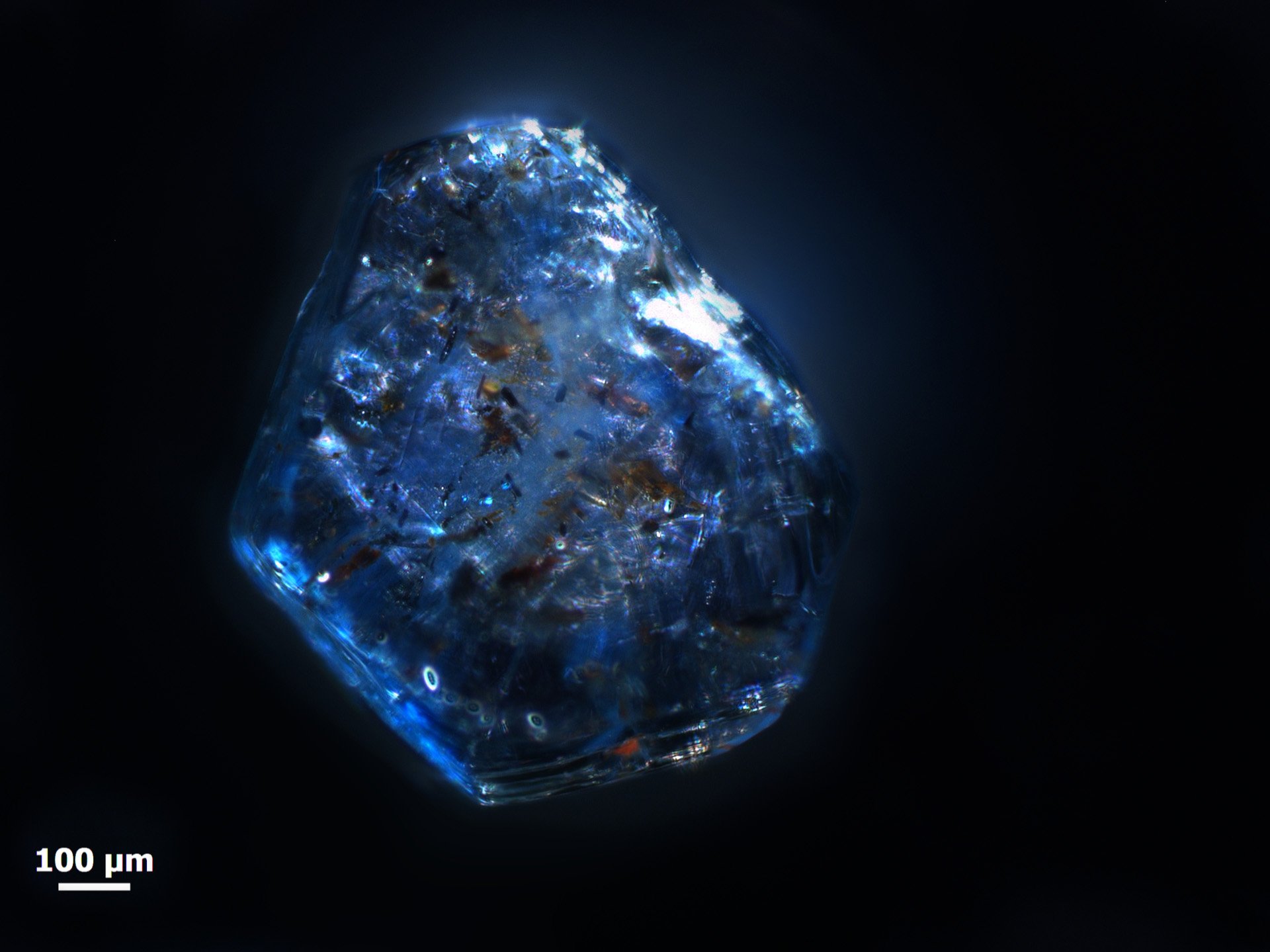
Researchers at Heidelberg University are investigating how this distinctively blue-colored crystal forms in volcanic melts.
Sapphires, highly valued as precious gems, are essentially aluminum oxide, or corundum, with chemical impurities. These typically blue crystals are predominantly found in silicon-poor volcanic rocks worldwide. It is widely believed that sapphires form in deep crustal rocks and are transported to the Earth’s surface by ascending magma. Geoscientists at Heidelberg University, through geochemical analyses, have demonstrated that the millimeter-sized sapphire grains discovered in the Eifel region of Germany formed in conjunction with volcanic activity.
The Eifel is a volcanic region in the center of Europe where magma from the Earth’s mantle has been penetrating the overlying crust for nearly 700,000 years. The melts are poor in silicon dioxide but rich in sodium and potassium. Magmas similar in composition worldwide are known for their abundance of sapphire.
The Mystery of Sapphire Formation
Why this extremely rare variant of corundum is frequently found in this type of volcanic deposit has been a mystery until now.
“One explanation is that sapphire in the Earth’s crust originates from previously clayey sediments at very high temperatures and pressure and the ascending magmas simply form the elevator to the surface for the crystals,” explains Prof. Dr Axel Schmitt, a researcher at Curtin University in Perth (Australia) who is investigating isotope geology and petrology as an honorary professor at the Institute of Earth Sciences at Heidelberg University – his former home institution.
To test this assumption, the researchers examined a total of 223 sapphires from the Eifel. They found a portion of these millimeter-sized crystals in rock samples collected from volcanic deposits in the numerous quarries in the region. Most of the sapphires, however, come from river sediments. “Like gold, sapphire is very weathering-resistant compared to other minerals. Over protracted time periods, the grains are washed out of the rock and deposited in rivers. Because of their high density, they are easy to separate from lighter sediment components using a gold pan,” explains Sebastian Schmidt, who conducted the studies as part of his master’s degree at Heidelberg University.
Age and Origin of the Sapphires
The researchers determined the age of the sapphires from the Eifel using the uranium-lead method on mineral inclusions in the sapphire using a secondary ion mass spectrometer that could also identify the composition of oxygen isotopes. The different relative abundances of the light isotope O-16 and the heavy isotope O-18 provide information on the origin of the crystals like a fingerprint. Deep crustal rocks have more O-18 than melts from the Earth’s mantle.
As the age determinations show, the sapphires in the Eifel formed at the same time as the volcanism. In part, they inherited the isotopic signature of the mantle melts, which were contaminated by heated and partially melted crustal rock at a depth of about five to seven kilometers. Other sapphires originated in contact with the subterranean melts, whereby melts permeated the adjacent rock and thus triggered sapphire formation. “In the Eifel, both magmatic and metamorphic processes, in which temperature changed the original rock, played a role in the crystallization of sapphire,” states Sebastian Schmidt.
Reference: “Petrologically controlled oxygen isotopic classification of cogenetic magmatic and metamorphic sapphire from Quaternary volcanic fields in the Eifel, Germany” by Sebastian Schmidt, Andreas Hertwig, Katharina Cionoiu, Christof Schäfer and Axel K. Schmitt, 7 May 2024, Contributions to Mineralogy and Petrology.
DOI: 10.1007/s00410-024-02136-x
Support for the work came from the Dr. Eduard Gübelin Association for Research and Identification of Precious Stones in Switzerland as well as the German Research Foundation.
Never miss a breakthrough: Join the SciTechDaily newsletter.
Follow us on Google and Google News.
1 Comment
IF H2O that is part of the terrestrial water cycle is enriched in the light 16O isotope and sea water is enriched in the heavier 18O isotope. And Deep crustal rocks have more O-18 than melts from the Earth’s mantle. Then Deep crustal rock are in contact with sea water! RIGHT…