
Close Menu
    Facebook X (Twitter) Instagram
    SciTechDaily
    • Biology
    • Chemistry
    • Earth
    • Health
    • Physics
    • Science
    • Space
    • Technology
    Facebook X (Twitter) Pinterest YouTube RSS
    SciTechDaily
    Home»Chemistry»Unveiling the Power of Air in Revolutionary “Plasmonic Black Gold” Catalysis
    Chemistry

    Unveiling the Power of Air in Revolutionary “Plasmonic Black Gold” Catalysis

    By Tata Institute of Fundamental ResearchJanuary 31, 20241 Comment3 Mins Read
    Facebook Twitter Pinterest Telegram LinkedIn WhatsApp Email Reddit
    Share
    Facebook Twitter LinkedIn Pinterest Telegram Email Reddit
    Black Gold Catalyst and Solar Light's Airborne Victory
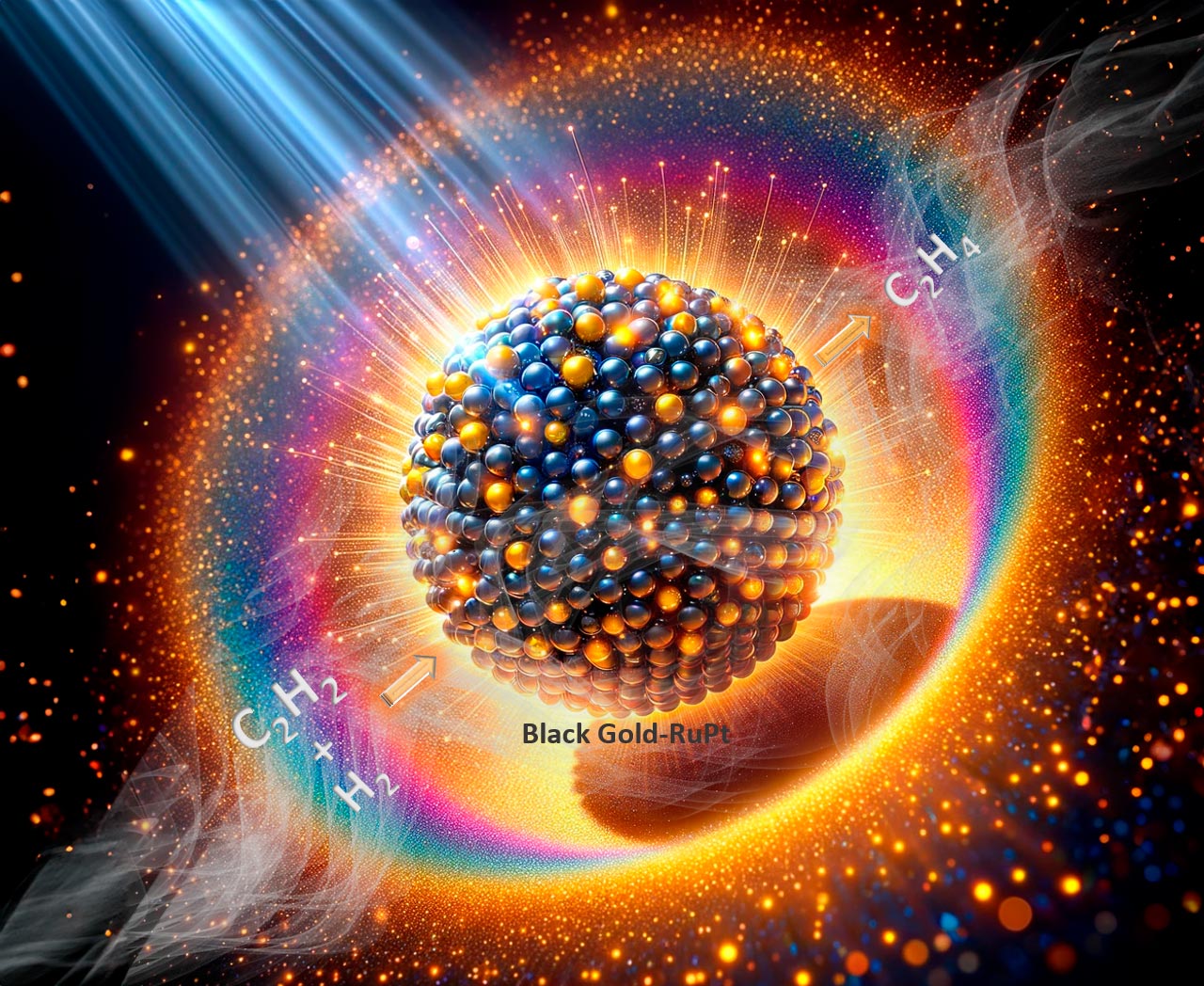
    The first highly efficient, air-stable, and plasmonically activated catalyst for acetylene semi-hydrogenation. Credit: Ms. Gunjan Sharma and Prof. Vivek Polshettiwar, edited

    A breakthrough plasmonic catalyst, stable in air, revolutionizes acetylene semi-hydrogenation, marking a significant advance in sustainable catalysis.

    In a significant breakthrough, Prof. Polshettiwar’s group at TIFR, Mumbai has developed a novel “Plasmonic Reduction Catalyst Stable in Air,” defying the common instability of reduction catalysts in the presence of air. The catalyst merges platinum-doped ruthenium clusters, with ‘plasmonic black gold’. This black gold efficiently harvests visible light and generates numerous hot spots due to plasmonic coupling, enhancing its catalytic performance.

    Superior Performance in Semi-Hydrogenation

    What sets this catalyst apart is its remarkable performance in the semi-hydrogenation of acetylene, an important industrial process. In the presence of excess ethene, and using only visible light illumination without any external heating, the catalyst achieved an ethene production rate 320 mmol g−1 h−1 with around 90% selectivity. This efficiency surpasses all known plasmonic and traditional thermal catalysts.

    Unique Air Stability and Mechanism Insight

    Surprisingly, this catalyst exhibits its best performance only when air is introduced alongside the reactants. This unique requirement leads to an unprecedented stability for at least 100 hours. The researchers attribute this to plasmon-mediated simultaneous reduction and oxidation processes at the active sites during the reaction.

    Further enhancing our understanding of this catalyst, finite-difference time-domain (FDTD) simulations revealed a five-fold increase in the electric field compared to pristine DPC. This field enhancement, due to the near-field coupling between the RuPt nanoparticles and DPC, plays a crucial role in activating chemical bonds.

    The catalyst’s effectiveness is also evident in its kinetic isotope effect (KIE), which is larger under light than in darkness at all temperatures. This indicates the significant role of non-thermal effects alongside photothermal activation of the reactants.

    In-depth in-situ DRIFTS and DFT studies provided insights into the reaction mechanism over the oxide surface, particularly highlighting the role of intermediates in selectivity. The partially oxidized RuPt catalyst surface generates di-σ-bonded acetylene, which then transforms through several steps to produce ethene.

    Implications for Sustainable Catalysis

    This research marks the first report of a highly efficient, air-stabilized, and plasmonically activated catalyst for acetylene semi-hydrogenation, with potential applications in a variety of other reduction reactions. The findings offer significant contributions to the understanding of plasmonic catalysis and pave the way for developing sustainable and energy-efficient catalytic systems.

    Reference: “Pt-doped Ru nanoparticles loaded on ‘black gold’ plasmonic nanoreactors as air stable reduction catalysts” by Gunjan Sharma, Rishi Verma, Shinya Masuda, Khaled Mohamed Badawy, Nirpendra Singh, Tatsuya Tsukuda and Vivek Polshettiwar, 24 January 2024, Nature Communications.
    DOI: 10.1038/s41467-024-44954-4

    Never miss a breakthrough: Join the SciTechDaily newsletter.
    Follow us on Google and Google News.

    Catalysts Nanoparticles Plasmonic Tata Institute of Fundamental Research
    Share. Facebook Twitter Pinterest LinkedIn Email Reddit

    Related Articles

    Converting CO2: Breakthrough Catalyst Flips Climate Change Enemy Into Valuable Resource

    “Swiss Army Knife” Nanoparticle Catalyst Can Make Natural Gas Burn Cleaner

    Super-Particles: The Importance of Good Neighbors in Catalysis

    New Nanoreactor Visualizes the Activity of Individual Catalytic Nanoparticles

    Gem-Like Nanoparticles of Precious Metals Shine As Catalysts – Can Lead to Better Fuel Cells

    New Nanoparticle Catalysts Improve Reactivity with Much Less Platinum

    Cobalt-Graphene Catalyst Performs Nearly As Well as Platinum

    Working to Recycle Greenhouse Gases

    Gold Improves the Performance of Nanoparticle Fuel-Cell Reactions

    1 Comment

    1. Steve Nordquist on February 1, 2024 1:40 pm

      …leaving us to go, so what happens to nano Ru Pt on Au when 100 hours are up? It turns all shiny instead and has to be de-polished? Making the best problems!

      Reply
    Leave A Reply Cancel Reply

    • Facebook
    • Twitter
    • Pinterest
    • YouTube

    Don't Miss a Discovery

    Subscribe for the Latest in Science & Tech!

    Trending News

    Your Blood Pressure Reading Could Be Wrong Because of One Simple Mistake

    Astronomers Stunned by Ancient Galaxy With No Spin

    Physicists May Be on the Verge of Discovering “New Physics” at CERN

    Scientists Solve 320-Million-Year Mystery of Reptile Skin Armor

    Scientists Say This Daily Walking Habit May Be the Secret to Keeping Weight Off After Dieting

    New Therapy Rewires the Brain To Restore Joy in Depression Patients

    Giant Squid Detected off Western Australia in Stunning Deep-Sea Discovery

    Popular Sugar-Free Sweetener Linked to Liver Disease, Study Warns

    Follow SciTechDaily
    • Facebook
    • Twitter
    • YouTube
    • Pinterest
    • Newsletter
    • RSS
    SciTech News
    • Biology News
    • Chemistry News
    • Earth News
    • Health News
    • Physics News
    • Science News
    • Space News
    • Technology News
    Recent Posts
    • The Hidden Types of Dementia Most People Have Never Heard Of
    • Scientists Discover Why Alcohol Prevents the Liver From Healing, Even After You Quit
    • Scientists Solve a 60-Year-Old Fat Cell Mystery — and It Changes What We Know About Obesity
    • A Crucial Atlantic Current Is Weakening and Weather Could Change Worldwide
    • Scientists Stunned As Volcano Removes Methane From the Air
    Copyright © 1998 - 2026 SciTechDaily. All Rights Reserved.
    • Science News
    • About
    • Contact
    • Editorial Board
    • Privacy Policy
    • Terms of Use

    Type above and press Enter to search. Press Esc to cancel.