
Close Menu
    Facebook X (Twitter) Instagram
    SciTechDaily
    • Biology
    • Chemistry
    • Earth
    • Health
    • Physics
    • Science
    • Space
    • Technology
    Facebook X (Twitter) Pinterest YouTube RSS
    SciTechDaily
    Home»Space»Updated Radar Images Provide New Details on Asteroid 2015 TB145
    Space

    Updated Radar Images Provide New Details on Asteroid 2015 TB145

    By DC Agle, Jet Propulsion LaboratoryNovember 4, 2015No Comments3 Mins Read
    Facebook Twitter Pinterest Telegram LinkedIn WhatsApp Email Reddit
    Share
    Facebook Twitter LinkedIn Pinterest Telegram Email Reddit
    New Radar Images Provide New Details on Asteroid 2015 TB145
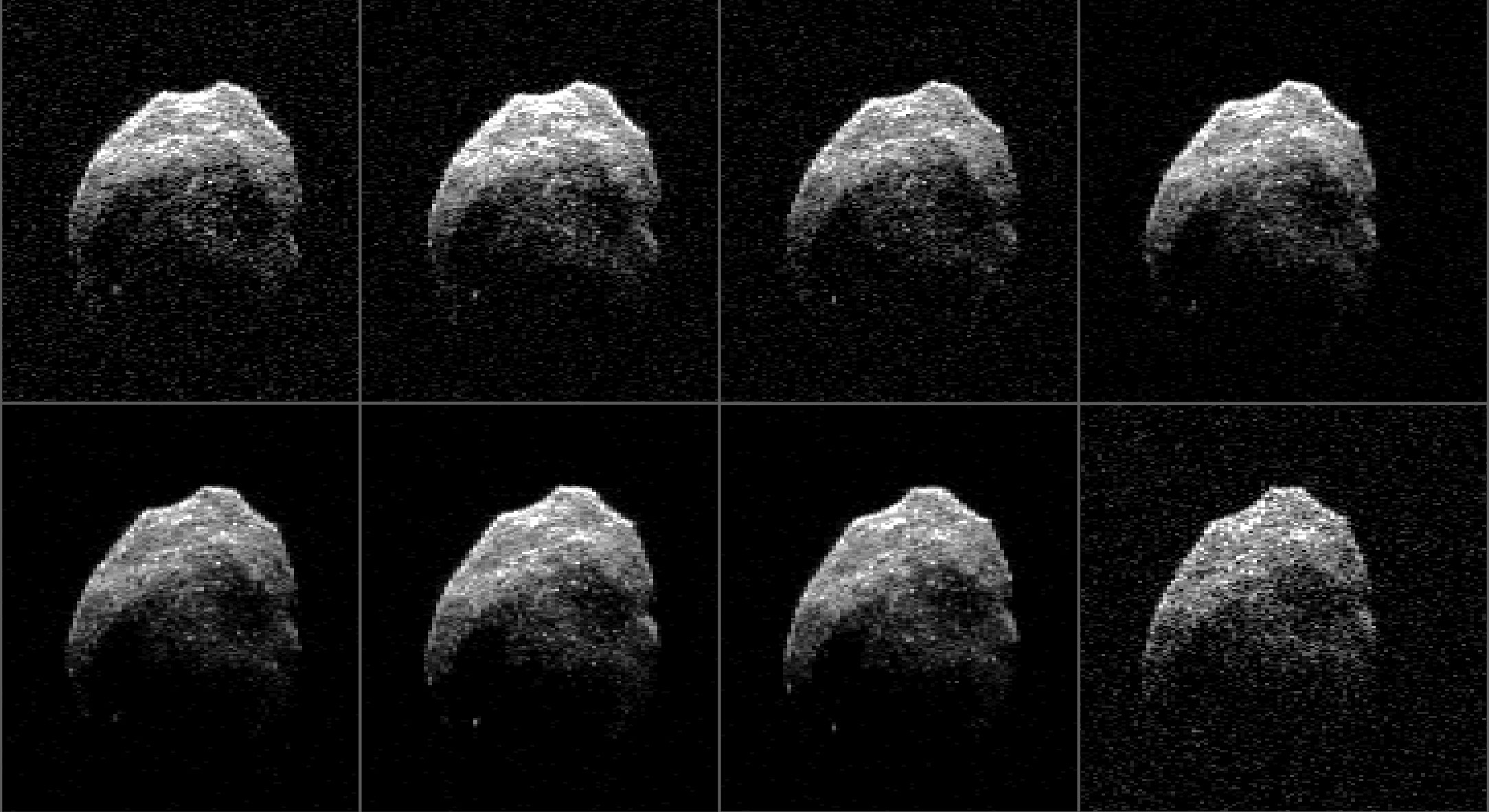
    Asteroid 2015 TB145 is depicted in eight individual radar images collected on October 31, 2015 between 5:55 a.m. PDT (8:55 a.m. EDT) and 6:08 a.m. PDT (9:08 a.m. EDT). At the time the radar images were taken, the asteroid was between 440,000 miles (710,000 kilometers) and about 430,000 miles (690,000 kilometers) distant. Asteroid 2015 TB145 safely flew past Earth on October 31, at 10:00 a.m. PDT (1 p.m. EDT) at about 1.3 lunar distances (300,000 miles, 480,000 kilometers). Credit: NASA/JPL-Caltech/GSSR/NRAO/AUI/NSF

    Astronomers captured new highest-resolution radar images of asteroid 2015 TB145 when it flew by Earth this past Halloween.

    The highest-resolution radar images of asteroid 2015 TB145’s safe flyby of Earth have been processed. NASA scientists used giant, Earth-based radio telescopes to bounce radar signals off the asteroid as it flew past Earth on October 31 at 10 a.m. PDT (1 p.m. EDT) at about 1.3 lunar distances (300,000 miles, or 480,000 kilometers) from Earth. Asteroid 2015 TB145 is spherical in shape and approximately 2,000 feet (600 meters) in diameter.

    “The radar images of asteroid 2015 TB145 show portions of the surface not seen previously and reveal pronounced concavities, bright spots that might be boulders, and other complex features that could be ridges,” said Lance Benner of NASA’s Jet Propulsion Laboratory in Pasadena, California, who leads NASA’s asteroid radar research program. “The images look distinctly different from the Arecibo radar images obtained on October 30 and are probably the result of seeing the asteroid from a different perspective in its three-hour rotation period.”

    To obtain these highest-resolution radar images of the asteroid, scientists used the 230-foot (70-meter) DSS-14 antenna at Goldstone, California, to transmit high-power microwaves toward the asteroid. The signal bounced off the asteroid, and its radar echoes were received by the National Radio Astronomy Observatory’s 100-meter (330-foot) Green Bank Telescope in West Virginia. The radar images achieve a spatial resolution as fine as 13 feet (4 meters) per pixel.

    The next time that asteroid 2015 TB145 will be in Earth’s neighborhood will be in September 2018, when it will make a distant pass at about 24 million miles (38 million kilometers), or about a quarter the distance between Earth and the sun.

    Radar is a powerful technique for studying an asteroid’s size, shape, rotation, surface features, and surface roughness, and for improving the calculation of asteroid orbits. Radar measurements of asteroid distances and velocities often enable computation of asteroid orbits much further into the future than would be possible otherwise.

    NASA places a high priority on tracking asteroids and protecting our home planet from them. In fact, the U.S. has the most robust and productive survey and detection program for discovering near-Earth objects (NEOs). To date, U.S. assets have discovered about 98 percent of known NEOs.

    Never miss a breakthrough: Join the SciTechDaily newsletter.
    Follow us on Google and Google News.

    Asteroid Astronomy NASA NEO
    Share. Facebook Twitter Pinterest LinkedIn Email Reddit

    Related Articles

    Near-Earth Asteroid 2014 JO25 Set to Fly Past Earth on April 19

    Asteroid 2013 TX68 to Pass Earth on March 5

    “Skull Shaped” Asteroid 2015 TB145 Will Flyby Earth This Halloween

    4.5 km Asteroid Tumbles Past Earth

    New Images of Near-Earth Asteroid 2007 PA8

    NASA’s Dawn Gets a Close Up View of the Canuleia Crater on Vesta

    NASA’s WISE Uncovers New Clues on Jovian Trojans

    Orbits of a Near-Earth Asteroid and a Potentially Hazardous Asteroid

    Near Miss Asteroid – An Opportunity To Test a Rapid Response Program

    Leave A Reply Cancel Reply

    • Facebook
    • Twitter
    • Pinterest
    • YouTube

    Don't Miss a Discovery

    Subscribe for the Latest in Science & Tech!

    Trending News

    Scientists Uncover Potential Brain Risks of Popular Fish Oil Supplements

    Scientists Discover a Surprising Way To Make Bread Healthier and More Nutritious

    After 60 Years, Scientists Uncover Unexpected Brain Effects of Popular Diabetes Drug Metformin

    New Research Uncovers Hidden Side Effects of Popular Weight-Loss Drugs

    Scientists Rethink Extreme Warming After Surprising Ocean Discovery

    Landmark Study Links Never Marrying to Significantly Higher Cancer Risk

    Researchers Discover Unknown Beetle Species Just Steps From Their Lab

    Largest-Ever Study Finds Medicinal Cannabis Ineffective for Anxiety, Depression, PTSD

    Follow SciTechDaily
    • Facebook
    • Twitter
    • YouTube
    • Pinterest
    • Newsletter
    • RSS
    SciTech News
    • Biology News
    • Chemistry News
    • Earth News
    • Health News
    • Physics News
    • Science News
    • Space News
    • Technology News
    Recent Posts
    • Early Warning Signals of Esophageal Cancer May Be Hiding in Plain Sight
    • Researchers Have Discovered a THC-Free Cannabis Compound That May Replace Opioids
    • Common Blood Pressure Drug Shows Surprising Power Against Deadly Antibiotic-Resistant Superbug
    • Students Build Dark Matter Detector and Set New Experimental Limits
    • Scientists Discover Caffeine Can Repair Key Memory Circuits After Sleep Loss
    Copyright © 1998 - 2026 SciTechDaily. All Rights Reserved.
    • Science News
    • About
    • Contact
    • Editorial Board
    • Privacy Policy
    • Terms of Use

    Type above and press Enter to search. Press Esc to cancel.