
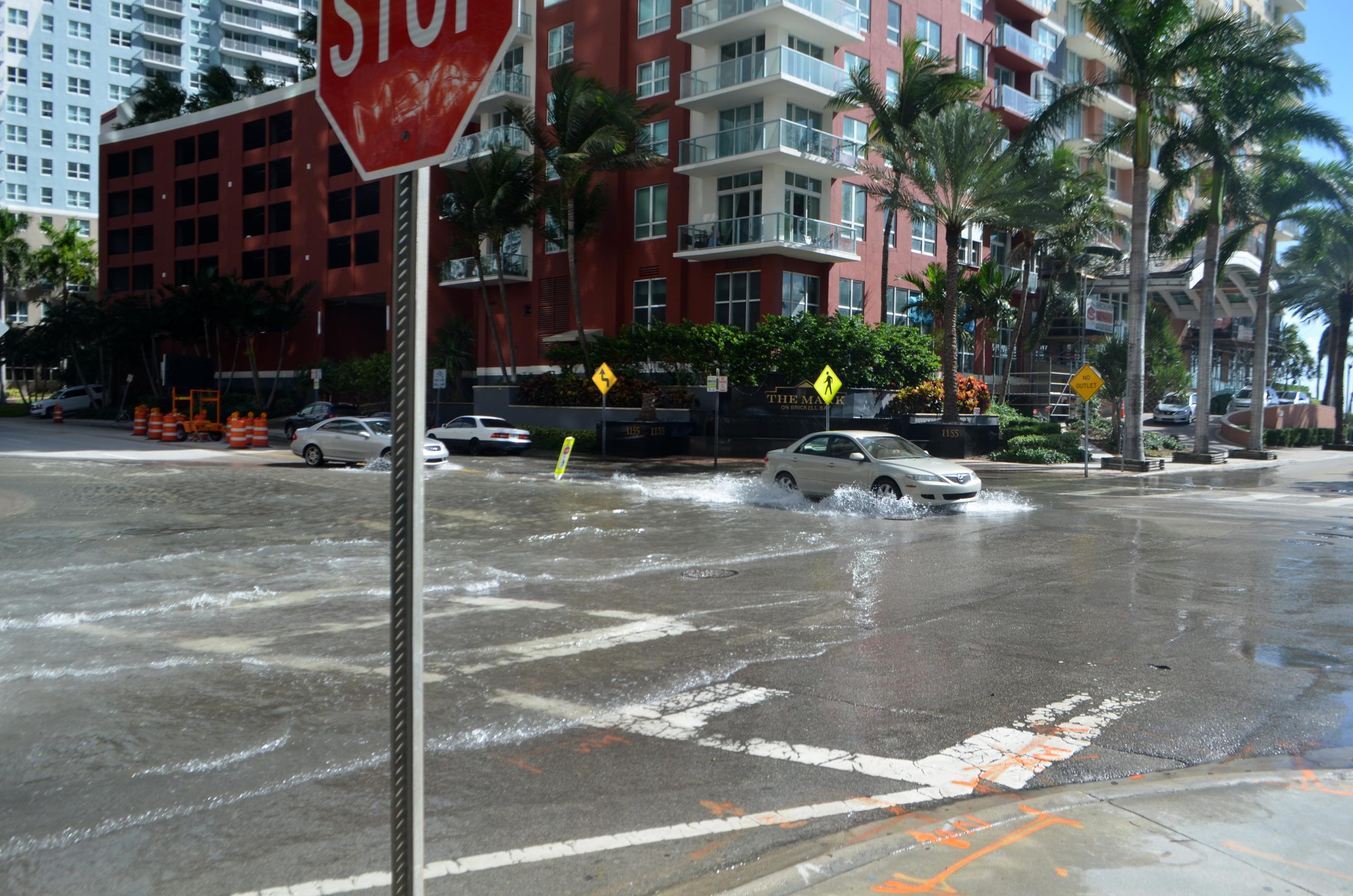
NASA, NOAA, USGS, and other U.S. government agencies project that the rise in ocean height in the next 30 years could equal the total rise seen over the past 100 years.
Coastal flooding will increase significantly over the next 30 years because of sea level rise, according to a new report by an interagency sea level rise task force that includes NASA, the National Oceanic and Atmospheric Administration (NOAA), and other federal agencies. Titled Global and Regional Sea Level Rise Scenarios for the United States, the February 15, 2022, report concludes that sea level along U.S. coastlines will rise between 10 to 12 inches (25 to 30 centimeters) on average above today’s levels by 2050.
The report – an update to a 2017 report – forecasts sea level to the year 2150 and, for the first time, offers near-term projections for the next 30 years. Agencies at the federal, state, and local levels use these reports to inform their plans for anticipating and coping with the effects of sea level rise.
NASA’s Commitment to Climate Monitoring and Data Accessibility
This report supports previous studies and confirms what we have long known: Sea levels are continuing to rise at an alarming rate, endangering communities around the world. Science is indisputable and urgent action is required to mitigate a climate crisis that is well underway,” said NASA Administrator Bill Nelson. “NASA is steadfast in our commitment to protecting our home planet by expanding our monitoring capabilities and continuing to ensure our climate data is not only accessible but understandable.”
The task force developed their near-term sea level rise projections by drawing on an improved understanding of how the processes that contribute to rising seas – such as melting glaciers and ice sheets as well as complex interactions between ocean, land, and ice – will affect ocean height. “That understanding has really advanced since the 2017 report, which gave us more certainty over how much sea level rise we’ll get in the coming decades,” said Ben Hamlington, a research scientist at NASA’s Jet Propulsion Laboratory in Southern California and one of the update’s lead authors.
NASA’s Sea Level Change Team, led by Hamlington, has also developed an online mapping tool to visualize the report’s state-of-the-art sea level rise projections on a localized level across the U.S. “The hope is that the online tool will help make the information as widely accessible as possible,” Hamlington said.
Consequences of Continued Greenhouse Gas Emissions
The Interagency Sea Level Rise Task Force projects an uptick in the frequency and intensity of high-tide coastal flooding, otherwise known as nuisance flooding, because of higher sea level. It also notes that if greenhouse gas emissions continue to increase, global temperatures will become even greater, leading to a greater likelihood that sea level rise by the end of the century will exceed the projections in the 2022 update.
“It takes a village to make climate predictions. When you combine NASA’s scenarios of global sea level rise with NOAA’s estimates of extreme water levels and the U.S. Geological Survey’s impact studies, you get a robust national estimate of the projected future that awaits American coastal communities and our economic infrastructure in 20, 30, or 100 years from now,” said Nadya Vinogradova Shiffer, who directs the NASA Sea Level Change Team at NASA Headquarters in Washington.
“This is a global wake-up call and gives Americans the information needed to act now to best position ourselves for the future,” said NOAA Administrator Rick Spinrad, Ph.D. “As we build a Climate Ready Nation, these updated data can inform coastal communities and others about current and future vulnerabilities in the face of climate change and help them make smart decisions to keep people and property safe over the long run.”
Building on a Research Legacy
The Global and Regional Sea Level Rise report incorporates sea level projections from the latest Intergovernmental Panel on Climate Change (IPCC) assessment, released by the United Nations in August 2021. The IPCC reports, issued every five to seven years, provide global evaluations of Earth’s climate and use analyses based on computer simulations, among other data.
A separate forthcoming report known as the Fifth National Climate Assessment, produced by the U.S. Global Change Research Program, is the latest in a series summarizing the impacts of climate change on the U.S., and it will in turn use the results from the Global and Regional Sea Level Rise report in its analysis. The Climate Assessment is slated to publish in 2023.
NASA sea level researchers have years of experience studying how Earth’s changing climate will affect the ocean. Their work includes research forecasting how much coastal flooding U.S. communities will experience in 10 years, helping to visualize IPCC data on global sea level rise using an online visualization tool, and launching satellites that contribute data to a decades-long record of global sea surface height.
Never miss a breakthrough: Join the SciTechDaily newsletter.
Follow us on Google and Google News.
7 Comments
“… government agencies project that the rise in ocean height in the next 30 years COULD equal the total rise seen over the past 100 years.”
I usually just take issue with ambiguous words like “could” when they appear in press releases. When probabilities aren’t associated with the undefined words, I assume it is because they don’t have reliable numbers to assign. However, in this case, I’m going to challenge the word “could” as being improbable. Sea level rise has been remarkably constant for the last 7,000 years, at about 10% of the rate of movement of tectonic plates. See the graph at this URL:
https://i.pinimg.com/originals/5c/c9/ec/5cc9ecd5b8d38a32da578bce2670d2ea.png
When apparent sea level rise rates higher than about 2.5 mm/yr are observed, it is invariably the result of local subsidence caused by compaction of sediments, resulting from ground water withdrawal — NOT increasing sea level. The mentioned “nuisance flooding” is well known, and is always associated with subsidence.
At current rates of sea level rise, the average true increase should be about 7.5 cm, not the 25 to 30 cm the article states, in the next 30 years. Something dramatic has to happen, which we haven’t seen for 6,000 years. That means, a sudden acceleration comparable to that which happened with the meltwater pulse right after the last glacial maximum! There have been no sudden changes in CO2 in the atmosphere (it is almost linear) in recent decades. What is going to cause the rapid acceleration in sea level rise? Melting in Greenland or Antarctica are usually mentioned. However, both locations have the bulk of their ice at high elevations in the interior. Ice doesn’t melt until it gets above 0 deg C, which rarely if ever occurs in the high interior. It seems that the authors are depending more on their institutional reputation to advance their claims than they are logic and facts. Reputations can be fragile.
“In God we trust. All others bring numbers.”
Go to the website here and scroll down to the video “The Hysteresis of the Antarctic Ice Sheet”
https://lowcarboncement.com/the-emc-difference
It’s very interesting
It is interesting. However, I’m not sure about the accuracy. Your link has the statement, “At more than 10 degrees of warming above pre-industrial levels [Which nobody is predicting in the near future!], Antarctica is committed to become virtually ice-free.”
The average annual Antarctic temperature is about -57 deg C, currently. At that temperature, steel becomes brittle and is at risk of failure under stress. If the temperature increased 10 deg, the average would be -47 deg C. Not exactly bathing suit weather! Exposed skin can suffer frostbite in a matter of minutes at that temperature, even in the absence of wind.
There is presently some melting near sea level in the Summer. Because the dry adiabatic lapse rate is about 10 deg for every 1,000 meters elevation change, we can assume that the future might see some melting up to 1,000 m if the starting elevation were 10 degs warmer. However, the ice/land mass below 1,000 m is a small percentage of the total.
https://earthobservatory.nasa.gov/images/5081/antarcticas-land-and-ice-elevation
Once the glaciers that currently extend into the oceans retreat enough to not be exposed to the salt water, the melting rate will decrease for the same air temperatures. Once again some scientists are making claims that don’t appear to be supported by independent facts.
Interesting phrase asserted by Nadya Vinogradova Shiffer, “It takes a village to make climate predictions…” I for one never knew that!
I would be interested in knowing how they figure ice that is already floating in the ocean, melting would cause the sea level to rise? Displacement is already accounted for in the ocean, and the amount of rise they are talking about could only happen if ice came here from another planet. The Earth is 75% water. Do the math people. There is not enough ice on the face of the planet to cause the increase in water levels. We could however decrease the sea levels by removing garbage and ships, as the two are not natural items to the oceans and are added, thus causing an increase in sea levels.
Are these agencies as reliable as the CDC?
More nonsense from pseudo scientists. Let’s have some plain old simple facts:
-Glaciers were Already Retreating Before 1900
-Ice ages have been coming and going for eons.
-The last 20 years have shown zero warming (hence the switch to ‘climate change’).
-Man produces less than 1/2 of 1 percent of C02 on the planet.
-It was warmer in the 15th century than it is now.
-The greatest warming in the 20th century was between 1935 and 1950.
-NASA confirms: Sea levels FALLING across the planet in 2016 and 2017.
-NASA Data: Earth Cooled by Half a Degree Celsius From ’16-’18
-Scientists have been caught manipulating and hiding data.
-None, NONE, of their prior predictions have come true.
-In 1995 Al Gore said by 2005 Miami will be underwater “due to Global warming”. Miami is NOT underwater.
-In 2004, the Department of Defense released a report assuring the world Climate Change would destroy all of us by the year 2020. Nope!
-The highest record temperature ever reported was 136 degrees Fahrenheit in Libya in 1922. The record high temperature for the United States was 134 degrees Fahrenheit in Death Valley, California in 1913.
-Excavations in the Antarctic have shown vegetation use to cover the continent. In the Eocene epoch, palm trees grew in Alaska!
-If all the C02 was removed from the atmosphere, we would die. Plants need C02 to live and we need plants to live.
-US had its coldest February (2021) in more than 30 years, NOAA reports.
-Until about 215 million years ago, the Triassic period had experienced extremely high CO2 levels,at around 4,000 parts per million about 10 times higher than today.
-2021 Arctic ice levels are the highest they’ve been in nine years, according to satellite imagery.
-Glacier National Park has removed “glaciers will be gone by 2020” signs because the “global warming” prediction never came true.
-31,072 Americans with college degrees in science includes 9,021 with PhDs. signed a petition rejecting climate change.