
Close Menu
    Facebook X (Twitter) Instagram
    SciTechDaily
    • Biology
    • Chemistry
    • Earth
    • Health
    • Physics
    • Science
    • Space
    • Technology
    Facebook X (Twitter) Pinterest YouTube RSS
    SciTechDaily
    Home»Chemistry»Using Ant Pheromones to Catch Crop Pests & Reduce Insecticide Spraying
    Chemistry

    Using Ant Pheromones to Catch Crop Pests & Reduce Insecticide Spraying

    By University of BathSeptember 12, 20201 Comment3 Mins Read
    Facebook Twitter Pinterest Telegram LinkedIn WhatsApp Email Reddit
    Share
    Facebook Twitter LinkedIn Pinterest Telegram Email Reddit
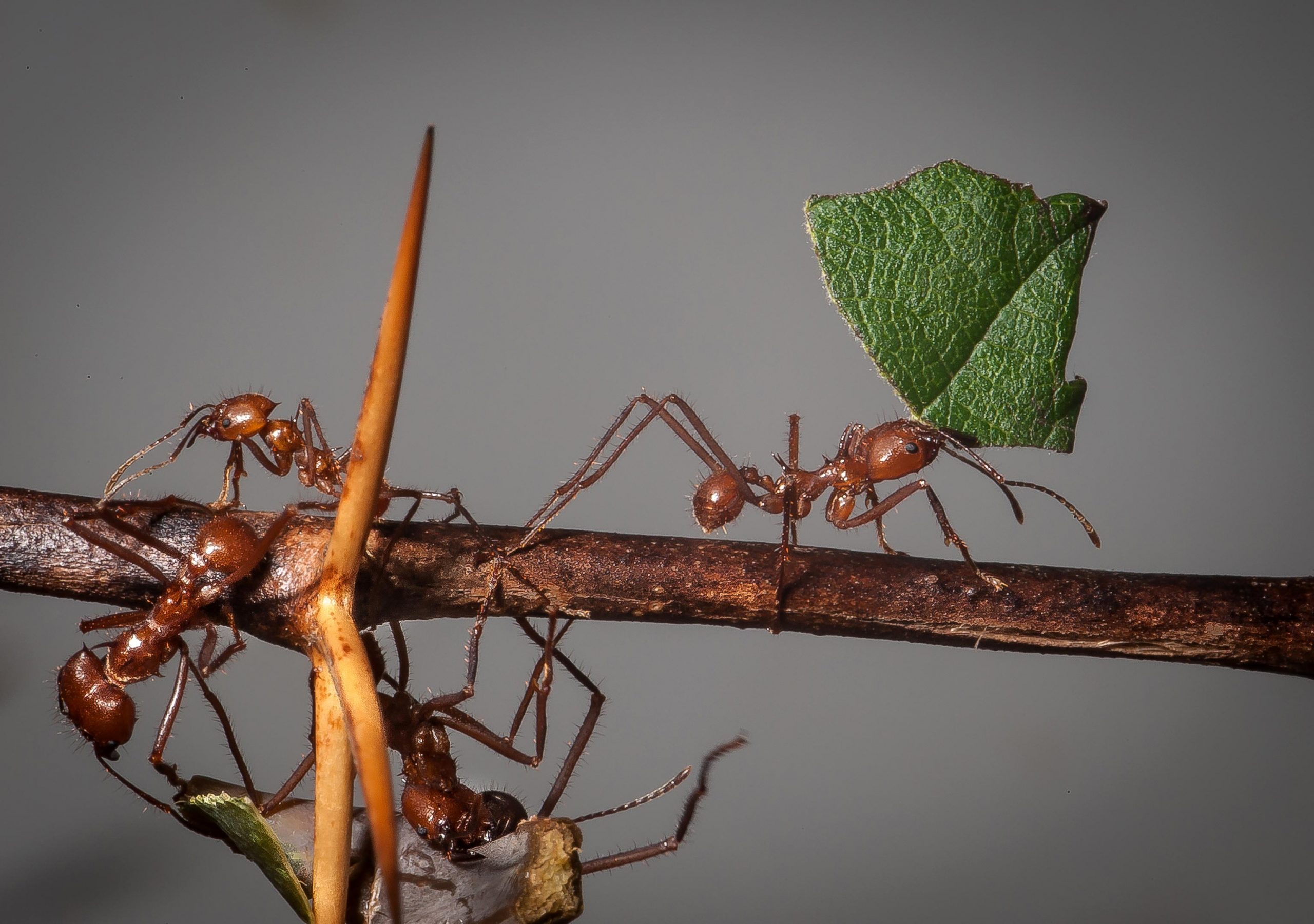
    Leaf Cutter Ants Atta cephalotes
    Atta cephalotes (Leaf-cutter ants), Wilhelma Zoo, Stuttgart, Germany. Credit: Pjt56 / Wikimedia Commons CC BY-SA 4.0

    Scientists at the Universities of Bath and Sussex have developed a new system that slowly releases ant pheromones to attract pests to an insecticide bait. This means that instead of spraying the whole crop with pesticides, traps can be placed in specific areas for more targeted protection.

    Leaf-cutting ants are major pest species of agriculture and forestry in many areas of the tropics causing an estimated $8 billion damage each year to eucalyptus forestry in Brazil alone.

    Traditional pesticides often degrade quickly and are not specific to particular pests, resulting in substantial wastage of pest control products, environmental contamination, and harmful effects on other insects.

    The team of chemists and chemical engineers at Bath used molecular sponges called metal-organic frameworks (MOFs), to soak up the alarm pheromones of leaf cutter ants and then slowly release them to attract the insects to a trap.

    In addition to experiments, they used computational modeling to simulate the movement of the pheromone molecule inside the pores of the MOFs to predict which structures would give the optimum capacity and speed of release.

    They found that by altering the chemical groups within the basic framework structure, they could adjust the speed of release of the pheromones so that the chemicals could be released over a period of several months rather than days.

    Field trials of the system by University of Sussex researchers in a eucalyptus plantation in Brazil showed that the pheromone-loaded MOFs had the desired effect in attracting the ants to a trap.

    Professor Andrew Burrows, Head of the Department of Chemistry at the University of Bath and Professor of Inorganic Chemistry at the University’s Centre for Sustainable and Circular Technologies, led the study that is published in the journal Dalton Transactions.

    He said: “Insect pheromones have been used previously for attracting pests, but the trouble is they are quite volatile, so their effects don’t last very long.

    “Our metal-organic frameworks act as a kind of sponge where the pheromones can be encapsulated in the pores and then released slowly over time. Our proof-of-principle study shows that these materials are effective in delivering the pheromone and that the insects respond normally to it.

    “This system could reduce the amount of pesticides sprayed on a crop and could be particularly useful for high value crops in small areas. We’re currently looking at a range of other insect messenger chemicals including those that can be used to control moth pest species in UK fruit orchards.”

    The project was funded by The Leverhulme Trust, the University of Bath, and University of Sussex.

    Reference: “Inclusion and release of ant alarm pheromones from metal–organic frameworks” by Harina Amer Hamzah, Daniel Rixson, Joseph Paul-Taylor, Huan V. Doan, Christopher Dadswell, Gavin W. Roffe, Arun Sridhar, Claire L. Hobday, Charlie Wedd, Tina Düren, William O. H. Hughes, John Spencer and Andrew D. Burrows, 21 July 2020, Dalton Transactions.
    DOI: 10.1039/D0DT02047H

    Never miss a breakthrough: Join the SciTechDaily newsletter.
    Follow us on Google and Google News.

    Agriculture Ants Polymers University of Bath
    Share. Facebook Twitter Pinterest LinkedIn Email Reddit

    Related Articles

    A New Method Causes Plastics To Break Down When Exposed to UV Light

    Plants From Plastics: Transforming Bio-Based Polymers Into Fertilizer

    “See Through Soil” to Study Hydrogels’ Hidden Workings Could Help Farmers Deal With Future Droughts

    Sustainable Plastics: Scientists Make Versatile Polymer From Sugars in Wood

    Super Durable, Flexible, Water-Repelling Material Inspired by Porcupinefish

    Scientists to Communicate Polymers More Easily With New Notation System

    Storing Secret Messages in Light-Sensitive Polymers

    Chemists Edge Closer to Using Ribosome to Create Designer Polymers

    MIT Researchers Develop New Strategy for Stronger Polymers

    1 Comment

    1. stephen schaffer on September 13, 2020 7:05 am

      “in a eucalyptus plantation in Brazil”
      seriously? how much of the rain forest was ripped out to plant these trees? go bolsanaro, go

      Reply
    Leave A Reply Cancel Reply

    • Facebook
    • Twitter
    • Pinterest
    • YouTube

    Don't Miss a Discovery

    Subscribe for the Latest in Science & Tech!

    Trending News

    New Study Reveals Why Ozempic Works Better for Some People Than Others

    Climate Change Is Altering a Key Greenhouse Gas in a Way Scientists Didn’t Expect

    New Study Suggests Gravitational Waves May Have Created Dark Matter

    Scientists Discover Why the Brain Gets Stuck in Schizophrenia

    Scientists Engineer “Tumor-Eating” Bacteria That Devour Cancer From Within

    Even “Failed” Diets May Deliver Long-Term Health Gains, Study Finds

    NIH Scientists Discover Powerful New Opioid That Relieves Pain Without Dangerous Side Effects

    Collapsing Plasma May Hold the Key to Cosmic Magnetism

    Follow SciTechDaily
    • Facebook
    • Twitter
    • YouTube
    • Pinterest
    • Newsletter
    • RSS
    SciTech News
    • Biology News
    • Chemistry News
    • Earth News
    • Health News
    • Physics News
    • Science News
    • Space News
    • Technology News
    Recent Posts
    • New Research Challenges 30-Year-Old Theory of Eye Development
    • The Protein “Sabotaging” Aging Muscle Recovery Could Be Key to Surviving Aging
    • This Diet–Gut Interaction Could Transform Fat Into a Calorie-Burning Machine
    • Why Some People Reach 100: New Study Reveals Key Biological Differences
    • This Is How Ovarian Cancer Spreads Before Doctors Can Detect
    Copyright © 1998 - 2026 SciTechDaily. All Rights Reserved.
    • Science News
    • About
    • Contact
    • Editorial Board
    • Privacy Policy
    • Terms of Use

    Type above and press Enter to search. Press Esc to cancel.